Barranco Camp beneath the south face of Kilimanjaro, Tanzania
Kilimanjaro The highest mountain in Africa, a free-standing volcano.
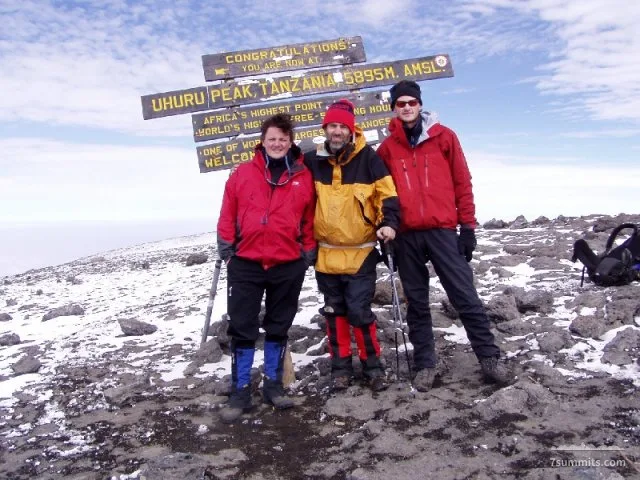
3°05′S 37°21′E · 5,895 m 19,341 ft · Tanzania
Kilimanjaro at a glance
Elevation 5,895 m / 19,341 ft
Summit of Africa
Location Tanzania
First ascent 1889
Main routes 6
Season Jan–Mar, Jun–Oct
Trip length 7–9 days
Typical cost from ~$3,500 Uhuru Peak is officially 5,895 m; recent GPS surveys put it a few metres lower.
Where on Earth: Kilimanjaro, one of the 7 summits. · Imagery: NASA Earth Observatory “Blue Marble” · borders: Natural Earth (public domain) All maps of Kilimanjaro
Kilimanjaro (5,895 m 19,341 ft ) is a walk-up via several routes. The challenge is altitude, not technical difficulty, a slow profile dramatically improves summit success.
What Kilimanjaro costs With a guided expedition $2,181–$5,995 for the middle half of the 51 trips we researched.
The full range is $1,302–$10,995.
21 more are priced in other currencies and are not included here.
Each company’s own price, in the currency it quotes, read from its website. Prices change, so check with the company.
Every company that guides it → Compare them side by side →
Organising it yourself About $1,700–$2,000 on the mountain.
A licensed guide and crew are required by law, so this is the cheapest licensed local operator. Park fees alone are about $1,000 to $1,200 for seven days; tips of $200 to $350 come on top.
Our estimate. International flights, gear and insurance are extra.
What every peak costs, guided or not →
Climbing guide Table of Contents →
Table of Contents The full contents of the Kilimanjaro guide, linked page by page. Kilimanjaro: Overview The highest free-standing mountain in the world, rising almost five kilometres out of the plains of northern Tanzania. A fit hiker can walk to the crater rim, through five ecological zones from rainforest to arctic summit. Kilimanjaro: Permits & costs What it costs to climb: the TANAPA park fees, and why prices range from under $2,000 to over $8,000 for what looks like the same mountain. Introduction: the 7 summits Kilimanjaro is the roof of Africa and, for many climbers, the first of the 7 summits, a walk-up giant where the real challenge is altitude. Planning and preparation Everything to settle before you fly: route, days on the mountain, operator, altitude, health, training and kit. Background information The mountain behind the climb: its volcanic geology, its five ecological zones, its history and its remarkable wildlife. The Machame route The most popular route on the mountain: a scenic southern trek with a good acclimatization profile. Best walked over seven days or more. The Lemosho route A scenic, quieter start from the remote western side, joining the Machame trail on the Shira Plateau. Many guides’ pick for the best all-round route. Best over eight days or more. The Umbwe route The steepest and most direct way up, short, hard and quiet, joining the southern circuit at Barranco. For fit, experienced trekkers, ideally with extra acclimatization days built in. The Marangu route The only hut route, sleeping in dormitories, up and down the same trail from the south-east. Comfortable and popular, but its short profile means a lower success rate than the camping routes. The Rongai route The only route up the quiet, dry northern side, near the Kenyan border. A gentle, wild approach that crosses to the eastern side to summit, best over seven days with an acclimatization day at Mawenzi Tarn. The Northern Circuit The longest route on Kilimanjaro and the best for acclimatization, looping almost all the way around the mountain through its quiet northern slopes. The strongest choice for reaching the summit. Tanzania and practicalities Getting to Tanzania and around it, the country and its history, and the guides and porters who make your climb possible, including how to tip them fairly. Mount Meru Kilimanjaro’s neighbour: a tough, beautiful four-day volcano climb to 4,562 m that is the best possible acclimatization before Kilimanjaro. Reference How this guide was put together, the sources behind it, and a linked A–Z index of everything it covers. Add a safari to your climb You have flown all the way to northern Tanzania, the same corner of Africa that holds the Serengeti, the Ngorongoro Crater and some of the best game-viewing on the planet. If you can spare the days, add a safari. Cycling on and around Kilimanjaro Kilimanjaro National Park allows mountain bikes on two routes: the Kilema route towards the summit, and a day ride on the Shira Plateau. Below the park, village rides need no permit at all. The rules, the fees, and which ride suits you. Books & films The guidebooks, expedition accounts and films worth your time before Kilimanjaro. Kilimanjaro expedition operators Every company that sells a guided climb of Kilimanjaro: who guides it, what it costs, and how long each has been in business. Did you know?
How many distinct climate zones does a climber pass through on the way up Kilimanjaro?
Climbers pass through five distinct climate zones, ranging from cultivated bushland and rainforest at the base to an arctic zone near the summit.
The lowest zone, bushland, sits around 800-1,800 meters, while the summit's arctic zone begins around 5,000 meters. This means a single Kilimanjaro trek can feel like traveling from the equator to the Arctic in less than a week.
Support 7summits This site is kept going by its readers. Give once, any amount.
Support us 








 Five Big Mountains: A Regular Guy's Guide to Climbing Orizaba, Elbrus, Kilimanjaro, Aconcagua, and VinsonDavid N. Schaeffer · 2010