





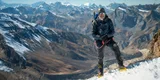

Mostafa Salameh hatte noch nie einen Berg bestiegen, als er 2004 davon träumte, den Gebetsruf vom Dach der Welt zu sprechen. Am 25. Mai 2008 wurde er der erste Jordanier auf dem Everest, und seitdem hat er durch seine Besteigungen Millionen für wohltätige Zwecke gesammelt.
Mostafa Salameh (born 25 June 1970) is a Jordanian-Palestinian mountaineer, author and fundraiser who on 25 May 2008, Jordan's Independence Day, became the first Jordanian to reach the summit of Everest. The son of Palestinian refugees, he had never climbed a mountain until 2004. He completed the 7 summits on Carstensz Pyramid on 16 November 2012 and went on to ski to both Poles, completing the Explorers Grand Slam. His climbs for charity have raised millions of dollars for cancer patients, refugees and the children of Gaza. He is in our record as a finisher of the Carstensz list.
A refugee's son
Salameh was born in Kuwait City to Palestinian parents and grew up in a refugee camp. He studied hotel management in Amman, graduating in 1992, and later international hospitality and tourism management at Queen Margaret University in Edinburgh, which gave him an honorary doctorate in 2022. Scotland became home, and the hotel trade his first career.
None of that pointed at mountains. In 2004, while he was working at a hotel in Edinburgh, he dreamed that he was standing on top of Everest reciting the adhan, the Islamic call to prayer. "That's where the journey started," he has said. "I had never climbed a mountain in my life before that." He treated the dream as a calling, and followed it literally.
From nothing to the highest
He trained from nothing, and he started high. Denali came first, in June 2004, then Vinson in January 2005.
His first attempt on Everest, in March 2005, at the age of 35, ended at about 7,000 metres with a stomach ulcer. Elbrus followed that September, and in July 2006 he climbed Mont Blanc. A second attempt on Everest, in 2007, ended with a chest infection. That July he reached the top of Kilimanjaro, and in February 2008 the top of Aconcagua.
The third attempt on Everest succeeded. At 6:50 in the morning on 25 May 2008, Jordan's Independence Day, he reached the summit, the first Jordanian to stand on top. King Abdullah II awarded him the Independence Medal and knighted him the same year.
Carstensz, and the Poles
That left Carstensz Pyramid, and he climbed it on 16 November 2012. Then he turned to the ice. On 19 April 2014 he skied to the North Pole, and on 15 January 2016 he reached the South Pole, completing the Explorers Grand Slam, the first Arab climber to do so. In May 2018 he crossed Greenland on skis from north to south.
From the lowest point to the highest
Much of his climbing raises money, and he plans it that way. In 2012 he launched an initiative called From the Lowest Point to the Highest Point for Cancer, for the King Hussein Cancer Center in Amman. In April 2013 he led 20 Jordanians from the Dead Sea, the lowest point on land, to Everest base camp, raising US$620,000. In February 2014 he took a team of 26 Jordanians to the top of Kilimanjaro, raising US$1.4 million for the hospital.
Others followed. With the Karam Foundation he led a climb up Kilimanjaro for Syrian refugee families. With Eye Can See, a Jordanian charity for blind and partially sighted children, he took a team of 14 up the same mountain in January 2018. A climb for the children of Gaza, run with the UN agency for Palestinian refugees, rebuilt schools damaged in the 2014 war and paid for a climbing wall. By 2022 his climbs had raised more than US$5.8 million.
Setbacks, and Everest again
In January 2023 a heart problem on Aconcagua ended an expedition with an evacuation.
In the spring of 2026 he went back to Everest with a campaign called Rising Dreams, to raise US$10 million for the Al-Khair Foundation's work with the children of Gaza. He carried a kite in the colours of the Palestinian flag, covered with messages from children he had met at the Rafah border crossing. Some wrote that they wanted to become doctors or engineers. One girl, Munira, asked him to write the number 47 on it: the number of her family members who had been killed.
Frostbite and a blood clot in his left hand kept Salameh himself at base camp. A team of Nepali Sherpas led by the Italian film-maker Leonardo Avezzano took the kite on, and on 21 May 2026 it reached the summit. "Massive respect and gratitude to the incredible Sherpa team, the real heroes of the Himalayas," he wrote afterwards.
The books and the talks
His memoir, Dreams of a Refugee, was published by Bloomsbury in 2016 and in Arabic in 2018. In 2019 he began a series of children's books about his expeditions with Everest, in Arabic and English, and in 2021 he published Journey of Ascension and Rising, a book in Arabic about the spiritual side of the mountain.
He speaks to schools and companies about teamwork, leadership and facing fear. He names the philosophers Al-Razi and Al-Kindi, the traveller Ibn Battuta and the poet Rumi among the people who shaped him. "Everyone has an Everest in his life," he tells his audiences. His own began with a dream and a man who had never set foot on a glacier. For anyone starting from the beginning, the FAQ covers the first questions, and the operator directory lists who runs trips on each of the seven.
Diesen Beitrag im Forum kommentieren →
Alle Teile von Finisher Files
- Teil 1: Carlos Soria, vom Elbrus mit 29 bis zum Kilimandscharo mit 70
- Teil 2: Andrea Cardona: 7 Gipfel und beide Pole mit 30
- Teil 3: Gangaamaa Badamgarav: Mongoleis erste Besteigerin der 7 Gipfel
- Teil 4: Sibusiso Vilane: vom Naturschutzgebiet zu den 7 Gipfeln
- Teil 5: Cheryl und Nikki Bart: Mutter und Tochter in der Finisher-Liste
- Teil 6: Gary Johnson: der Governor, der auf dem Vinson Massif seine 7 Gipfel vollendete
- Teil 7: Mostafa Salameh: der Sohn eines Flüchtlings auf den 7 Gipfeln (du liest gerade diesen Beitrag)
- Teil 8: Michał Leksiński: neun Gipfel für Kinder in Pflegefamilien
Bildnachweise: © Mostafa25 · CC BY-SA 4.0 · Wikimedia Commons · bearbeitet