









On 20 May 2026, 274 people reached the summit of Everest in one day, a record, and the season ended with 1,008 summits, all from Nepal. This deep dive explains the six causes behind the queues: more climbers every year, the closed Tibet side, forecasts that send every team up on the same days, the new guide rule, helicopters over the Icefall and drones on the lower mountain.
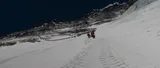
On 20 May 2026, 274 people stood on the summit of Everest in a single day, a record. The day before, a line of climbers stretched across the Yellow Band on the Lhotse Face at about 7,500 m24.606 ft, the picture at the top of this post. The spring of 2026 ended with 1,008 summits, all of them from Nepal, and about 80% of them in the ten days from 17 to 26 May.
Queues on Everest are not new, but the causes behind them have changed in the last few years. Some are old (more people want to climb it, and the weather allows only a few days), and some are new: a closed border, a new rule about guides, and helicopters and drones on the lower mountain. This post takes them one at a time.
The queue that made the news
The picture most people know is from 22 May 2019. After several days of bad weather a short window of calm opened, more than 200 climbers went for the top that day, and roughly 320 people stood in line on the summit ridge in the death zone. Nirmal Purja's photograph of that line went around the world. Eleven people died on Everest that season, and the queue became the symbol of everything said to be wrong with the mountain.
That day had every ingredient this post describes: a crowd, one route, a narrow window and a long wait above 8,000 m26.247 ft. What has changed since is the size of each ingredient.
Cause one: more people every year
Nepal issued 381 Everest permits in spring 2019. In 2023 it issued a record 478, in 2024 it issued 421 and in 2025 469. In 2026 it issued about 495, the most ever, even though the climbing fee had just gone up from $11,000 to $15,000 per climber. By nationality the largest groups in 2026 were China with 109 permits, the United States with 77 and India with 61, out of climbers from 56 countries.
The permit count is only part of the head count. Clients climb with Nepali support climbers, most of them Sherpas, and they reach the summit too: of the 13,737 Everest summits recorded by the Himalayan Database to the end of 2025, 7,081 were made by hired climbers. That is why about 495 permits turned into 1,008 summits in 2026.
The long-term growth is just as clear. When the guidebook this site's Everest guide grew out of went to press, with figures to 2007, the summit had been reached 3,681 times. By the end of 2025 that had risen to 13,737, so more than two thirds of all Everest ascents have been made since 2007. How many people climb Everest each year? has the yearly figures.
Cause two: one route instead of two
For decades Everest had two busy routes. In the 2000s about as many climbers went up the Tibet side, by the North Col, as up the Nepal side, by the South Col. Since then the Nepal side has carried most of the traffic. For the 2026 season China closed the Tibet side of Everest, together with Cho Oyu and Shishapangma, to foreign climbers, after a scandal over a fireworks display near Shigatse in September 2025. No reopening date had been announced when our guide was last checked in October 2026.
So in 2026 every commercial expedition went to Nepal. The Chinese climbers who would once have driven to the Tibet base camp took Nepali permits instead, and at 109 they became the largest national group on the mountain. A route that had shared the traffic with a second one now carried all of it.
The places where that traffic stops are well known. On the Nepal side climbers wait at the ladders in the Khumbu Icefall, on the fixed lines up the Lhotse Face and at the South Summit and the Hillary Step, where queues still form on busy days even though the earthquake of 2015 made the Step easier. Should I climb Everest from Nepal or from Tibet? compares the two sides.
Cause three: few good days, and everyone sees them
For most of the year the summit of Everest is pounded by jet-stream winds of 200 to 300 km/h. The main window opens just before the monsoon, from late April until early June, and roughly two thirds of all ascents in history were made between 15 and 31 May. That has not changed. What has changed is how precisely every team knows when the window will come.
Before a team goes for the top, three things must be in place: the ropes fixed to the summit, the climbers acclimatized by a climb to about 6,000 to 7,000 m19.685 to 22.966 ft, and a forecast of several calm days with winds under about 50 km/h (30 mph). Alan Arnette, who has reported on Everest seasons for many years, calls the weather forecast the main factor behind the crowds. If there are only a few good days, everyone competes for a place in line.
In our view better forecasting has made that competition sharper. The forecasts do not make the window any smaller. They make every team see it at the same moment and with the same confidence, and so every team commits to the same days. In 2026 a storm on 9 and 10 May brought up to a foot of snow, the jet stream blocked the summit from 14 to 18 May, and when the window opened on 18 May the mountain filled. The single-day record of 274 summits came two days later.
Cause four: a guide for every two climbers
On 1 September 2025 Nepal changed its rules for Everest and its other peaks above 8,000 m26.247 ft. The spring climbing fee rose from $11,000 to $15,000 per climber, solo climbing was banned, every two climbers must now be accompanied by one certified Nepali guide, and a permit is valid for 55 days instead of 75.
The guide rule is about safety, and there is a good case for it: on the upper mountain a climber in trouble often cannot count on anyone but their own team. It also adds people to the ropes. Every pair of clients brings at least a third person, and every one of them needs a place in the line on summit day. The shorter permit, meanwhile, leaves teams less time to wait for a quieter day. The permit and its rules are explained in How much is the Everest permit?
Cause five: helicopters over the Icefall
On the Nepal side every load and every climber has to pass through the Khumbu Icefall, the broken glacier above Base Camp, where a team of Sherpas fixes ladders and ropes each spring. In 2026 a huge block of ice near the top of the Icefall blocked the route, and the team stopped work for almost two weeks. The route was only finished on 26 April, against 10 April in 2025.
With the season running out, Nepal's Department of Tourism allowed helicopters to fly supplies over the Icefall. Ten helicopters carried ropes, oxygen cylinders and food straight to Camp 2. Under the normal rules flights above Base Camp are for rescue only, so 2026 became the first season in which helicopters supplied the higher camps. The airlift helped the route-fixing work catch up, and the late start squeezed the whole season into fewer weeks.
Helicopters already reach Camp 2 in good weather for rescues, and longer rescues on a line below the helicopter have been flown higher still. That is a good thing for anyone who falls ill. It is also part of a wider change, in which the lower mountain is no longer the hard limit on how fast an expedition can be supplied.
Cause six: drones on the lower mountain
The newest change is in the air between Base Camp and Camp 1. In the 2025 spring season the Kathmandu company Airlift Technology flew DJI FlyCart 30 drones on Everest in the first full commercial operation of its kind. They carried 444 kg of ladders and ropes for the Icefall team, 900 kg of expedition gear and 150 oxygen cylinders up, and 300 kg of rubbish down. Their highest delivery reached 6,130 m20.112 ft at Camp 1, in April 2025.
In 2026 a larger model, the DJI FlyCart 100, flew the same route, carrying about 40 kg a trip at that altitude, including ladders, rope and oxygen. A test of an American heavy-lift drone was stopped at Base Camp in May 2026 because it lacked permits. The work runs under an agreement between Airlift Technology, the Sagarmatha Pollution Control Committee and the local Khumbu Pasang Lhamu municipality.
A Sherpa carrying 12 kg needs six to seven hours for the climb that a drone flies in about ten minutes. Drones do not put a single extra climber on the summit ridge by themselves. What they change is how quickly the lower camps can be stocked, and how many loads a Sherpa no longer has to carry through the Icefall, which makes the mountain safer for the people who work on it. Together with more permits and one route, faster logistics make it easier to support more clients in the same few weeks.
What a queue costs
Waiting is dangerous at that height. Above about 7,500 m24.606 ft the body cannot acclimatize and steadily deteriorates, even at rest, and a climber standing still in a line is getting colder and using oxygen without gaining a metre. Climbers on Everest have been frostbitten after standing motionless for one or two hours at a bottleneck, and a bottle that would have lasted to the summit and back can run short. What is the death zone on Everest? explains what happens to the body up there.
Fewer people died in 2026 than in 2019, and a crowd does not by itself kill anyone. But a long queue turns every small problem into a bigger one, because it adds hours to the longest day of the climb.
What climbers and operators can do
The most effective step is to avoid the busiest days. Teams that can wait for the second or third day of a window, or go before the main wave, meet far fewer people on the ropes. That needs spare days in the plan, which is one reason a cheap, tight itinerary costs more than it saves.
Ask an operator how it spreads its teams across a window, what its turnaround plan is, and how much oxygen each climber has for a long day. Read the guide's chapter Danger, Death Zone and turnaround before you decide, and How many oxygen bottles do I need on Everest? for the oxygen. The autumn season is far quieter, though very few expeditions run then.
The authorities are watching too. With the record number of permits in 2026, Nepal opened a temporary government office at Base Camp to monitor the expeditions. Whether the Tibet side reopens will make the biggest single difference to next year's lines, and that is a decision for China, not for the climbers.
Until then the rule of the mountain is simple. The jet stream sets the dates, the forecasts tell everyone at once, and on the best day of the year everyone is there. The climber who is not has a quieter summit.
Comenta esta entrada en el foro →
Créditos de imagen: © AngeliSherpa · CC BY-SA 4.0 · Wikimedia Commons · modificada