








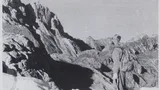

For most of its climbing history the hard part of Carstensz Pyramid was getting to it. The last part of our Carstensz history follows how the mountain joined the 7 summits, from Messner in 1971 to Pat Morrow in 1986, and how climbers reached it: the Ilaga and Sugapa treks, the mine road almost nobody could use, and the helicopters of today.
For most of its climbing history, the hard part of Carstensz Pyramid was not the climb. It was getting to the foot of it. That meant a week of mud and rain forest from Ilaga or Sugapa, a permit that could be withdrawn at any time, and villages where passage had to be agreed one by one. Today almost everyone flies in by helicopter from Timika in well under an hour, and that change is the most recent chapter in a story that began with a ship in 1623.
This is the last part of a series on the history of Carstensz Pyramid. Part 4 told of the first ascent in 1962, part 5 of the politics that followed, and part 6 of the mine next door. This part follows the climbers who came after Harrer, and the ways they found in.
How Carstensz joined the 7 summits
What brought climbers to Carstensz Pyramid in numbers was a list. In the early 1980s the American businessman Dick Bass and his partner Frank Wells set out to climb the highest mountain on each continent. For Australia they chose Mount Kosciuszko, the high point of the Australian mainland. Bass completed his list on 30 April 1985, on the summit of Everest.
Reinhold Messner argued for a different list. He had climbed Carstensz Pyramid himself in 1971, and in his view the continent was not mainland Australia but the wider Australasian region, including New Guinea, which made Carstensz its high point. The Canadian Pat Morrow was the first to complete that version. He climbed Carstensz Pyramid on 7 May 1986 and finished the list on 5 August 1986, the first person to climb all eight peaks on both lists. Messner finished his own version the same year.
From then on Carstensz drew a stream of climbers who would never otherwise have gone to Papua. Both lists survive, neither is objectively right, and many climbers now do both. What are the official 7 summits, and what about Kosciuszko? sets out the two lists and how they came about.
Ilaga: the classic way in
For much of the mountain's climbing history the way in started at Ilaga, a village in the highlands to the north, the same valley Philip Temple and Harrer had used. From there, expeditions walked for several days through forest and high country to the Carstensz basin, over high passes, through boggy valleys and across rivers, carrying everything. It was the shorter and higher of the two classic treks, starting from country that was already high, and it was still days of hard, roadless walking. Many of the early 7 summits climbers came this way.
None of it happened without the people of the highlands. The trek depended on local guides and porters, often Dani, who carried the loads, found the way and made passage possible. Travelling this way meant travelling among the people whose land it was, with the negotiation, hospitality and occasional friction that involved. Our guide's chapter The Ilaga trek describes it.
Sugapa: the mud years
When access from Ilaga became difficult, a newer route opened from Sugapa, a settlement to the west. For a stretch of the 2010s it was the way most trekking expeditions reached the mountain. It was long, roughly a week each way through dense lowland and montane rain forest. It is remembered above all for its deep mud, with river crossings, leeches and rain on most days. For many climbers the walk in took more out of them than the climb.
Like the Ilaga route, it ran through the lands of highland communities, and passage and payment had to be agreed with the villages along the way. A dispute over money or permission could cost an expedition days, or turn it back, and sometimes did. When neither main route was workable, expeditions and their local partners found others, from settlements such as Beoga and Singa (also spelled Tsinga). These were alternative doorways to the same high country, opened when the usual ones closed. The guide's chapters on the Sugapa trek and the Beoga and Singa variants tell those stories.
The road almost nobody could use
There was always a faster way, and almost nobody was allowed to take it. The Freeport mine's road climbs from the coast near Timika, through the company town of Tembagapura, to the mine at about 4,100 m13.451 ft. From where the mapped road ends, a footpath of about 5 km leads over a small col to the climbers' Base Camp. An expedition allowed onto it could reach Base Camp the day it left the coast. A handful were, over the years. The rest were turned away, because the road runs through private, tightly controlled mine territory, and permission was rare and unpredictable. Part 6 of this series tells how the mine got there.
Open, closed, open
Access to Carstensz has never been fixed. Because the highlands have seen periodic unrest and security operations, the Indonesian authorities control who may go, and the mountain has opened and closed to climbers repeatedly over the decades. One long closure, reported by climbing operators in the region, ran from 1995 to 2005. Each time it reopened, the way in tended to change.
The helicopter years
The latest change is the biggest. As the overland routes became risky and the village negotiations unreliable, operators started flying their climbers in, and by now the helicopter is how almost every expedition reaches the mountain. Climbers stage in or near Timika and fly to a landing near Base Camp, in the Yellow Valley below the north face at about 4,270 m14.009 ft. The flight takes well under an hour, when the weather lets it fly. Cloud and rain can ground it for days at either end, which is why every operator builds in spare days.
The helicopter buys speed and sidesteps most of the problems of travelling overland, and it costs a great deal: it dominates the price of the whole trip. It also flies over everything that made the old treks memorable, the forest, the villages and the people. A climber now gains the summit and misses the journey Wollaston, Colijn and Harrer could not avoid.
Permits, organisers and the treks that may return
The paperwork has grown with the traffic. Every climber needs a SIMAKSI, the entry permit of Lorentz National Park. Under the park's climbing procedure of September 2025, a climber from abroad can only get one through a trekking organiser the park has licensed. The park closes the climb every year in April and May, and limits it to 30 people a day, guides and porters included. Do I need a permit to climb Carstensz Pyramid, and how do I get one? and Who is allowed to take me up Carstensz Pyramid? have the detail.
The treks are not gone for good. The park's climbing procedure still lists the routes from Ilaga, Beoga, Ugimba, Hitadipa and Tsinga as official. One licensed organiser prices a trek in from Tsinga for 2026, and another lists a Sugapa trek as coming soon. At the time of writing a temporary closure for high fire risk also covers the Lorentz trekking routes. Can I still trek in to Carstensz Pyramid, or is it helicopter only? is kept up to date.
What is left of the snow
Jan Carstensz saw snow from the sea in 1623, Wollaston reached it in 1913, and the Colijn expedition stood on its highest dome in 1936. The glaciers have been shrinking for decades, and the last of them are expected to disappear within a few years. The rock that Harrer climbed in 1962 will still be there, and so will the question every expedition since has had to answer first: how to get to it. Our guide's Getting there now has today's answer, and The approaches all the earlier ones.
Alle delen van Carstensz: a history
- Deel 1: Sneeuw op de evenaar: Jan Carstensz, 1623
- Deel 7: Ilaga, Sugapa, helicopter: the ways to Carstensz (je leest dit)
Afbeeldingscredits: © Wissel, F. · CC BY 4.0 · Wikimedia Commons · bewerkt