








Un estudio de campo de la Ludwig-Maximilians-University Munich siguió a voluntarios desde los 450 metros hasta la Capanna Regina Margherita a 4554 metros y tomó muestras de su fluido lagrimal en cada etapa. Los escaladores con cefalea moderada a grave mostraron un aumento claro de CGRP, el neuropéptido central en la investigación sobre la migraña. La saturación de oxígeno no diferenció a los afectados del resto. Publicado en Annals of Clinical and Translational Neurology.
A research group at Ludwig-Maximilians-University Munich has reported that high-altitude headache is accompanied by a rise in calcitonin gene-related peptide, the neuropeptide known as CGRP that sits at the centre of migraine research and migraine drug development.
The work was published in Annals of Clinical and Translational Neurology and described by Bioengineer.org on 7 October 2026.
What makes the study worth a climber's attention is where it was done. The measurements were taken on the mountain, not in a hypoxic chamber.
What the team did
The group followed healthy volunteers on a five-day ascent through the Italian Alps in August 2022. They started in the valley town of Varallo at 450 metres and finished at the Capanna Regina Margherita at 4554 metres, one of the highest permanently staffed buildings in Europe.
Certified guides from the International Federation of Mountain Guides Association accompanied every group, and the protocol was approved by the university ethics committee.
At each stage the participants filled in structured headache questionnaires, rated pain from zero to ten, completed the 2018 Lake Louise Acute Mountain Sickness Score, and gave a sample of tear fluid.
Tear fluid is the unusual part. Drawing blood at 4554 metres is awkward and cerebrospinal fluid is out of the question in a hut, but tears can be aspirated from the lateral corner of each eye with a thin plastic capillary in under a minute, as long as the investigator does not irritate the eye and set off reflex tearing, which would dilute the sample.
The researchers pooled fluid from both eyes after confirming there were no significant left-right differences at baseline, stabilized it in protein extraction reagent, kept it on dry ice, and later measured CGRP with a commercial enzyme-linked immunosorbent assay read in duplicate.
The headache numbers
Twenty-four people were recruited and 13 completed the full protocol with usable tear samples. The authors put the reduction down to early terminations and samples that were too small to analyse.
Among those 13, the headache load rose with every camp. Nobody reported a headache at baseline in the valley.
After reaching 3498 metres on day two, 46 percent did. At 3647 metres on day three it was 62 percent, and at 4554 metres on day four it reached 85 percent, with a mean pain score of 3.2 out of ten.
Eight participants, 62 percent, met the formal ICHD-3 criteria for high-altitude headache at the top hut.
The authors note that earlier studies at comparable elevations have reported an incidence between 36 and 73 percent.
The ICHD definition of high-altitude headache used here is a bilateral, mild-to-moderate pain that develops within 24 hours of going above 2500 metres and gets worse with exertion. Anyone who has walked up to a hut in an afternoon will recognize it.
Why the group average hid the finding
Across all 13 participants, tear fluid CGRP at 4554 metres was not significantly different from the valley baseline. Taken alone, that would read as a dead end.
The signal appeared when the researchers split the group by how badly people suffered.
The six participants with moderate-to-severe headaches, mean pain score 5.0, showed an average rise of 1.86 nanograms per millilitre of CGRP from baseline. The seven with mild headaches showed a slight fall of 0.19 nanograms per millilitre.
The difference between the two groups was statistically significant, and baseline CGRP levels in the two groups had been virtually identical, which points to the altitude exposure as the trigger instead of some pre-existing difference between the people.
The same split appeared when participants were sorted by diagnosis. Those meeting ICHD-3 criteria for high-altitude headache showed a mean rise of 1.49 nanograms per millilitre, against a fall of 0.42 in those without the diagnosis.
Six participants, close to half the cohort, developed a headache that met the criteria for migraine without aura: moderate-to-severe pulsating pain, nausea or vomiting in half of those cases, and light sensitivity in some.
That subgroup reported higher pain intensity and a CGRP rise of 1.75 nanograms per millilitre compared with the participants who had no symptoms.
Oxygen saturation did not sort the sufferers
At the highest altitude, oxygen saturation sat around 78 percent for everybody, and it did not differ between the people with headaches and the people without. On this evidence, how hypoxic you are does not by itself decide whether your head hurts.
The team also looked at the cerebral circulation, using transcranial colour-coded duplex sonography at baseline and at 4554 metres to measure blood flow velocity in the middle cerebral arteries on both sides and to calculate the Lindegaard index as a screen for vasospasm.
Neither high-altitude headache nor migraine-like symptoms were associated with any difference in flow velocity or in the change from baseline, and no group showed evidence of vasospasm.
That absence is part of the result. It moves attention away from simple narrowing or widening of blood vessels and towards neurogenic inflammation, where activated trigeminal nerves release CGRP and other mediators around the membranes covering the brain.
Low oxygen or low pressure
Separating the two candidate triggers, hypoxia and falling barometric pressure, is something a field study cannot do cleanly, and the authors say so. The report sets out the surrounding evidence on both sides.
Animal work has shown that dropping atmospheric pressure by as little as 40 hectopascals increases firing in neurons of the spinal trigeminal nucleus, particularly those receiving input from the cornea.
Human volunteers exposed to modest pressure drops in a climate chamber have reported a feeling of head compression along with mild-to-moderate headache.
On the other side, chamber studies of pure normobaric hypoxia have produced headache in roughly 80 percent of healthy volunteers and raised plasma CGRP in migraine patients.
Because the tear fluid CGRP in this study did not rise uniformly and did not track oxygen saturation, the authors read their data as a hint that low oxygen alone may not be enough, and that the combination of low pressure and low oxygen, in people who are susceptible to it, is what sets the trigeminovascular system off.
What a climber can take from it
Thirteen completers is a small sample and the authors say so themselves. Tear fluid CGRP has also not been formally validated against plasma or cerebrospinal fluid measurements, which is the next piece of work somebody will need to do.
Two things still carry over to the hill. A history of migraine is already a known risk factor for altitude headache, and this study strengthens the biological reason why: the same molecule appears in both.
If you get migraines at home, plan your ascent profile with that in mind and talk to a doctor who knows altitude medicine before you book.
The second is the oxygen saturation finding. Pulse oximeters are common in base camps and on trekking peaks, and a reading on its own did not tell these researchers who would get a headache and who would not.
Symptoms and the Lake Louise score remain what people actually act on.
Our FAQ covers the standard approach to altitude sickness and when to go down, and the ascent profiles on the Kilimanjaro and Elbrus guides are where the decision really gets made, because both peaks are routinely climbed fast enough for this kind of headache to be the normal experience rather than the exception.
The obvious next question is whether the CGRP-blocking drugs now used in migraine prevention do anything for altitude headache. This study does not test that, and nothing here is a reason in itself to carry one up a mountain.
This story is part of This week on the 7 summits: 5–11 October 2026, the week's news in brief.
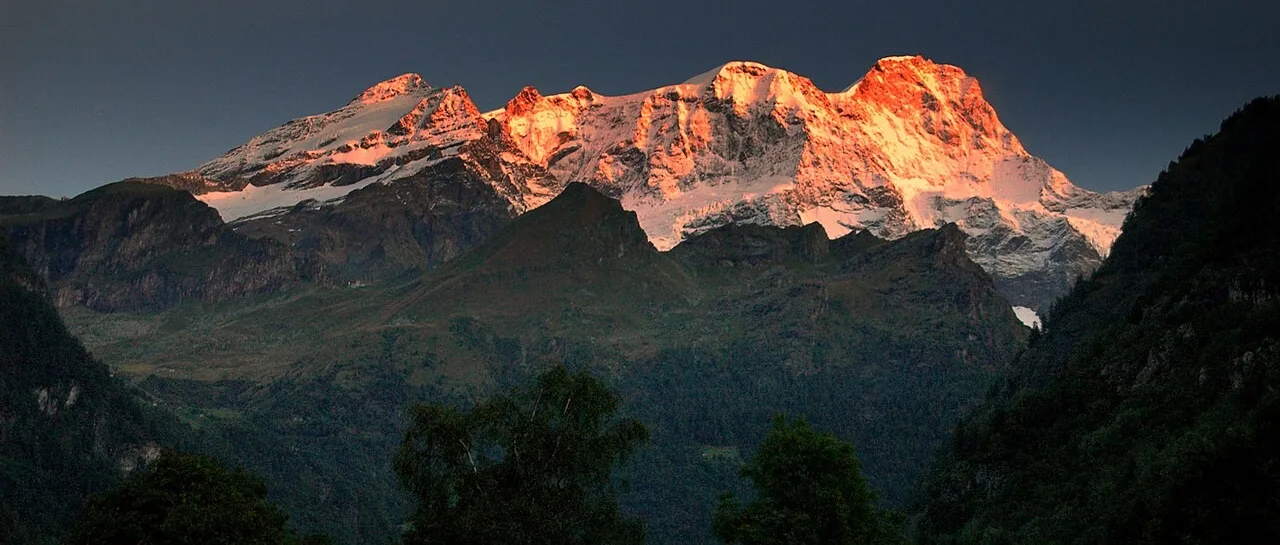
Header photograph: Monte Rosa Valsesia alba.JPG by Maxinmilan, CC BY-SA 4.0 (licence), via Wikimedia Commons.