








Elke lente, voordat ook maar één klimteam voet zet op Everest, is een kleine groep Sherpa-klimmers al tientallen keren op en neer gegaan door de Khumbu Icefall. Zij zijn de icefall doctors, en de route door de gevaarlijkste kilometer op de berg bestaat dankzij hen. Ze sjouwen aluminium ladders over gletsjerspleten die een mens volledig kunnen verzwelgen, fixen touwen door een gletsjer die elke dag ongeveer een meter naar beneden verschuift, en keren elke paar dagen terug om te herbouwen wat het ijs heeft verschoven of laten instorten. De naam is niet officieel en ook niet oud: hij is relatief recent bedacht, en het verhaal van hoe hij is blijven hangen zegt iets over hoe Everest werkt. Dit verslag volgt die geschiedenis: wie de icefall doctors zijn, hoe de rol is georganiseerd, wat ze betaald krijgen, welk materiaal ze dragen, en waarom het werk even gerespecteerd als gevaarlijk is. Als je ooit een foto hebt bekeken van ladders gespannen over een blauwwitte leegte en je je hebt afgevraagd wie ze daar heeft neergelegd, dan is dit het antwoord.
The icefall doctors
Every spring climbing season on Everest begins the same way. Months before the summit windows open, a small team of Sherpa climbers walks into the Khumbu Icefall alone, carrying aluminium ladders on their backs. They are known as the Icefall Doctors, and without them the mountain does not open.
What the icefall actually is
The Khumbu Icefall sits between Base Camp at roughly 5,380 metres and Camp I at around 6,065 metres. It is the lowest section of the standard South Col route, and it is the most consistently dangerous.
The Western Cwm glacier above it presses downhill at roughly one metre per day, and some estimates put it higher during active periods. That movement fractures the ice into seracs, towers of compressed glacier that can weigh thousands of tonnes and collapse without warning. The crevasses between them run deep enough that a fall into one is not a rescue; it is a recovery, if that.
No fixed route exists from one season to the next. The ice moves too far and changes too much. Every year, the route through it must be built from scratch.
Who does the work
The Icefall Doctors are a dedicated crew, separate from the high-altitude Sherpas who work for individual expedition companies. For most of the modern era the team has been organised through the Sagarmatha Pollution Control Committee (SPCC), the body responsible for environmental management on the Nepali side of Everest. The crew typically numbers around a dozen climbers, though the exact count varies by season.
They are selected from experienced Sherpa climbers, and the work demands a specific combination of skills: ice craft, rope work, structural judgement about what a serac is doing, and the willingness to return to the same unstable terrain every few days. A high-altitude Sherpa guiding a client through the icefall moves through it as quickly as possible. An Icefall Doctor stops in the middle of it, looks up at what is above, and decides where to put a ladder.
Where the name came from
The term "Icefall Doctor" was not always in use. For the early decades of Everest expeditions, the people who fixed the icefall route were simply the strongest and most experienced Sherpa climbers on whichever expedition happened to go first that season. Each team looked after its own section, or the first team through did the bulk of it and later teams benefited.
The shift toward a dedicated, paid, independent crew gathered momentum through the 1990s and into the 2000s as commercial expeditions multiplied and the number of teams using the same fixed route grew too large for the old informal arrangement to hold. With dozens of expeditions sharing one path, the question of who was responsible for maintaining it became impossible to ignore.
The phrase "Icefall Doctors" (the idea being that they diagnose problems in the route and treat them before they become fatal) came into wider use as this dedicated crew became a recognised institution. It is the kind of name that catches on because it is accurate: these climbers do not simply fix ropes, they assess the health of a dynamic, shifting structure and intervene.
[IMAGE: Icefall Doctors placing an aluminium ladder across a major crevasse in the Khumbu Icefall, wide enough to show the scale of the gap and the serac walls on either side]
Who pays them, and how
The funding model is straightforward in structure. Every expedition that uses the fixed route through the Khumbu Icefall pays a fee to the SPCC. The fee is collected as part of the overall permit and logistics process. In recent seasons this contribution has been in the range of several hundred US dollars per expedition member, though the exact figure has varied and teams should confirm the current rate through the Himalayan Database or their permit agent.
That collective pool funds the Icefall Doctors' wages for the season, their equipment, and the logistics of maintaining a crew at Base Camp from roughly late March through to late May. The arrangement means that no single expedition owns the route, and no expedition can opt out of maintaining it. You use the icefall, you contribute to the people who keep it open.
The wages, by the standards of what is being asked, are not high. The Icefall Doctors are Sherpa climbers taking on the most hazardous work on the mountain, and the gap between what they earn and what expedition companies charge clients has been a subject of ongoing discussion in the mountaineering community.
Gear and technique
The core equipment is aluminium ladders, fixed rope, snow stakes, ice screws, and the collective experience of people who have watched the icefall change over many seasons.
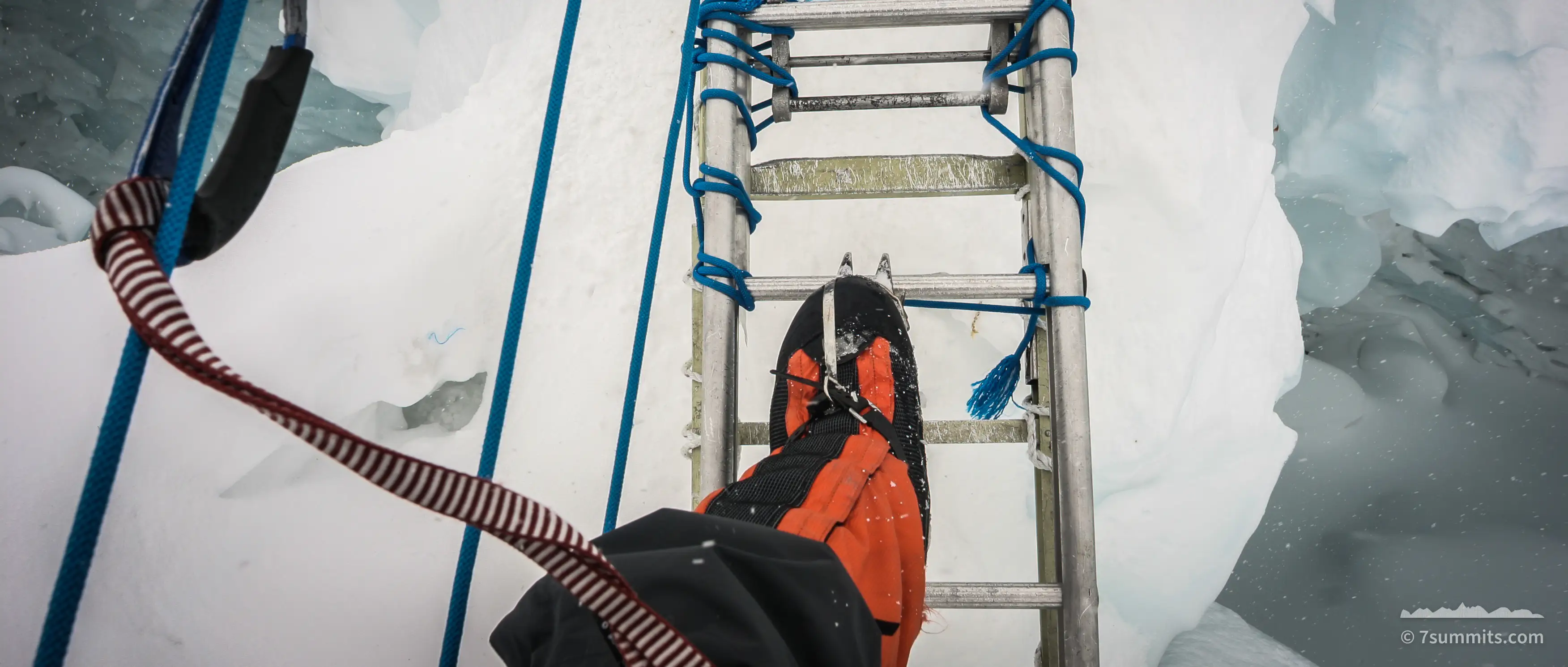
The ladders used in the Khumbu Icefall are standard aluminium extension ladders, the same type used in construction, lashed end to end to span crevasses that may be two, three, or more ladder-lengths across. They are secured at each end with anchors driven into the ice (a combination of snow stakes, pickets, and ice screws depending on what the terrain offers), and a fixed rope runs alongside them as a handline. A climber crossing a crevasse on a ladder clips their jumar or a carabiner to that handline and moves across in crampons, which grip the ladder rungs.
Beyond the ladders, the Icefall Doctors fix continuous rope through the entire route, running from anchor to anchor through the seracs. The anchors are reassessed every few days. Ice moves; what was solid last week may be leaning today. The team carries spare ladders and rope for emergency repairs and makes regular assessment runs through the route specifically to check what needs attention.
The route is not fixed once. It is fixed continuously. During a busy season with a stable icefall, the team might make adjustments every two or three days. After a serac collapse or a significant shift in the glacier, a section may need to be entirely re-routed, which can close the icefall for twenty-four hours or more while the new line is established.
The danger
The Khumbu Icefall has killed more people on the south side of Everest than any other section of the mountain. The Icefall Doctors work there more hours than anyone else on the mountain.
The 2014 avalanche, triggered by a serac collapse above the icefall, killed 16 Sherpa climbers, the majority of them working as high-altitude guides and load-carriers who were passing through at the time. It was the single deadliest day in Everest history to that point. The Icefall Doctors were not the direct target, but the event made visible what the Sherpa community had long understood: the icefall is the equaliser. No amount of skill eliminates the exposure, because the hazard is a serac that falls when it decides to.
In the aftermath of 2014, and again after the 2015 earthquake closed the season entirely, there were serious conversations about whether the icefall route should continue to be used at all, and whether a different approach (a more westerly line, or a route that avoided the worst serac zones) was feasible. Those conversations continue at the margins. The route through the icefall is still the standard.
Recognition
The Icefall Doctors do not appear in summit dispatches. They are rarely named in the expedition accounts that circulate after a season. The climbers who top out in May are photographed on the South Summit, not the people who made the path through the first five hours of the route possible.
That has begun to shift, slowly. The Sherpa community's visibility has grown since 2014, and the specific role of the Icefall Doctors has become better understood by the people who write about Everest. Several climbers and journalists have spent time at Base Camp specifically documenting the crew's work.
For anyone planning an Everest expedition via the South Col route, the Icefall Doctors are the first fact on the ground. The season does not start until they open the route. It stays open because they maintain it. Understanding that is not just courtesy. It is understanding what the climb actually is.
Full route details for the South Col route, including the icefall section, are in the Everest South Col route guide.