








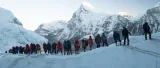

Phurba Tenjing Sherpa, an 18-time Everest summiteer who runs his own guiding business, told the South China Morning Post that young Nepalis are leaving the mountains for education and work abroad. He expects a shortage of Sherpa climbing staff to become a serious problem for the industry. He was in Hong Kong for the premiere of Road To Everest, a documentary about climber Raj Gurung.
Phurba Tenjing Sherpa has reached the summit of Everest 18 times. In two interviews published by the South China Morning Post on 16 September 2026, he said the biggest problem facing high-altitude guiding in Nepal is that the people who do the work are leaving it.
"The Sherpa community is no longer climbing," he told the paper. He is 37, runs his own guiding business on Everest, and said he has never been to school.
What he said
The quotation the SCMP carries is direct. "Young Sherpas are no longer going to the mountains because they are well educated," Phurba said. "They have now moved to America, Canada, Australia and Europe because the mountains are quite dangerous and the earnings are low. In the future, a shortage of sherpas is going to be a big problem."
He framed the change as a result of opportunity rather than decline. The generation after his has schooling he did not have, and it has options that do not involve carrying loads through the Khumbu Icefall. In the first of the two pieces, he also said he fears global warming could one day make the mountain unclimbable. The report gives no further detail on what he expects to change and over what period.
The figures the paper cites
The companion article sets out a set of Everest tallies. They are the paper's numbers, reproduced here as published:
- More than 7,500 individuals have reached the summit since 1953.
- More than 15,780 successful ascents have been recorded, counting climbers and guides who return.
- At least 346 people have died on the mountain since records began in the 1920s.
- The summit is given as 8,849 metres, or 29,032 feet.
- The first ascent is dated 29 May 1953, by Edmund Hillary and Tenzing Norgay.
The gap between the two counts is the point Phurba is making without saying so. Roughly twice as many ascents as ascenders means a large share of the traffic on the route each spring is people going up for the second, fifth or eighteenth time. Most of those repeat ascents are made by Nepali staff working for clients.
Why the shortage would be felt by clients first
A guided Everest expedition depends on work that is done before any client arrives at the high camps, and on staff who repeat the ground many times in a season:
- Fixing and maintaining the rope on the route, and rebuilding the ladder line through the icefall.
- Carrying oxygen, tents, food and fuel to the camps above base camp.
- Guiding clients on summit day, and turning them round when that is the call.
If fewer young Nepalis take up that work, the effect on a climber is not abstract. It shows up as the ratio of staff to clients on a permit, the amount of oxygen stocked high on the hill, and the experience level of the person clipped to the same rope. Those are the terms worth asking an operator about in writing before a deposit is paid. Our operators page lists companies by peak, and the Everest guide covers how the standard routes are staffed and what the seasons look like.
7summits.com's position on this is plain and it is not new. Pay, insurance and load limits for Nepali high-altitude workers are the mechanism that decides whether the job keeps attracting people. A guide who says the earnings are low is describing a labour market, and labour markets respond to the price. That is one reading of a short interview, and it is ours rather than his.
The documentary
Phurba was in Hong Kong for the premiere of Road To Everest, a documentary about the Hong Kong climber Raj Gurung. The SCMP puts the screening on the Sunday of that week. The paper describes Phurba as part of a record-breaking mountaineering family, without naming the relatives or the records.
Nothing is loaded from YouTube until you press play.
He also gave the softer version of why he keeps going back. Reaching a summit "makes me happy", he said, and guiding is now a way to help other people get there. Two articles by the same reporter, published an hour apart, carry the warning and the pleasure side by side.
Context for anyone tracking the 7 summits
Everest is the peak on the 7 summits list where the client is least likely to be self-sufficient. Vinson has logistics but no fixed-rope economy of this size. Denali is carried by the climbers themselves. Everest, on both the Nepal and Tibet sides, runs on a workforce that comes back season after season, and Phurba's remarks are about whether that workforce will be there in ten years.
Nothing in the two reports quantifies the shortfall. There is no figure for how many Nepali climbing staff worked the 2026 season, no comparison with earlier years, and no statement from the Nepal Mountaineering Association or the Department of Tourism. What there is, is a guide with 18 summits saying the people he would once have recruited are now in Sydney and Toronto.
The practical read for a climber booking a 2027 or 2028 expedition is unchanged by any of this. Ask who is on the permit, ask what the staff are paid and insured for, and read the FAQ on acclimatization and altitude illness before the first email to an operator. The rope on summit day is fixed by somebody. It is worth knowing who, and on what terms.
Header photograph: Waiting their turn.jpg by AngeliSherpa, CC BY-SA 4.0 (licence), via Wikimedia Commons.