







Climbing Aconcagua in short
- What it is: Aconcagua (6,961 m22,838 ft) in Argentina is the highest mountain in South America, the highest outside Asia, and one of the 7 summits.
- How hard: The Normal Route on Aconcagua needs no ropes and is mostly free of snow, but it is a real expedition in fierce wind and cold, and you carry your own loads above base camp.
- How long: Allow 18 to 22 days for Aconcagua.
- When: The Aconcagua season is the southern summer, with permits for entry from 1 December to 15 February.
- Cost: In 2025-26 a foreign climber paid US$1,170 for the Aconcagua permit with a registered company and US$1,640 without.
- Insurance: Evacuation insurance is compulsory on Aconcagua.
- Elevation
- 6,961 m / 22,838 ft
- Summit of
- South America
- Location
- Argentina
- First ascent
- 1897
- Main routes
- 2
- Season
- Dec–Feb
- Trip length
- 18–21 days
- Typical cost
- from ~$4,500
Permits are bought in Mendoza or through a registered company; this season's fees are on the Permits & costs page.
How hard is it to climb Aconcagua?
On its main routes Aconcagua asks for no technical climbing. There are steep slopes, but no crevasses and no ladders, and the wind and sun strip most of the snow away. People with experience only of hard hiking at altitude have reached the top.
Climbing Aconcagua is still much harder than climbing Kilimanjaro. The weather is severe, with very high winds. The ground is scree, loose rock and fields of penitentes, tall blades of ice. Above base camp you carry your own loads, make and break your own camps and melt snow to drink, for weeks. A pack of at least 20 kg at altitude is normal.
More people die on Aconcagua each year than on far more technical mountains, largely because its reputation as a walk-up draws climbers who are not prepared, and often under-dressed. Some years have seen five or more deaths. The introduction to the Aconcagua guide places it among the seven, and the FAQ I climbed Kilimanjaro. Am I ready for Aconcagua? answers the question most readers arrive with. See also Which of the 7 summits is the hardest to climb?
Aconcagua climbing routes: the Normal Route, the Polish Traverse and the Polish Glacier
Two valleys lead to the mountain, and each has its own base camp.
| Route | Valley and base camp | Character |
|---|---|---|
| Normal Route | Horcones; Plaza de Mulas, 4,300 m14,108 ft | Not technical; chosen by over 75% of climbers; busy, with the best-served base camp |
| Polish Traverse | Vacas; Plaza Argentina, 4,200 m13,780 ft | Not technical; three days' walk in; more snow, rougher ground, far fewer people |
| Polish Glacier | Vacas; Plaza Argentina | Technical ice, about 35° on average with steeper sections; for experienced ice climbers |
For most people the choice is between the Normal Route and the Polish Traverse. Choose the Normal Route if you like company and a well-served base camp, or are new to crampons and high mountains. Choose the Polish Traverse if you want a wilder trek and have the experience for rougher ground. Some groups go up the Vacas side and down the Normal Route, a full crossing of the mountain, often sold as "Aconcagua 360", with all their gear carried over 6,000 m19,685 ft.
Choosing your route compares them, and the FAQ Normal Route or Polish Traverse? gives the short answer. If you have never been in high mountains, Aconcagua is not the place to learn, on any route.
The Aconcagua Normal Route, camp by camp
The Normal Route starts at the Horcones ranger station, 2,950 m9,678 ft, and follows a marked trail the whole way.
| Stage | Height gained | Time |
|---|---|---|
| Puente del Inca to Confluencia | 470 m1,542 ft | 4 to 5 hours |
| Confluencia to Plaza de Mulas (base camp, 4,300 m14,108 ft) | 1,000 m3,281 ft | 7 to 10 hours |
| Plaza de Mulas to Plaza Cañada (about 4,900 m16,076 ft) | 600 m1,969 ft | 2 to 5 hours |
| Plaza Cañada to Nido de Cóndores (about 5,400 m17,717 ft) | 500 m1,640 ft | 2 to 4 hours |
| Nido de Cóndores to Berlín (about 5,900 to 5,930 m19,357 to 19,455 ft; most groups now use Cólera, just above at about 5,950 m19,521 ft) | 500 m1,640 ft | 2 to 5 hours |
| Summit day (6,961 m22,838 ft) | 1,060 m3,478 ft | 10 to 18 hours round trip |
The second day is the one to respect: a long walk with 1,000 m3,281 ft of height gain. The route tempts people to reach base camp too fast, and that is where many altitude problems begin. Plaza de Mulas is a large tented camp where the companies run mess tents, meals and showers for their clients.
Above base camp most groups climb each stage twice (see cache and carry below). Summit day ends in the Canaleta, a gully of loose rock at about 6,500 m21,325 ft, which is tiring at that height. The descent describes the way down.
The Vacas Valley routes on Aconcagua: Polish Traverse and Polish Glacier
The Vacas Valley routes begin at Punta de Vacas, 2,400 m7,874 ft, with three days of walking: to Pampa de Leñas at 2,800 m9,186 ft, on to Casa de Piedra at 3,200 m10,499 ft, and then a long day with 1,000 m3,281 ft of climbing to Plaza Argentina (Punta de Vacas to Pampa de Leñas, Pampa de Leñas to Casa de Piedra, Casa de Piedra to Plaza Argentina).
Two more hard days with heavy loads lead to Camp 1 at 5,000 m16,404 ft and Camp 2 (Plaza Argentina to Camp 1, Camp 1 to Camp 2). From there the Polish Traverse goes around the glacier and joins the Normal Route, by the direct line or by White Rocks at 6,095 m19,997 ft (Summit via Polish Traverse (Direct), Summit via Polish Traverse (White Rocks)).
The Polish Glacier is ice and snow all the way, a summit day of 8 to 24 hours, and it is only possible when the snow is in good condition. If it looks wrong from high camp you can still switch to the Traverse (Summit via Polish Glacier, the descent). The permit for the Vacas side costs more.
Cache and carry on Aconcagua: why you climb every stage twice
The usual rule of gaining no more than 300 m984 ft of sleeping height a day cannot be kept on Aconcagua, because the campsites are too far apart in height. So most groups use cache and carry. First you carry a load up to the next camp, leave it there and come back down to sleep. The next day you move up and sleep beside your cache.
This splits heavy loads in two, and it is "climb high, sleep low" in practice, which helps your body adapt. It also doubles the walking above base camp, and it is the main reason an expedition takes about three weeks. Mules carry your gear to base camp, and porters can be hired higher up.
A typical load between the high camps is 15 to 20 kg, and 25 kg or more on the way down, when everything comes off the mountain in one trip. About 5 kg of that is the day's water, food and spare layers. The first days above base camp are the heaviest, because you still have all the food.
Mules carry your gear to base camp, up to 60 kg each, in two bags of at most 30 kg that the mule company weighs. On the Normal Route they go straight to Plaza de Mulas, so you will not see those bags for two days: keep what you need for the walk in with you. Above base camp, porters can be hired from both base camps, at about US$160 to 420 for a 20 kg load per stage in the 2025-26 season. They are usually experienced mountaineers, often guides in training.
The cache-and-carry system explains how to plan it. The FAQ How heavy is my pack on Aconcagua, and can I hire a porter? has the weights.
How long does it take to climb Aconcagua, and when is the season?
Allow 18 to 22 days for a complete expedition, with spare days for weather. A cheap 15-day package does not leave enough time on the mountain once altitude, double carries and a storm are counted, and extra days added on the spot are expensive. Book the longer trip.
The season is the southern summer, from the end of November to early March. Climbing permits are issued for entry between 1 December and 15 February, and January has the most stable weather. Outside the season the wind and cold are worse and the park's rangers, doctors and rescue are not on the mountain.
The park prices its permits in three seasons. High season is 15 December to 31 January, when the weather is most stable, the camps are fullest and the permit costs most. Early December and February are cheaper and quieter, and a few degrees colder. For 2026-27 the ascent permit is valid only from 1 December 2026 to 15 February 2027, after heavy snow and a late opening.
The weather to fear is the viento blanco, the white wind, when the jet stream drops onto the upper slopes with snow and extreme cold. A large lens-shaped cloud over the summit is a warning to go down at once. Every sound itinerary carries two or three spare days for it. On summit day expect −20 to −30 °C−4 to −22 °F with strong wind. Planning your trip covers the season, and the FAQs are How long does it take to climb Aconcagua? and When is the Aconcagua climbing season?
What climbing Aconcagua costs: permit fees and expedition prices
The Aconcagua permit is set each season by the Government of Mendoza. These are the 2025-26 fees for foreign visitors from outside Latin America.
| Permit | With a registered company | Without |
|---|---|---|
| Ascent via Horcones (Normal Route) | US$1,170 | US$1,640 |
| Ascent via Vacas (Polish routes, or a crossing) | US$1,450 | US$2,000 |
| Trek of 7 days to Plaza de Mulas | US$380 | US$540 |
| Trek of 3 days to Confluencia | US$190 | US$270 |
Latin American visitors, Argentine residents and Mendoza residents pay less. For 2026-27 the government ran an advance sale in September 2026 at US$950 for the Horcones ascent and US$1,290 for Vacas, through registered companies only. The full 2026-27 schedule had not been published when the guide was last checked in October 2026.
A guided expedition costs several thousand dollars on top of the permit, depending on the company and the level of service. Evacuation is not covered by the permit: a climber who is evacuated pays for it. Aconcagua: Permits and costs has every rate, and the FAQ What does the Aconcagua permit cost, and is it cheaper through an operator? works through it. For the whole list, see what the 7 summits cost.
What Aconcagua costs
- With a guided expedition
$6,595–$9,800 for the middle half of the 62 trips we researched.
The full range is $3,700–$27,995.
18 of them are priced in other currencies and counted at their value in US dollars today.
Each company’s own price, read from its website; a price in another currency is counted here at its value in US dollars. Prices change, so check with the company.
- Usually extra
- Park permit fee (extra at 89 of the 98 companies that say)
- Organising it yourself
About $3,000–$4,500 on the mountain.
The permit ($1,640 unassisted for a foreign climber in high season, less through a registered provider), mules to base camp, food, fuel, a tent and transport from Mendoza.
Our estimate. International flights, gear and insurance are extra.
- Permits and fees
Aconcagua climbing permits: how and where to get one
Every climber and trekker needs a permit before reaching the park gate. Nothing is sold at the entrance. Arrive without one and you go back to Mendoza.
There are two ways to get it. With a registered company, the company arranges the permit, you pay the lower rate and its name is on your permit. Without one, you collect the permit in person in Mendoza, so plan your journey through the city. The climbing permit is valid for 20 days and the minimum age is 16. Everyone signs a declaration accepting the risk.
Insurance is a condition. The park will not issue an ascent or long-trek permit without evacuation and medical cover, written in Spanish or English and naming you by policy number (travel insurance). Aconcagua: Permits and costs lists the permit types, and Practical issues on the mountain covers rangers, medical checks, waste and mules.
Aconcagua Provincial Park: rangers, doctors, rubbish and water
The park was founded in 1983 and its fees pay for a real service. Rangers check your permit at the entrances and camps and help where they can. At the first checkpoint you are given numbered rubbish bags. They are checked again on your way out, and you can be fined if they do not come back. Toilets must be used wherever they exist, and even climbers without a company pay for the toilet service at base camp.
During the season the park runs a free medical service at Confluencia, Plaza de Mulas and Plaza Argentina. The doctors expect to see every climber on arrival, measure heart rate and blood oxygen, and can send you down. Follow their advice, but do not lean on the service: being acclimatized is still your job.
Treat all water. Low on the mountain the streams are fouled by mules and by careless people, and clear water is no safer than cloudy water. Higher up the streams may thaw only in the afternoon, so you melt snow. Allow about an eighth of a litre of white gas per person per day. At both base camps the service companies sell cooked meals and drinks for most of the season (Other health issues, Which stove and fuel work best at high altitude?).
Can I climb Aconcagua without a guide?
Yes. Aconcagua can be climbed without a guide, and the permit for it costs more. Going alone as a team gives you a free choice of route and dates. It also makes you responsible for navigation, mules, cooking, supplies and first aid, and it is hard without fluent Spanish.
Hire a guide unless you have climbed above 5,000 m16,404 ft, camped in winter and run an expedition before. Guides know the route and the camps, speak to the rangers and base camp doctors, read the weather daily and provide the base camp services the park requires. Check that they are licensed and what the price includes. Even with a guide, carry your own first aid, know the route and keep your own judgement.
Aconcagua operators lists the companies we have checked and whether each leads its own expeditions. Can I climb each of the 7 summits without a local guide? compares the rules on all seven, and How do I join a guided climb? explains booking.
Altitude sickness and acclimatization on Aconcagua
Nobody can climb straight to nearly 7,000 m22,966 ft. Even a night at every camp is not enough to prevent acute mountain sickness (AMS), the headache, nausea and poor sleep that mean you have gone up too fast, unless you arrive from another high mountain. Left alone and taken higher, AMS can become fluid on the lungs (HAPE) or on the brain (HACE).
The answers are cache and carry, rest days, and time. Some climbers acclimatize first on a lower peak nearby, such as Cerro Vallecitos (5,770 m18,930 ft) or El Plata (6,300 m20,669 ft). Others do it on Aconcagua itself, which keeps them in place for a weather window. Doctors at the base camps check climbers during the season.
Altitude effects is the chapter, and Other health issues covers cold, sun and stomach. The FAQs: What are HAPE and HACE?, How do you train to prevent altitude sickness? and What should I eat and drink at high altitude?
The dangers of climbing Aconcagua, and when to turn around
Wind, cold and altitude cause most of the harm on Aconcagua, and they do it to people who underestimated the mountain. Storms can make the summit unsafe for days on end. Your aim, and your team's, is that everybody gets down in good health, with or without the summit.
Some groups agree a fixed turnaround time for summit day. We disagree with this idea. A fixed time can be a dangerous thing. Weather and the condition of your team should decide. If the weather turns bad at eight in the morning, that is the time to turn back, wherever you are. On a clear, windless day, strong climbers have summited late and come down safely in daylight.
Danger, death and turnaround sets out the reasoning, and Can weaker climbers in my group hurt my summit chances? covers the team.
How do I train for climbing Aconcagua?
Train to carry a heavy pack uphill for many hours, many days in a row. Endurance matters more than speed. Long hill days with a loaded pack are the best preparation, and you should arrive sure that you can carry 20 kg at altitude and stay cheerful in a cold, windy tent for weeks.
Fitness, heart rate and load-carrying has the training method, and Planning and preparation lists every planning chapter. The general FAQs: How do you train for the 7 summits?, What does a training plan look like? and Which skills do the 7 summits need?
What gear do I need for climbing Aconcagua?
The Aconcagua gear list has every item. The core is warm mountaineering boots, crampons and an ice axe for the icy sections, an insulated jacket, expedition mitts, goggles for the wind, a cold-rated sleeping bag, a tent that stands up to storms, a stove, trekking poles and an expedition pack big enough for the carries.
Equipment and packing explains the choices, and Technical gear covers what the Polish Glacier adds. The FAQs: What gear do I need for Aconcagua?, What bags do I need, and are there porters?, Why would I need two sleeping bags? and Which gear works on more than one of the 7 summits?
How to get to Aconcagua: Mendoza and Argentina
The gateway is Mendoza. Your international flight will probably be to Buenos Aires or Santiago de Chile, and Mendoza has direct flights from both. From Mendoza the road leads up to the trailheads at Puente del Inca and Punta de Vacas.
The park lies about 180 km west of Mendoza on Ruta Nacional 7, the only paved road across the Andes to Santiago. The drive takes three to four hours by taxi or van, and a public bus runs to Horcones and Puente del Inca. Arrive early and spend at least one night at Puente del Inca or Los Penitentes, to start acclimatizing and to pack your mule bags. Puente del Inca is named after a natural rock bridge with warm springs, which Charles Darwin sketched in 1835. If you cross between Chile and Argentina, bring no fresh fruit, vegetables or meat: all luggage is scanned.
From November to March Mendoza is warm, about 15 °C59 °F at night and 25 °C77 °F by day, and known for its wine and steaks. Unless a company arranges your permit, you collect it there in person. Argentina describes the country, and Practical issues on the mountain the park. The jet lag FAQ helps if you cross many time zones.
Aconcagua the mountain: the Stone Sentinel, its history and its wildlife
Aconcagua, the Stone Sentinel, stands in Argentina near the border with Chile. It is drier than the Alps or the Rockies, with few glaciers, which is why some dismiss it as a big scree heap. Look closer and it is a remarkable place. Guanacos and condors live in the valleys, mostly on the quieter Vacas side (The Andes: habitat and wildlife).
The first ascent was made on 14 January 1897 by Matthias Zurbriggen of Switzerland, who reached the summit alone on an expedition led by Edward FitzGerald, by what is now the Normal Route. A Polish group opened the Vacas side in March 1934 and gave the glacier its name. The 2,700 m8,858 ft South Face was climbed 20 years after that. History of the mountain tells the rest. Background information opens the section, and the English and Spanish glossary helps on the trail.
Aconcagua questions
About this Aconcagua climbing guide
The Aconcagua guide grew out of 7 summits finisher Harry Kikstra's printed guidebook for Rucksack Readers and has since been expanded and brought up to date. Harry climbed both routes himself. 7summits.com ran expeditions to the 7 summits for more than twenty years.
Every chapter is on a review schedule, and the permit page is re-checked most often because the fees change every season. Sources and credits lists the sources, the table of contents and the index reach every chapter, and the books worth reading first are on Aconcagua books and films.
Climbing guide
Read before you go
 Five Big Mountains: A Regular Guy's Guide to Climbing Orizaba, Elbrus, Kilimanjaro, Aconcagua, and VinsonDavid N. Schaeffer · 2010
Trip reports
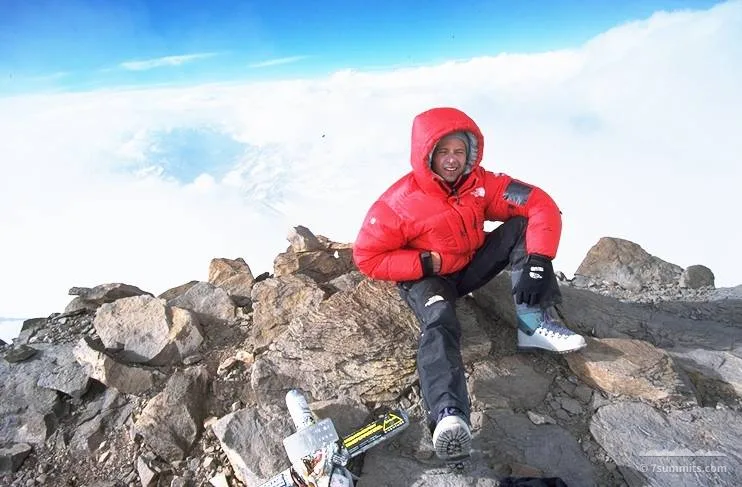
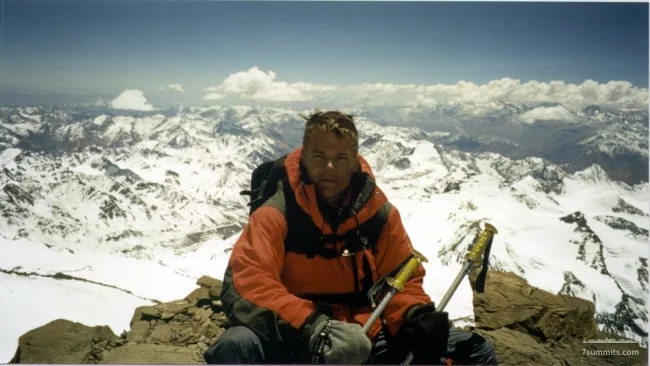
The Aconcagua summit log
Stood on top of Aconcagua, or turned back on the way? Sign the log. It takes a minute, and the climb goes into your own 7 summits record.
887 climbers on our finishers list have stood on top of Aconcagua. In members’ own logs: summited 4, turned back 0.
Also stood on top of Aconcagua, close to finishing the 7 and not yet claimed: Akash N., Bradley L., Catherine G., Chhiri Aangjum S., Cokie C., Dawa Futi S., Dennis K., George K., Holger B., Kamaldeep K., Kevin W., Molly J., Morten R., Nelly A., Nima Jangmu S., Ralph K., Richard M., Robin D., Sambhaji G., Sylvie F., Tshering Namgya S., Wilco D.. On their way
- Jakub Patecki · March 2025 · summited (finisher record)
- Garrett Madison · 7 Feb 2025 · summited (finisher record)
- Anar Burasheva · February 2025 · summited (finisher record)
- Kryspin Mitura · 1 Feb 2025 · summited (finisher record)
- Jenn Drummond · 25 Jan 2025 · summited (finisher record)
- Jan Poláček · 22 Jan 2025 · summited (finisher record)
- Lenka Poláčková (Vacvalová) · 22 Jan 2025 · summited (finisher record)
- Mingma Gyalje Sherpa · 27 Dec 2024 · summited (finisher record)
- Gu Xuming · 27 Dec 2024 · summited (finisher record)
- Zhang Jian · 27 Dec 2024 · summited (finisher record)
- Sam Schwerin · 9 Dec 2024 · summited (finisher record)
- Rajasekhar Reddy Kandi · 4 Feb 2024 · summited (finisher record)
Show 88 more
- Muthamilselvi Narayanan · 2024 · summited (finisher record)
- Jo Byeok-rae · 2 Jan 2024 · summited (finisher record)
- Shaikh Hassan Khan · January 2024 · summited (finisher record)
- Chen Min · 2023 · summited (finisher record)
- Megan Rath · December 2023 · summited (finisher record)
- Jesse Williams · 2023 · summited (finisher record)
- Johnny Ward · 20 Jan 2023 · summited (finisher record)
- Nikol Kovalchuk · 16 Jan 2023 · summited (finisher record)
- Harpreet Singh Cheema · 2023 · summited (finisher record)
- Navneet Kaur Cheema · 2023 · summited (finisher record)
- Gao Li · 2023 · summited (finisher record)
- Hemant Leuva · 2023 · summited (finisher record)
- Surabhi Leuva · 2023 · summited (finisher record)
- Andrey Pekurov · 2022 · summited (finisher record)
- Andrea Dorantes · February 2022 · summited (finisher record)
- Alexis Uddin · 2022 · summited (finisher record)
- Lhakpa Sonam Sherpa · 24 Jan 2022 · summited (finisher record)
- Alina Pekova · 24 Jan 2022 · summited (finisher record)
- Matt Dawson · 15 Jan 2022 · summited (finisher record)
- Julian Evans · 12 Jan 2022 · summited (finisher record)
- Eva Perglerová · 10 Jan 2022 · summited (finisher record)
- María Belén Silvestris · 6 Jan 2022 · summited (finisher record)
- Mingma Sherpa · 2022 · summited (finisher record)
- Chhang Dawa Sherpa · 2022 · summited (finisher record)
- Teofil Vlad · January 2022 · summited (finisher record)
- David Landman · January 2022 · Normal route · summited (finisher record)
- Sidharth Routray · 2022 · summited (finisher record)
- Kaamya Karthikeyan · February 2020 · summited (finisher record)
- Sundaram Karthikeyan · February 2020 · summited (finisher record)
- Sharad Kulkarni · 29 Jan 2020 · summited (finisher record)
- Asad Ali Memon · 26 Jan 2020 · summited (finisher record)
- Lonnie Bedwell · 26 Jan 2020 · summited (finisher record)
- Margarita Moreno · 20 Jan 2020 · summited (finisher record)
- Grace Tseng · 2020 · summited (finisher record)
- Vlad Safyanovskiy · 20 Jan 2020 · summited (finisher record)
- Jeffrey Sradomski · 19 Jan 2020 · Normal route · summited (finisher record)
- Julie McKelvey · 7 Jan 2020 · summited (finisher record)
- Tashi Lakpa Sherpa · 4 Jan 2020 · summited (finisher record)
- Dorota Rasinska-Samocko · 2020 · summited (finisher record)
- Nguyễn Thị Thanh Nhã · 2020 · summited (finisher record)
- Danielle Wolfson · 2020 · summited (finisher record)
- Fumiaki Nishikawa · 2020 · summited (finisher record)
- Thais Herrera · 2020 · summited (finisher record)
- Kenton Cool · 2020 · summited (finisher record)
- Jur Rademakers · 23 Dec 2019 · summited (finisher record)
- Ema Dantas · 19 Feb 2019 · summited (finisher record)
- Anuja Vaidya · 16 Feb 2019 · summited (finisher record)
- Mrika Nikçi · 16 Feb 2019 · summited (finisher record)
- Arianit Nikçi · 2019 · summited (finisher record)
- Grace Chen · 2019 · summited (finisher record)
- Jason Wang · 2019 · summited (finisher record)
- Steve Davis · 2019 · summited (finisher record)
- Malavath Purna · February 2019 · summited (finisher record)
- Joel Schauer · 21 Jan 2019 · summited (finisher record)
- Mariam Ktiri · 12 Jan 2019 · summited (finisher record)
- Scott Cutlan · 11 Jan 2019 · Vacas Valley · summited (finisher record)
- Yevgen Staroselskiy · 10 Jan 2019 · summited (finisher record)
- Radek Jaros · 6 Jan 2019 · summited (finisher record)
- Iulia Jaso · 6 Jan 2019 · summited (finisher record)
- Delia Wookey · 6 Jan 2019 · summited (finisher record)
- Derek Mahon · 2019 · summited (finisher record)
- Steve Stevens · 2019 · summited (finisher record)
- Deeya Suzannah Bajaj · 2019 · summited (finisher record)
- Robert Alt · 2019 · summited (finisher record)
- Sheikha Asma Al Thani · 2019 · summited (finisher record)
- Hedayet Ali · 2019 · summited (finisher record)
- Clayton Wolfe · 2019 · summited (finisher record)
- Valery Zaitsev · December 2018 · summited (finisher record)
- Dave Arnett · 28 Feb 2018 · summited (finisher record)
- Makiko Shindo · 2018 · summited (finisher record)
- Michał Leksiński · 13 Feb 2018 · summited (finisher record)
- Denis Grachev · 3 Feb 2018 · summited (finisher record)
- Steven Plain · 28 Jan 2018 · summited (finisher record)
- Jon Gupta · 2018 · summited (finisher record)
- Benjamin Breckheimer · 2018 · summited (finisher record)
- Adrian Ahrițculesei · 11 Jan 2018 · summited (finisher record)
- Carina Dayondon · 2018 · summited (finisher record)
- Debbie Bulten · January 2018 · summited (finisher record)
- Rawan Dakik · 2018 · summited (finisher record)
- Emil Neszmélyi · 10 Dec 2017 · summited (finisher record)
- Andrew Dawson · December 2017 · summited (finisher record)
- Napassaporn Chumnarnsit · November 2017 · summited (finisher record)
- Joyce Azzam · February 2017 · summited (finisher record)
- Koen Wittevrongel · February 2017 · summited (finisher record)
- Vasily Shakhnovsky · February 2017 · summited (finisher record)
- Andrew Hughes · 28 Jan 2017 · Polish Traverse, from Plaza de Argentina to Plaza de Mulas · summited (finisher record)
- Meghan Buchanan · 8 Jan 2017 · Ameghino Valley, Upper Guanacos Traverse · summited (finisher record)
- Mona Kamal Shahab · 2017 · summited (finisher record)
Members’ entries are their own and are not checked by us. They never count towards the finishers list or its statistics. The finishers list