








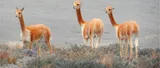

The dry high Andes around Aconcagua: the habitat, the plants and the wildlife, guanacos among them.
The Andes form the dramatic, rugged spine of the continent of South America. This range differs from the Rockies and the Himalaya in being much drier, with less plant life. On your first day’s approach hike you will see cactus, hardy grasses and some wildflowers, including yellow-hearted calendrinias and perhaps a few orchids.
Vegetation is very limited on the walk-in and dies out completely above 3500–4000 m11,483–13,123 ft, whereas in the Himalaya it persists up to about 5000 m16,404 ft. After weeks of seeing the desolate greys and browns of scree and rock, your eyes will thirst for greenery and flowers. The Provincial Park’s own booklet notes the psychological effect of this: some experts believe climbers may perceive Aconcagua’s arid 6962 m22,841 ft as feeling more like 8000 m26,247 ft on a greener mountain elsewhere.
The relatively few species that survive here show remarkable adaptations to altitude and extreme weather. There are low steppe-type bushes and some open pastureland, but conditions keep plants stunted and low-profile. With such poor vegetation, few animals can subsist (mostly some lizards on the lower slopes) though over 60 species of bird have been recorded in the Park, including the condor and the águila mora (black-chested buzzard-eagle).
Fauna
Mammals include mountain mice, red foxes and European hares. There are large herds of grass-eating guanacos (a tall, slender cousin of the llama) along with some pumas that prey on them. Mountain mice cope with winter by hibernating in their burrows, while more mobile species such as guanacos, foxes and most birds migrate to lower slopes during winter snowfalls. As an adaptation to the cold, the mountain animals are generally larger than their lowland relatives, with thicker fur to reduce heat loss.
Realistically, during your time on Aconcagua you are unlikely to see much wildlife beyond birds and, possibly, some guanaco, more likely on the Vacas routes than in the more crowded Horcones Valley. Like other camelids, guanacos can survive long periods without water, which suits them well to the Andes.