








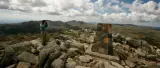

Climbing Mount Kosciuszko in short
- What it is: Mount Kosciuszko (2,228 m7,310 ft) in New South Wales is the highest point on mainland Australia and the easiest of the 7 summits by a wide margin.
- How hard: In summer Kosciuszko is a day walk. The Thredbo summit walk is about 13 km return from the top of a chairlift, four to five hours, much of it on a raised metal walkway.
- Permit and guide: No permit and no guide are needed for Kosciuszko, only a park pass for your vehicle.
- Weather: The weather is the thing to prepare for.
- Winter: In winter the same routes are under snow and become ski tours.
- Elevation
- 2,228 m / 7,310 ft
- Summit of
- Australia
- Location
- Australia
- First ascent
- 1840
- Main routes
- 4
- Season
- Nov–Mar
- Trip length
- 1 day
- Typical cost
- from ~$500
The one of the 7 summits most people can reach in a single day — but the alpine weather still bites.
How hard is it to climb Mount Kosciuszko?
Calling it a climb overstates it. Kosciuszko is a high, exposed walk in beautiful country. There is no glacier, no altitude to speak of and no technical ground on the normal ways up. Most people walk to the top and back in a day.
That does not make it trivial. Kosciuszko stands in the only true alpine country on the Australian mainland, and the weather there can close in to a whiteout on a morning that began clear. The mountain is easy. The conditions are what you prepare for.
The introduction to the Kosciuszko guide places it among the seven, and the FAQ Which of the 7 summits is the easiest to climb? compares it with the rest.
Is Mount Kosciuszko one of the 7 summits? Kosciuszko or Carstensz Pyramid
It depends on the list. Kosciuszko is the high point of the Australian mainland, and it is the seventh summit on the list Dick Bass completed in 1985. The other list counts the wider continent of Oceania, whose high point is Carstensz Pyramid in Papua, a rock climb. Neither is wrong, and many climbers do both to be sure.
The FAQ What are the official 7 summits, and what about Kosciuszko? explains the two lists, and the history of the 7 summits tells how they came about.
Mount Kosciuszko walking routes compared
There are three straightforward summit walks and one serious historic route.
| Route | Distance | Time | Character |
|---|---|---|---|
| Thredbo summit walk | About 13 km return | 4 to 5 hours | Chairlift to about 1,930 m6,332 ft, then walkway and track; the easiest and most popular |
| Charlotte Pass summit walk | About 18.6 km return | 6 to 8 hours | The old Summit Road, on foot the whole way; longer and quieter |
| Main Range loop | About 22 km | 7 to 9 hours | Past Blue Lake and the glacial lakes, over the high tops; the best views and the most exposed |
| Hannels Spur | About 15.5 km to the summit | Two days | Over 1,800 m5,906 ft of ascent from the Geehi valley; steep, remote, for experienced hikers |
The Thredbo walk is the classic: ride the chairlift, follow the walkway past Kosciuszko Lookout and Rawson Pass, and you are on the roof of Australia. From Charlotte Pass, at about 1,835 m6,020 ft, the old road climbs about 390 m1,280 ft past Seaman's Hut. The Main Range loop adds about 750 m2,461 ft of climbing over the tops and is the one to avoid in bad weather.
Hannels Spur is a different order of effort: the biggest single ascent of any walk in Australia, from about 350 m1,148 ft in the Geehi valley, on a faint track (Geehi to the spur camp, the spur camp to the summit). Choosing your route compares all four, and Walking routes opens the section.
The Thredbo chairlift to Mount Kosciuszko
The Kosciuszko Express chairlift at Thredbo lifts you 560 m1,837 ft to about 1,930 m6,332 ft, to the Eagles Nest station, and turns the summit into an easy day walk. It is run by the resort and paid for separately from the park pass, so you pay two different bodies.
The Thredbo chairlift explains how it works, roughly what it costs, and how summer and winter differ.
When to climb Mount Kosciuszko: summer walking and winter snow
The season is the biggest planning decision. In summer the routes are walks on marked tracks. In winter the whole plateau is under snow, and the same routes become ski tours and snowshoe outings with whiteouts, cornices and avalanche risk on the exposed tops. The weeks in between catch people out, because they look like summer and behave like winter.
Seasons: summer walking and winter snow covers the choice, and the FAQ Can I climb Kosciuszko in winter? answers the winter question.
What climbing Mount Kosciuszko costs: the park pass and the chairlift
There is no climbing permit and nothing to apply for. Kosciuszko is a public national park, and if you walk or cycle in, entry is free. If you drive in, you buy a park pass for the vehicle.
| Item | Cost |
|---|---|
| Park pass, winter (June long weekend to October long weekend) | About A$29 per vehicle per day |
| Park pass, rest of the year | About A$17 per vehicle per day |
| Chairlift at Thredbo | Paid to the resort, separately |
| Climbing permit | None |
| Guide | Not needed on the standard routes |
Those are the figures the park service published as at July 2026; check the current ones before you go. For a stay of several days a multi-day or annual pass usually costs less. Kosciuszko: Permits and costs has the detail, and Kosciuszko National Park the park's rules, winter road closures and snow-chain rules.
What Kosciuszko costs
- Organising it yourself
A walk: a park pass for the car and, from Thredbo, a chairlift ticket.
Our estimate. International flights, gear and insurance are extra.
- Permits and fees
Do I need a guide or a permit for Mount Kosciuszko?
No. On the standard routes you need neither. You turn up and walk. What the park asks is that you stay on the marked tracks and walkways, because the alpine plants are fragile, carry out your rubbish and come prepared for the weather.
Planning your trip covers where to base yourself (Thredbo, Jindabyne or Charlotte Pass) and the fitness you need. For the other six peaks the answer is different: see Can I climb each of the 7 summits without a local guide?
Weather and safety on Mount Kosciuszko
The danger on Kosciuszko is weather and exposure. Altitude plays no part. Alpine storms and whiteouts arrive suddenly, even in summer. It can be cold and windy on the tops when the valley is warm, and the sun is strong. In winter add navigation in cloud, cornices and avalanches.
Check the forecast, carry a map and a way to navigate (navigation), and turn back when the cloud comes down. Seaman's Hut, below the summit, is an emergency shelter. Health and safety covers each hazard.
What gear do I need for Mount Kosciuszko?
For a summer walk the list is a day-hike list: sturdy walking boots, a waterproof jacket, a warm layer, a warm hat and a sun hat, sunscreen, a daypack and water. No climbing kit is needed. Winter needs a separate, more serious list for snow.
The Kosciuszko gear list has both, and Equipment and packing explains them. Planning and preparation lists every planning chapter.
How to get to Mount Kosciuszko: Jindabyne, Thredbo and Charlotte Pass
Kosciuszko is in the Snowy Mountains, reached by road from Sydney, Canberra or Melbourne. The drive leads to the town of Jindabyne and on to Thredbo or Charlotte Pass, where the walks start. In winter the roads have closures and snow-chain rules.
Getting there and around has the routes and where to stay, Australia and the Snowy Mountains opens the section, and the Aussie words and expressions list is there for the conversations on the way.
Mount Kosciuszko: the Main Range, the name, Aboriginal heritage and wildlife
Kosciuszko is a gentle, once-glaciated summit on the Main Range, beside the only glacial lakes on mainland Australia (The mountain and the Main Range). A Polish explorer named it in 1840 after a Polish-Lithuanian revolutionary, and there was a curious mix-up over which peak he actually climbed (History and the naming story).
For thousands of years before that, the high country was a summer gathering place for the Ngarigo and their neighbours, drawn by the Bogong moths (Aboriginal heritage). The alpine zone holds plants and animals found nowhere else: snow gums, the corroboree frog and the mountain pygmy-possum (Wildlife and plants of the Alps). Background information opens the section.
Mount Kosciuszko questions
About this Mount Kosciuszko guide
The Kosciuszko guide was written from scratch for 7summits.com, checked against the park service's own pages and several walking guides, and written and edited by 7 summits finisher Harry Kikstra, who hiked all the main routes.
Every chapter is on a review schedule and is updated when something changes. Sources and credits lists what the guide was checked against, the table of contents and the index reach every chapter, and the books worth reading first are on Kosciuszko books and films.
Climbing guide
Read before you go
 Australian Alps [OP]: Kosciuszko, Alpine and Namadgi National ParksDeirdre Slattery · 1997