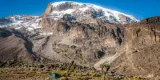

Climbing Kilimanjaro in short
- What it is: Kilimanjaro (5,895 m19,341 ft) in northern Tanzania is the highest mountain in Africa and one of the 7 summits.
- How hard: Kilimanjaro is a walk: no ropes, no ice axe and no crampons on any of the six main routes. What stops people is the altitude.
- How long: Seven days on Kilimanjaro is a sensible minimum, and eight to ten is better. The number of days matters more than anything else.
- When: The best months for Kilimanjaro are January to early March and June to October.
- Guide: You must climb Kilimanjaro with a licensed operator; nobody is allowed up alone.
- Cost: A good local operator charges about US$2,000 to 3,500 for seven or eight days on Kilimanjaro, park fees included.
- Elevation
- 5,895 m / 19,341 ft
- Summit of
- Africa
- Location
- Tanzania
- First ascent
- 1889
- Main routes
- 6
- Season
- Jan–Mar, Jun–Oct
- Trip length
- 7–9 days
- Typical cost
- from ~$3,500
Uhuru Peak is officially 5,895 m; recent GPS surveys put it a few metres lower.
How hard is it to climb Kilimanjaro?
Kilimanjaro is a trek. On the normal routes there is no technical climbing, only a long walk uphill with one easy rock scramble on the Barranco Wall. A fit hiker who can walk for several hours a day, many days in a row, can reach the top. That is why it is the first of the 7 summits for so many people, and one of the non-technical ones.
The height is the hard part. At 5,895 m19,341 ft the air holds about half the oxygen of sea level, and the trails let you gain height faster than a body adapts. Altitude sickness turns back or harms a good number of climbers every year, almost always on an itinerary that was too short. Summit night is the other test: a midnight start, six to eight hours up in the cold and dark, then the long way down the same day.
The great majority of people who give themselves enough days reach the summit. The FAQ How hard is it to climb Kilimanjaro? answers this in full, the introduction to the Kilimanjaro guide places the mountain among the seven, and Which of the 7 summits is the easiest to climb? compares it with the others.
Kilimanjaro routes compared: Machame, Lemosho, Marangu, Rongai, Umbwe and the Northern Circuit
Six main routes lead to Uhuru Peak. The days below are days of walking on the mountain at the length we recommend.
| Route | Days | Sleep | Approach | Character |
|---|---|---|---|---|
| Machame route | 7 (6 minimum) | Camping | South | The most popular; scenic, with a good walk high, sleep low profile |
| Lemosho route | 8 (7 minimum) | Camping | West | Remote start, excellent acclimatization, many guides' pick |
| Marangu route | 6 | Huts | South-east | The only hut route; same trail up and down |
| Rongai route | 7 (6 minimum) | Camping | North | The only northern approach; drier, quieter, gentler |
| Umbwe route | 6 to 7 | Camping | South | The steepest and most direct; for the fit and acclimatized |
| Northern Circuit | 9 | Camping | West, then north | The longest and quietest, with the best acclimatization |
There is no single best route. Machame suits most people with at least a week. Lemosho and the Northern Circuit are for those who can give more days, and they repay it. Marangu is the choice if you want a bed in a hut, but take the six-day version. Choosing your route goes through all six.
We do not quote a summit success percentage per route. The figures operators publish cannot be checked, and they mostly reflect how many days a route is sold with. The rule that can be checked is simpler: on any route, more days means a better and safer climb.
One route you may see advertised is closed. The Western Breach, the steep way through Kibo's western crater wall, was closed again in 2024 after fatal rockfalls in 2006 and 2015, and as of 2026 it has no reopening date. Choosing your route explains what to ask a company that still sells it.
How many days do I need to climb Kilimanjaro?
Seven days on the mountain is a sensible minimum, and eight, nine or ten is better. This is the decision that matters most, because the problem is altitude and the cure is time. Every extra night gives your body more time to adapt.
Count the days the way we do. Operators label a climb by the length of the whole package, which often includes the days you fly in and out. A trip sold as "8 days" can be a six-day climb. What counts is the days you walk on the mountain, gate to gate, and that is always the nights you camp plus one.
Operators quote success rates anywhere between 30 and 70% for five-day climbs and above 85% for eight-day climbs. Nobody audits those figures, but the direction is not in doubt. Very fit people fail in five days and unfit people summit in nine. An extra day costs roughly US$150 to 250 in park fees, plus the crew's wages and food, which is far less than coming back to try again.
Decide the length when you book. You can come down early, but you cannot stay longer: the park fees are paid for an exact number of days before the climb starts, and overstaying a permit is fined. If you come down early, the unused fees are not refunded (Can I change the length of my climb once I am on the mountain?).
There are three ways to add time: a route's official longer version (the extra night at Karanga on Machame, or at Mawenzi Tarn on Rongai), splitting a long stage in two, or a rest day with a hike above camp. How many days do you need? explains the counting, Acclimatization days and hikes shows where the good extra days are on each route, and the FAQ How long does it take to climb Kilimanjaro? gives the short answer.
The Machame route on Kilimanjaro, day by day
The Machame route is the busiest on the mountain, and the seven-day version shows how a good Kilimanjaro climb is built.
| Day | Stage | Height | Time |
|---|---|---|---|
| 1 | Machame Gate to Machame Camp | 1,800 m5,906 ft to 2,835 m9,301 ft | 5 to 7 hours |
| 2 | Machame Camp to Shira Camp | to 3,850 m12,631 ft | 4 to 6 hours |
| 3 | Shira to Barranco via Lava Tower | up to about 4,600 m15,092 ft, sleep at 3,960 m12,992 ft | 6 to 8 hours |
| 4 | Barranco Wall to Karanga | to 3,995 m13,107 ft | 4 to 5 hours |
| 5 | Karanga to Barafu | to about 4,640 m15,223 ft | 3 to 4 hours |
| 6 | Summit day: Barafu to Uhuru Peak, then down to Mweka Camp | 5,895 m19,341 ft, sleep at about 3,100 m10,171 ft | 6 to 8 hours up |
| 7 | Descent via Mweka | to about 1,640 m5,381 ft | 3 to 4 hours |
Day 3 is the one that makes the route work. You climb to Lava Tower at about 4,600 m15,092 ft and drop back to sleep at Barranco, so your body meets the height without spending the night there. The six-day version leaves out the night at Karanga and pushes from Barranco to Barafu in one long day. It can be climbed, but it gives away the margin that matters on summit night.
Lemosho, Umbwe and the Northern Circuit on Kilimanjaro
The Lemosho route starts at the remote Londorossi Gate on the western side. It spends two quiet days climbing through forest to the Shira Plateau (Londorossi Gate to Mti Mkubwa, Mti Mkubwa to Shira 1), crosses the plateau (Shira 1 to Shira 2) and then follows the Machame trail to the summit. Strong, well-acclimatized groups can add a night in the crater at about 5,750 m18,865 ft (the Crater Camp variant).
The Umbwe route climbs a forested ridge straight up from the south: about 1,050 m3,445 ft on the first day and 1,110 m3,642 ft on the second, to join the others at Barranco (Umbwe Gate to Umbwe Cave Camp, Umbwe Cave Camp to Barranco). It gains height too fast for most people and suits those who arrive acclimatized, for example from Mount Meru.
The Northern Circuit leaves the Lemosho trail on the Shira Plateau and loops around the empty northern side of Kibo over four days (Shira 1 to Moir Hut, Moir Hut to Buffalo Camp, Buffalo Camp to Third Cave, Third Cave to School Hut). It summits from the east (School Hut to Uhuru) and descends by Mweka. Nine days at altitude make it the strongest choice for reaching the top.
The Marangu and Rongai routes on Kilimanjaro
The Marangu route is the only one with huts. You sleep in dormitories at Mandara (about 2,700 m8,858 ft), Horombo (about 3,720 m12,205 ft) and Kibo Hut (4,700 m15,420 ft), and walk the same trail up and down (Marangu Gate to Mandara Hut, Mandara to Horombo, Horombo to Kibo Hut, descent via Marangu). It is often sold as the easy route in five days. That schedule is short, which makes Marangu one of the harder routes to acclimatize on. Take the sixth day, with a second night at Horombo.
The Rongai route comes in from the dry northern side near the Kenyan border, after a long drive around the mountain (Rongai Gate to Simba Camp, Simba to Kikelewa). The seven-day version adds an acclimatization day at Mawenzi Tarn, about 4,315 m14,157 ft, in the cirque under Mawenzi's cliffs, one of the best such days on the mountain (Kikelewa to Mawenzi Tarn). It then crosses the Saddle to Kibo Hut (Mawenzi Tarn to Kibo Hut) and descends by Marangu.
Summit night on Kilimanjaro: to Uhuru Peak by Stella Point or Gilman's Point
Every route ends with the same kind of night. You leave camp around midnight, climb slowly by headlamp for hours, reach the crater rim near sunrise and walk around it to Uhuru Peak.
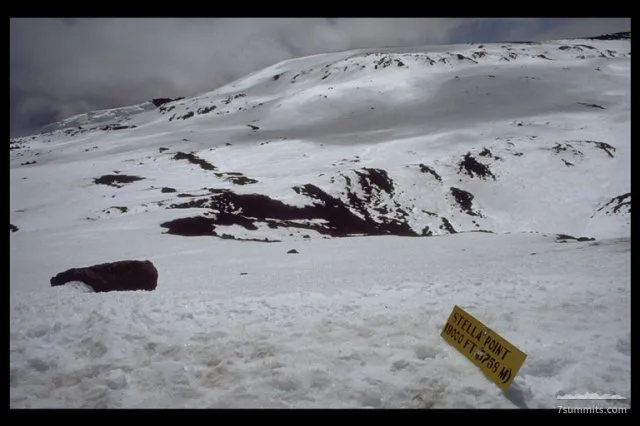
From the south (Machame, Lemosho, Umbwe) you start at Barafu Camp, about 4,640 m15,223 ft, and reach the rim at Stella Point, 5,756 m18,885 ft: about 1,255 m4,117 ft of climbing and six to eight hours to Uhuru, then four to six hours back down to camp (Summit day: Barafu to Uhuru). From the east (Marangu, Rongai) you start at Kibo Hut, 4,700 m15,420 ft, and reach the rim at Gilman's Point, 5,681 m18,638 ft, five to seven hours up, with another one to two hours around the rim (Summit day: Kibo Hut to Uhuru).
After the summit you do not stop at high camp. You rest, eat and walk on down for another three to four hours to a camp near 3,100 m10,171 ft. That is a safety rule. Nobody is truly acclimatized to sleep at 4,600 m15,092 ft after a week on the mountain, and the dangerous forms of altitude sickness most often develop at night, hours after the effort. Going down is the treatment, and the schedule builds it in.
It is cold, well below freezing with the wind on the rim. Wear nearly everything you brought, keep your water from freezing, and keep eating. The FAQ Why is summit day on Kilimanjaro so long? explains why nobody sleeps at high camp a second night, and Should I time my climb with the full moon? covers the light.
When is the best time to climb Kilimanjaro?
Climb Kilimanjaro in one of the two dry seasons. The main one runs from late June to October and is the busiest and most reliable. The second, from January to mid-March, is warmer and quieter, with a good chance of snow on the summit.
The long rains fall from late March through May and the short rains around November. Climbing is still possible then, with mud, cloud and wet camps, fewer people and sometimes a lower price. Fires can also close routes in the dry season: Lemosho and Rongai were shut for about a week in autumn 2026, so check with your operator shortly before you go.
| Months | What to expect |
|---|---|
| January to early March | Warm, clear mornings and the best views; busy in January and February |
| Late March to May | The long rains: rain in the forest most afternoons, snow possible above 4,000 m13,123 ft, few climbers |
| June and July | Dry, with cold nights and clear skies; quieter than the peak |
| August to October | The main high season, dry and busy; October is the least crowded of the three |
| November | The short rains, different every year, with afternoon storms and fresh snow on top |
| December | Clearing through the month; the weeks around Christmas and New Year are among the busiest |
Two things hold in every month. It usually rains in the forest on the first and last days, and summit night is well below freezing, around −10 to −20 °C14 to −4 °F. The rainy seasons bring afternoon showers more than all-day rain, and above 4,000 m13,123 ft it falls as snow that is mostly gone the next day. With good waterproofs, gaiters and dry bags the mountain is quieter in those months and still climbable. A longer route matters more than the calendar.
A full moon on summit night lights the whole upper mountain, and on a clear night you can walk to the crater rim with the headlamp off. Plan the summit for the date of the full moon or the two nights before it. Those nights are also the busiest of the month, so book early.
Planning your trip covers the seasons, and two FAQs go further: When is the best time to climb Kilimanjaro? and Can I climb Kilimanjaro during the rainy seasons?
How much does it cost to climb Kilimanjaro?
The same route is advertised from about US$1,500 to more than US$8,000 a person. The mountain is the same. The difference is who you book with, how many days you take, and how the crew is paid.
| What you book | Rough price per person |
|---|---|
| Rock-bottom local operator | Under US$1,800 |
| Reputable local operator, booked directly, 7 to 8 days | US$2,000 to 3,500 |
| International or Western-led operator | US$4,000 to 8,000 and up |
| Luxury and fully private climbs | US$6,000 to 30,000 and up |
| Park fees inside every price, 7-day camping route | About US$960 |
| Tips for the crew, 7 days, group of two to four | US$190 to 430 |
The park fees set a floor. Tanzania National Parks charges US$70 a day to be in the park, US$50 a night to camp (US$60 in the Marangu huts) and a US$20 rescue fee, all before 18% VAT. That comes to about US$960 for seven days and about US$1,100 for eight. These are the last figures the park authority published, for 2023/24; operators still quote them for 2026. A price far below US$1,800 means the rest is being squeezed: porter wages, food, safety equipment.
A price from a reputable operator normally includes the park fees, a licensed guide and crew, three meals a day and treated water on the mountain, a tent and a sleeping pad, transport to and from the gate, and one hotel night before and one after the climb. Flights, the visa, tips, personal gear and insurance are almost always extra. A mid-range seven-day climb of US$2,500 to 4,000 spends about half on park fees.
A cut-price climb cuts the same things every time: porters paid too little or carrying more than the 20 kg limit, too few porters, guides without first-aid training, a pulse oximeter or oxygen, a five-day itinerary sold as normal, and extras that appear after you have paid.
Foreign companies cannot hold the operating licence, so they pass the climb to a Tanzanian company and add 20 to 40%. Some of that buys real extras, and some is margin. Compare like with like: days on the mountain, clients per guide, what the guides carry, and how the porters are paid.
Kilimanjaro: Permits and costs has every fee. Three FAQs cover the rest: How much does it cost to climb Kilimanjaro?, Why do Kilimanjaro prices vary so much? and What does a Kilimanjaro climb price usually include? For the whole list, see what the 7 summits cost.
What Kilimanjaro costs
- With a guided expedition
$2,080–$5,995 for the middle half of the 52 trips we researched.
The full range is $1,302–$10,995.
21 more are priced in other currencies and are not included here.
Each company’s own price, in the currency it quotes, read from its website. Prices change, so check with the company.
- Organising it yourself
About $1,700–$2,000 on the mountain.
A licensed guide and crew are required by law, so this is the cheapest licensed local operator. Park fees alone are about $1,000 to $1,200 for seven days; tips of $200 to $350 come on top.
Our estimate. International flights, gear and insurance are extra.
- Permits and fees
Can I climb Kilimanjaro without a guide? Park rules and choosing an operator
No. Tanzanian law requires every climber to go with a licensed operator, and nobody is allowed up the mountain alone. You never buy a permit yourself. You pay the operator one price, and the operator pays the park through the government's payment system. Fees are not refunded, whatever happens on the mountain.
So the choice that is yours is the operator. Ask how many days you will walk, how many clients each guide has, whether the guides carry a pulse oximeter and emergency oxygen, and how the porters are paid, loaded and housed. Companies that are partners of the Kilimanjaro Porters Assistance Project (KPAP) have their pay and load limits checked.
Kilimanjaro operators lists the companies we have checked and shows which run their own climbs. The FAQ How do I choose a Kilimanjaro operator? is the checklist, and Can I climb each of the 7 summits without a local guide? compares the rule with the other six peaks. Travelling alone, see Can I join a group?
Guides, porters and tipping on Kilimanjaro
The size of the crew surprises most first-timers. Two climbers on a seven-day camping route usually walk with nine people, and a group of eight with about two dozen: a lead guide, assistant guides, a cook and the porters who carry the tents, food, water and your duffel bag.
Their day wage is low. Porters at KPAP's partner companies earned an average of TSh 25,140 a day in 2024, about US$10, and some companies pay less than half that. Tips are a large part of what the crew takes home, and they are paid in cash by the group at the end: about US$190 to 430 per climber for a week in a group of two to four, and US$390 to 560 if you climb alone.
Guides, porters and your crew explains who does what and how to tell a fair company, and Tipping on Kilimanjaro has the daily rates and totals for every group size. The FAQ How much should I tip the guides, cooks and porters? is the short version.
Altitude sickness and acclimatization on Kilimanjaro
From gate to summit you climb more than four vertical kilometres in a few days. That is faster than a body likes, and it is why altitude sickness is the main risk on Kilimanjaro.
The common form is acute mountain sickness, AMS: headache, nausea, poor sleep and loss of appetite. Mild AMS usually settles if you stop gaining height. The danger is climbing on while it gets worse, because it can turn into fluid in the lungs (HAPE) or swelling of the brain (HACE), and those kill. The treatment is to go down, and on Kilimanjaro going down is always possible and usually quick. Tell your guide early.
What protects you is the altitude you sleep at and how slowly you raise it. Walk high, sleep low, as on the Lava Tower day, and go "pole pole", slowly, as every guide will tell you. Many climbers take acetazolamide (Diamox); that is a decision to make with a doctor, and it does not replace days.
Altitude and acclimatization is the chapter. The FAQs with the medical detail are What are HAPE and HACE?, How do you train to prevent altitude sickness? and Do I need oxygen on Kilimanjaro?
Is climbing Kilimanjaro dangerous? Rescue, health and vaccinations
Most of the risk on Kilimanjaro is altitude, followed by cold and exhaustion on summit night. Almost all of it can be managed by climbing slowly and acting early. If you are too slow, feel seriously ill or the weather turns, going down is the right decision. The FAQ How many people have died on Kilimanjaro? gives the numbers we could verify.
The park has a rescue system. Low on the mountain a casualty goes down on a one-wheeled stretcher to a gate. Helicopters fly only from set landing zones, lower down, in weather that allows it. Do not count on one from high camp. Your insurance must cover trekking to 5,895 m19,341 ft and evacuation; many policies stop at 4,000 or 5,000 m16,404 ft (Does my travel insurance cover Kilimanjaro?, travel insurance). Since 1 October 2026 every foreign visitor must also buy Tanzania's own US$44 inbound policy.
The mountain itself has no malaria, but Moshi, Arusha and the airport do, so ask a travel clinic about tablets and about hepatitis A and typhoid vaccines six to eight weeks ahead. A yellow fever certificate is needed only if you arrive from, or spend more than 12 hours in transit in, a country with the disease. Health and safety and Tropical health cover both, with the FAQs Which vaccinations do I need?, Is the water safe to drink on Kilimanjaro? and Can children climb Kilimanjaro?
Oxygen, drinking water and children on Kilimanjaro
Nobody needs bottled oxygen to climb Kilimanjaro. What a good operator carries is emergency oxygen, for a sick climber on the way down, and a pulse oximeter to check everyone morning and evening. Readings in the 80s are normal at the high camps, so a single number means little. Guides watch the trend from day to day, together with your headache, appetite and sleep.
The crew collects water from streams and boils it every evening. At Barafu Camp water boils at about 85 °C185 °F, so it is boiled for longer. Carry two to three litres a day. Drinking tubes freeze on summit night, so keep a bottle inside your jacket. Stomach trouble comes from hands more often than from water: wash or gel them before every meal (At what temperature does water boil at high altitude?, What should I eat and drink at high altitude?).
The park sets a minimum age of 10 for a summit climb. Younger children may go only to about 3,100 m10,171 ft unless the park gives a special permit. Children often cannot describe the early signs of altitude sickness, or hide them, so choose a route of eight or nine days and a private climb at the child's pace.
How do I train for climbing Kilimanjaro?
Train to walk uphill for hours at an easy pace, day after day. You need endurance, and no climbing skills. The best training is long hill walks on consecutive days, in the boots and with the daypack you will use on the mountain. Without hills, use stairs or a treadmill set on an incline. A little easy scrambling practice helps if rock makes you nervous, because of the Barranco Wall.
Fitness makes the climb more enjoyable, but it does not replace days on the mountain. Training for Kilimanjaro has the plan. For the bigger picture read How do you train for the 7 summits? and Which skills do the 7 summits need?, and if Kilimanjaro is your first step, I climbed Kilimanjaro. Am I ready for Aconcagua? Planning and preparation lists every planning chapter.
What gear do I need to climb Kilimanjaro?
You walk through five climate zones in a few days, from hot rainforest to a frozen summit, so pack layers. The Kilimanjaro gear list has every item: broken-in trekking boots, base layers and mid layers, an insulated jacket, a waterproof shell, warm gloves, a warm hat and a sun hat, a sleeping bag for nights below freezing, a headlamp, trekking poles and sunscreen.
No technical equipment is needed: no rope, crampons, harness or ice axe on any normal route. Almost everything can be rented in Moshi or Arusha. A sleeping bag costs about US$30 to 50 for the climb and a down jacket about the same. Quality varies, so check zips and warmth ratings and reserve ahead in high season. Bring your own boots, and wear them on the plane: rented boots are the item people regret, and a lost bag is easier to replace than broken-in boots.
Take two bags: a daypack of 25 to 35 litres and a duffel of 70 to 90 litres with a small padlock. What you do not need on the mountain stays in the hotel's locked luggage room.
You carry a daypack. Porters carry the rest in a duffel bag, kept under about 15 kg, because a porter's 20 kg limit includes their own kit. Confirm the figure with your operator. Equipment and packing explains the system. The FAQs are What gear do I need for Kilimanjaro, and can I rent it in Tanzania?, What bags do I need for Kilimanjaro? and Which gear works on more than one of the 7 summits?
How to get to Kilimanjaro: flights, visas and money
Fly to Kilimanjaro International Airport, code JRO. It lies between Moshi, the usual base for the climb, about 45 minutes away, and Arusha, about an hour away. If the fares to JRO are poor, fly to Nairobi and take a short flight or the shuttle bus, five to six hours to Arusha, for which you need a Kenyan visa as well.
Most visitors need a tourist visa, about US$50, or about US$100 for US citizens, who must buy the multiple-entry one. Apply online before you travel. Bring US dollars in clean notes printed after 2009 for tips; cards work in town hotels but not on the mountain.
Arrive at least one full day before the climb, better two. It deals with jet lag, the heat and a late bag, and leaves a night at the end before you fly. Getting there and around has the detail, and Tanzania and practicalities opens the section. The FAQs: How do I get to Kilimanjaro?, What visa do I need for Tanzania and Kenya?, What happens when I land in Tanzania?, Should I take a rest day before climbing?, Do I need cash, and are cards accepted? and Can I fly home the evening I come off the mountain?
Arriving in Tanzania for a Kilimanjaro climb: the airport, cash and the rest day
Most flights from Europe land in the evening. You walk across the apron into a small terminal, pass immigration, collect your bags and find your operator's driver with a name board. After a full flight the queue can take an hour. Most climbers are at their hotel within two hours of landing.
Have these ready: the eVisa approval, your return ticket, the US$44 inbound insurance policy, a yellow fever certificate if you came through a country with the disease (a stop of more than 12 hours in Nairobi counts), and the QR code of the Traveller's Health Surveillance Form that all arrivals have had to complete since 17 October 2026. Tanzania has banned plastic carrier bags since 2019, so pack in fabric or dry bags.
Bring US dollars in small, clean, recent notes; nobody on the mountain can change a hundred. Cards work in hotels and larger restaurants, often with a surcharge of 5 to 15%. Cash machines in Moshi and Arusha give shillings, with a limit of about US$150 a withdrawal.
The day after you land is for sleep, local mealtimes and daylight. Most operators hold their briefing and gear check then, and it is the moment to rent what is missing. If a bag missed its connection, it usually follows a day or two later. Two or three days on safari before the climb do the same job as a rest day. On the way out, an evening flight on your last mountain day is usually possible but leaves no margin: most climbers reach the gate around noon. A night in the hotel is the safer plan.
Mount Meru, a safari or a bike: what to add to a Kilimanjaro climb
Mount Meru, 4,562 m14,967 ft, stands about 70 km west of Kilimanjaro beside Arusha. It is a steeper and more exposed climb than Kilimanjaro, done in four days from huts, with an armed ranger because the lower slopes are full of game. Climbed first, with a day or two of rest after it, it is the best acclimatization there is for Kilimanjaro (Mount Meru: logistics and cost, Meru summit day).
The Serengeti, the Ngorongoro Crater and Tarangire are a short drive from the mountain. Add a safari to your climb covers where to go, what it costs, itineraries of two to six days and staying safe. The FAQs Should I go on safari before or after the climb? and What else can I do in Tanzania? help with the order.
Zanzibar is a one-hour flight from Kilimanjaro Airport, from about US$100 to 190 one way, so two weeks can hold the climb, a few days among the animals and three days on a beach. Closer by are the Materuni waterfall and the coffee villages on the southern slopes, half a day from Moshi, and Lake Chala, a crater lake on the Kenyan border. Leave a full night between the climb and whatever comes next.
The park also allows mountain bikes on two routes. Cycling on and around Kilimanjaro describes the Kilema route towards the summit, the Shira Plateau ride and riding below the mountain.
Kilimanjaro the mountain: volcano, glaciers, five zones and history
Kilimanjaro is a dormant volcano with three cones. Kibo is the youngest and carries the summit. Mawenzi, about 5,149 m16,893 ft, is a jagged technical peak to the east. Shira collapsed long ago into the plateau that Lemosho and Machame cross. The volcano stands where the East African Rift is pulling the continent apart, and it began erupting about 750,000 years ago. Kibo is dormant: gas still vents in its ash pit, but nothing suggests an eruption is coming. The glaciers on Kibo are what is left of an ice cap once more than 100 m328 ft thick, and they have lost more than 80% of their area since 1912 (The mountain: cones and glaciers; How was Kilimanjaro formed, and could it erupt again?).
The climb passes through five zones: farmland to about 1,800 m5,906 ft, rainforest to 2,800 m9,186 ft, heath and moorland to 4,000 m13,123 ft, alpine desert to 5,000 m16,404 ft, and the arctic summit above that (The five ecological zones). Monkeys live in the forest and giant groundsels on the moorland (Wildlife and plants).
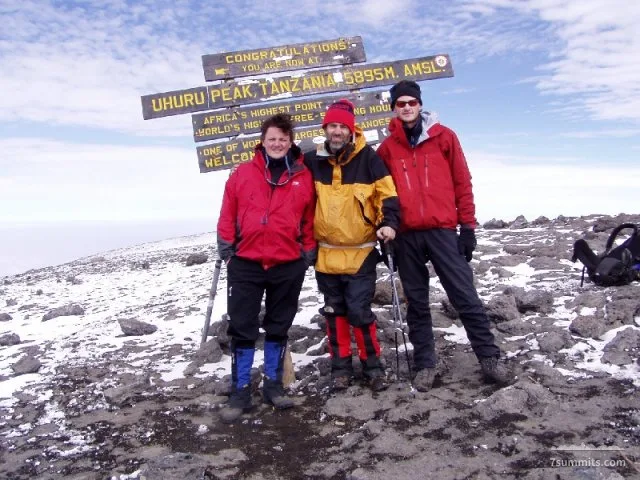
Kibo was first climbed on 6 October 1889 by Hans Meyer and Ludwig Purtscheller, guided by the Chagga man Yohani Kinyala Lauwo. At independence in 1961 the summit was renamed Uhuru Peak; uhuru is Swahili for freedom (History of the mountain; How many people have climbed Kilimanjaro?). The people of the mountain's slopes are the Chagga (Local culture, A short history of Tanzania), and a few words go a long way (A few words of Swahili). Background information opens the section.
Kilimanjaro questions
About this Kilimanjaro climbing guide
The Kilimanjaro guide was written from scratch for 7summits.com, with every fact checked against current sources. It was written and edited by 7 summits finisher Harry Kikstra, who has climbed Kilimanjaro and organised many expeditions on it. His first climb there, in December 1998, is where 7summits.com began.
Every chapter is on a review schedule and is updated when something changes. Sources and credits lists what the guide was checked against, the table of contents and the index reach every chapter, and the books worth reading first are on Kilimanjaro books and films.
Climbing guide
Read before you go
 Five Big Mountains: A Regular Guy's Guide to Climbing Orizaba, Elbrus, Kilimanjaro, Aconcagua, and VinsonDavid N. Schaeffer · 2010