








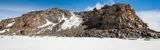

A night at Crater Camp, about 5,750 m, just below Uhuru Peak: the highest camp on the mountain, for strong and well-acclimatized climbers only.
| Time | 7–8 hours up to Crater Camp; a short push to Uhuru the next morning |
| Altitude gained | about 1,110 m3,642 ft: Barafu 4,640 m15,223 ft → Crater Camp ~5,750 m18,865 ft, just below Uhuru 5,895 m19,341 ft |
| Grade | the same hard summit-night scree, but you camp at extreme altitude instead of coming down |
| Terrain | the crater floor, beside the Furtwängler Glacier, inside the summit crater |
| Summary | the highest camp on the mountain, extraordinary, but only for the strong and well-acclimatized |
Crater Camp sits at around 5,750 m, the highest campsite on Kilimanjaro, higher than most people ever sleep. Spending a night this high, rather than summiting and descending the same day, sharply increases the risk of serious altitude sickness, and there is no quick rescue from up here. It is only for climbers who are strong and well-acclimatized on a long itinerary. Park rules on crater overnights have changed over the years and this option is offered only by special arrangement, confirm the current situation with your operator before you count on it.
On the nine- and ten-day Lemosho itineraries, summit night is done differently. Instead of climbing to the rim, tagging Uhuru and descending all the way back down, you climb to the crater rim and then drop down onto the crater floor to camp for the night at Crater Camp, at around 5,750 m18,865 ft (sources put it anywhere from about 5,730 to 5,790 m18,799 to 18,996 ft). It is the highest place you can sleep on the mountain.
Inside the crater
Camping up here puts you in a place most climbers never see. You are inside Kibo’s summit crater, beside the Furtwängler Glacier (a surviving remnant of the ice that once capped the mountain) with the walls of the crater around you and the summit just above. There is usually time in the afternoon to walk over to the glacier, and the strong can take the optional walk to the Reusch Crater and the Ash Pit at the mountain’s volcanic heart, where fumaroles still leak sulphurous gas. It is a stark, silent, otherworldly place.
Nothing is loaded from YouTube until you press play.
A drone flight over Kilimanjaro's crater floor shows the mix of snow, rock and the retreating Furtwängler Glacier, with the crater camp visible far below from above.
Nothing is loaded from YouTube until you press play.
A first-hand walk across Kilimanjaro's outer crater with the Furtwängler and Northern Icefields overhead, then up to the inner Reusch Crater and its ash pit, before rejoining the rim near Crater Camp. It shows exactly what the crater floor and its glaciers look like, ground that few climbers ever see.
It is also brutally cold and desperately high, and this is not somewhere to be if you are struggling. Sleep is hard and broken at this altitude; you must be honest with yourself and your guide about how you feel. The next morning you make the short, slow climb up to Uhuru Peak (you are already almost there) for the summit at 5,895 m19,341 ft, and then begin the long descent all the way down. Because you have spent a night at extreme altitude, getting down promptly and sleeping low afterwards matters more than ever.