








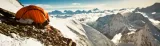

Camp 2 at 7,600m on the north side of Everest, Tibet
The 7 summits
How do you train to prevent altitude sickness?
Altitude sickness cannot be trained away with fitness. What decides whether you get it is how fast you ascend and whether your body has time to acclimatize to the lower oxygen pressure, not how strong you are at sea level; a very fit climber can still get it, and excellent shape is no protection. The reliable prevention is to ascend gradually, with rest days and lower sleeping altitudes, and to descend when symptoms get worse.
The Wilderness Medical Society's 2024 guideline makes careful ascent, rest days and limiting the gain in sleeping altitude the core of prevention. The practical rule of thumb from the Cleveland Clinic is that above 2,500 m8,202 ft you should raise your sleeping altitude by no more than 300 to 500 m984 to 1,640 ft a day, with a rest day every third or fourth day. The body adapts, but only if the ascent gives it the time.
That adaptation is acclimatization. At altitude each breath delivers less oxygen, and over days to weeks the body responds by breathing differently and changing how it carries and uses oxygen. Go up faster than those changes happen and the gap between what you need and what you get is altitude sickness.
What acute mountain sickness is
Mild acute mountain sickness, AMS, the common form, brings headache, nausea, tiredness, poor sleep and sometimes dizziness. The serious forms, high-altitude pulmonary oedema, HAPE, and high-altitude cerebral oedema, HACE, are medical emergencies that can become fatal within hours, which is why recognising symptoms early matters as much as preventing them. See What are HAPE and HACE?
So "the only way to prevent altitude sickness is to take your time" is close but too narrow. Slow ascent is the foundation; rest days, sleeping lower when possible and in some cases preventive medication all reduce the risk further, and for climbers with a history of altitude illness or an unavoidably fast ascent, medication is appropriate. Discuss acetazolamide, sold as Diamox, with a doctor before you travel.
Can you pre-acclimatize?
Sometimes. Reviews of simulated-altitude exposure in hypoxic tents and rooms find a lower risk of AMS before a trip, with bigger effects from longer exposure; a 2026 review found the same, while noting that the evidence is thinner than for careful ascent on real mountains. Treat these tools as a supplement, not a replacement: a tent at home may start the adaptation, but it does not make it safe to go high too fast once you are on the mountain, because the rate of ascent, especially of sleeping altitude, remains the biggest risk factor.
A useful way to hold it:
Fitness helps you perform.
Acclimatization helps you tolerate altitude.
Slow ascent helps you avoid altitude sickness.
Pre-acclimatization may help in advance, but is no substitute for the mountain plan.
Misconceptions
Drinking extra water is important but does not by itself prevent altitude sickness.
Aerobic fitness helps general performance but does not reliably protect against AMS.
Alcohol and sedatives worsen the risk, especially in the first nights at altitude, by interfering with breathing and recovery.
The practical advice
Go up slowly.
Rest when needed.
Sleep lower when possible.
Do not ignore symptoms. If they are getting worse, stop ascending; if they are significant, descend. That is the single most important safety habit in altitude travel.
Summary
You cannot reliably train away altitude sickness with fitness alone. The main way to prevent it is to ascend gradually and give the body time to acclimatize. Fitness helps performance, not protection, because altitude sickness can affect almost anyone. The most effective prevention is slow ascent with rest days and, where possible, lower sleeping altitudes; altitude tents and hypoxic rooms before a trip are only supplements to a careful mountain plan.