








A study of Everest Base Camp calculates that heat from fuel burning and human waste could melt around 2,492 tonnes of ice and snow in a single spring season, with roughly 154 tonnes of that attributed to urine. The research covers the Khumbu Glacier on the Nepali side, where hundreds of climbers and staff live for weeks each April and May. The researchers say climate change remains by far the main driver of glacier loss, and that base camp acts as an additional local heat source.
A study of Everest Base Camp has put figures on something long discussed without them. Heat released by human activity on the Khumbu Glacier during one spring season is enough to melt roughly 2,492 tonnes of ice and snow, according to the calculations. Urine accounts for about 154 tonnes of that total.
The work was published in Regional Environmental Change, Travel Tomorrow reports. The site noticiasambientales.com describes it as published in Springer Nature, which publishes that journal.
What is being counted
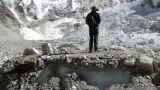
Everest Base Camp sits on the Khumbu Glacier on the Nepali side, at 5,364 metres according to noticiasambientales.com. Through April and May it holds hundreds of climbers, guides and support staff living on moving ice. The Dutch site Gewoonvoorhem reports that around 1,600 tents stood on the glacier for about 50 days during the 2023 season.
The mechanism the researchers describe is straightforward. Bodies dehydrate fast at altitude, so climbers are told to drink a great deal.
Urine leaves the body warm, and that warmth is transferred to the ice it lands on. Solid waste is largely collected and carried off the mountain. Urine mostly is not, and a large share of it ends up directly on or beside the glacier.
Gewoonvoorhem and noticiasambientales.com both report more than 6,000 litres of urine produced at base camp per day during the season. Over weeks, the researchers calculate, that adds up to enough thermal energy to melt about 154 tonnes of ice.
The numbers hold up against basic physics. Melting ice takes about 334 kilojoules per kilogram, the standard latent heat of fusion. A litre of urine at body temperature, cooling to 0°C32°F before it refreezes into the glacier, gives up roughly 155 kilojoules.
At 6,000 litres a day across a 60-day season, that is enough heat, on paper, to melt a figure close to the study's 154 tonnes. Read the same 6,000 litres as a total for the whole season, rather than per day, and the heat available would melt only a few tonnes of ice, far short of the published figure. The physics backs the per-day reading.
The fuel is the larger share
Urine is the headline, but it is the smaller part of the total. For the 2023 season, Gewoonvoorhem lists 824 gas cylinders, 18,935 litres of kerosene and 5,130 litres of petrol burned for cooking, heating and other camp activity. Travel Tomorrow gives the same fuel figures in rounder form.
Travel Tomorrow also describes what those fuels now support: heated and powered tents, Wi-Fi and coffee bars among them. The Ecuadorian magazine Vistazo describes generators and stoves inside tents as small points of thermal radiation spread across the camp, each one raising the local temperature.
Add the fuel to the body waste and the figure reaches 2,492 tonnes of potential melt for a season. The fuel volumes reported for 2023 carry far more raw combustion energy than that melt figure requires, which fits: most of that heat goes into cooking, warming tent air and running stoves, and only a share of it ever reaches the ice.
What the total leaves out
The researchers are explicit that the calculation is incomplete, and that the real figure is likely higher. Not included:
- the body heat of the climbers and staff themselves
- helicopter traffic
- the yaks that carry loads to and from the camp
- trekkers, who arrive at base camp in far greater numbers than climbers
noticiasambientales.com reports that base camp temperatures have risen at twice the rate of other parts of the glacier. Travel Tomorrow attributes a similar finding on base camp warming to reporting in the New York Times.
Climate change is still the driver
Every source carries the same caveat from the researchers, and it matters. Global warming remains by far the main cause of long-term ice loss on the Khumbu Glacier. What base camp adds is a concentrated extra heat source in a small, heavily used area that is already under pressure.
The point of the study is not that climbers are melting the Himalaya. But the numbers in circulation do not sit easily together. Travel Tomorrow, citing the New York Times, puts total spring ice and snow loss at base camp at three million kilograms, which is roughly 3,000 tonnes. The study's own figure for human-driven melt, 2,492 tonnes, is not far below that.
If both numbers are right, base camp's fuel and waste would account for most of the spring's ice loss there, not a small addition to it. None of the sources explains how the two totals were calculated or whether they measure the same thing, so that gap is worth watching rather than a settled finding.
Rules and proposals
Climbers have in recent years been required to carry their faeces back down the mountain, Travel Tomorrow reports. The same requirement does not extend to urine.
One measure discussed in the coverage is moving base camp to a more stable site away from the glacier, which noticiasambientales.com reports as a proposal arising from the study. Vistazo reports that local authorities are looking at stricter regulation of expedition impact, and frames the balance between tourism income and glacier conservation as the harder problem.
Anyone planning a season on the south side will find the camp layout and the icefall described in our Everest guide, and the fluid intake and acclimatization questions that sit behind these numbers are covered in the FAQ. The teams that build and supply the camp each spring are listed by peak on our operators page.
The August flood was a separate event
Coverage of the study has run alongside news of the 26 August disaster in Nepal, and the two are not connected. Bhaskar English describes a large rock-and-ice collapse in Rasuwa that sent water and debris down the valley, destroying roads, bridges and hydropower sites. It reports hundreds dead and thousands still missing. Travel Tomorrow places the collapse on the China-Nepal border and reports more than 1,000 combined fatalities.
Bhaskar English states plainly that the Nepal disaster had nothing to do with climbers or human waste, and that the two stories are entirely separate. What links them is the setting. Glaciers in the range are shrinking, weather is less predictable, and more people are travelling and building in places that were remote a generation ago.
Travel Tomorrow notes that scientists at the International Centre for Integrated Mountain Development in Kathmandu warned in a 2014 report that visitor-driven climate impacts could bring more frequent avalanches, floods and landslides to the region.
The practical question now sits with Nepal's authorities and with the operators who rebuild the camp each April. Waste management at base camp has changed before, when the rule on solid waste came in. A rule on urine, or a camp on rock rather than ice, would be the next visible change on the Khumbu.
Header photograph: South Everest Base Camp sleeping platform.jpg by Alpalfour, CC BY-SA 3.0 (licence), via Wikimedia Commons.
Comment on this post on the forum →
All parts of And now, for something completely different...
- Part 1: Everest study puts a number on the heat base camp adds to the Khumbu Glacier (you are reading this)
- Part 2: Bangor man pulls the 7 summits on a SkiErg for suicide prevention charity