









Rustam Nabiev, reported by Russian media as the first person to reach the summit of Everest on his arms alone after losing both legs, appeared at the International Youth Festival in Yekaterinburg in September 2026. He was one of eight people featured in the stage show "Vyzov" ("Challenge"), part of the festival's cultural programme. Russian outlets report the summit as 20 May 2026. Here is what the sources say, and which details still rest on a single report.
Rustam Nabiev told an audience in Yekaterinburg that he does not think of himself as a superhero. "If there is some superpower in me, it is certainly not in my arms and not in the number of summits I have climbed," he said, in an account published by Life.ru on 15 September. "My superpower lies in ordinary human qualities: in character, in discipline, in responsibility."
The appearance was part of the International Youth Festival, MFM-2026, held in Yekaterinburg from 11 to 17 September under the slogan "Follow your dream. Together with Russia". According to URA.RU, the festival brought together 10,000 participants from 191 countries. Life.ru credited FederalPress for the description of the audience reaction.
The show
Nabiev was one of eight people featured in "Vyzov" ("Challenge"), a stage production in the festival's cultural programme. URA.RU reports that the programme's operator was Tavrida.ART and that the production premiered during the festival. The eight stories came from different countries and, in the words of the report, described people who turned difficult circumstances into a starting point.
The others named by URA.RU include the volunteer Nikolay Tolpinsky, Daniil Kolotushkin, the Chinese scientist Lu Qi and the Mexican programmer Gabriela Salas Cabrera.
Two other lines from the stage were quoted directly. On the decision he made after his injury: "I had a choice: to follow someone else's opinion, or to do everything my own way. I chose the second." And the closing line: "The impossible exists right up until someone proves otherwise."
He also made a point about where he thinks effort actually comes from. Real strength, he said, shows when nobody is there to support you and one more step still has to be taken. Both Russian reports carry a version of this, and both frame it as the moment the hall stopped holding back.
The Everest claim
All three sources describe Nabiev as the first person to reach the summit of Everest on his arms alone. URA.RU gives the date and time as 20 May 2026, at 08:16 Nepal time. Life.ru gives the same date and calls the ascent historic.
The Meta MMA report uses a broader wording, "the first person to conquer Everest without legs", which is a different claim from the one the other two outlets make. The distinction matters, because double-amputee summits of Everest are not new; what the Russian reports describe is an ascent made without prosthetic legs, moving on the arms.
None of the three sources names the expedition operator, the route or the date of the summit push, and none quotes a Nepali permit record. For readers who want the ground under those claims, the Everest guide sets out the two standard routes and the season structure that a 20 May summit date implies.
Before Everest
URA.RU reports that Nabiev lost both legs in the collapse of a paratroop barracks in Omsk in 2015, that he spent more than seven hours under the rubble and that he experienced clinical death. Life.ru gives the barracks collapse as the cause without the other detail.
The same report lists the mountains he climbed afterwards: Elbrus, Manaslu, Aconcagua, Kilimanjaro and Ararat. Four of those names sit inside the classic list. Elbrus is the European summit, Aconcagua the South American one and Kilimanjaro the African one, and Everest completes the Asian entry. The Elbrus guide covers the standard south-side route on that one; Manaslu and Ararat are outside the 7 summits challenge altogether.
That leaves Denali, Vinson and one of Carstensz Pyramid or Kosciuszko, depending on which version of the list is being counted. The sources describe no plan to climb them, and no report among the three mentions the 7 summits as a goal. Anyone who does complete the list appears on the finishers page once the ascents are documented.
The Makhachev post
Separately from the festival, the UFC welterweight champion Islam Makhachev wrote on social media that he had met Nabiev. Meta MMA quotes the post: "I met a legend, the only person who has climbed to the highest point in the world, Everest, on his arms. Your feat will be an example and a huge motivation for people, and not only for those with disabilities. You proved that nothing is impossible, and you wrote your name into history forever. Glad to have met you."
The same report says Makhachev's most recent bout was against Ian Machado Garry in August 2026 at UFC 330 in Philadelphia, won by unanimous decision, and puts his record at 29 wins and one defeat. The report does not say where or when the meeting with Nabiev took place, or whether it was connected to the Yekaterinburg festival.
What is still open
The date, the time and the wording of the record are the pieces that will decide how this ascent is eventually catalogued. A summit on 20 May 2026 falls inside the usual spring window, and 08:16 local time is a plausible arrival hour for a night departure from the top camp. Both details currently come from one outlet.
One point of substance is worth separating from the stage language. "First on his arms alone" and "first without legs" are not interchangeable, and the three reports do not use a single form of words. Whichever wording holds, the climb happened in the same weather and the same air as every other summit that week, and the physiology of that air is the part that does not negotiate. The FAQ covers the altitude questions that follow, including acclimatization and altitude sickness.
The quotes from Yekaterinburg are translated from the Russian originals. Readers who follow Russian can compare the two accounts directly; the phrasing of the closing line in particular differs slightly between Life.ru and URA.RU, though the sense is the same in both.
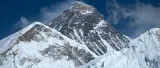
Header photograph: Everest, Himalayas.jpg by Vyacheslav Argenberg, CC BY 4.0 (licence), via Wikimedia Commons.