








#81: Stipe Božic


Peaks climbed
Journey
Kosciuszko list (Bass): #53
Carstensz Pyramid list (Messner): #61
8 Summits (both lists): #33
* Estimated date, duration, or age: only the year (or year and month) was recorded; the exact day is unknown.
7summits journey
7summits timeline
Books & films by Stipe Božic


Penjačevi zapisi, nova, šesta knjiga Stipe Božića zasigurno je njegov najveći spisateljski izazov dosad jer je, uz opise penjačkih avantura i bilježenje putositnica, ona i korak u… Read more →: Penjačevi zapisi: put do najviših vrhova svijeta

Najuspješniji hrvatski alpinist svih vremena osvojio je tri najviša svjetska vrha (Mount Everest, K2 i Kangchenjunga), popeo se na najviše vrhove svih kontinenata te ispenjao sve… Read more →: K2: trijumf i tragedija
Wikipedia: Egyptian Arabic · Bosanski · Hrvatski · Italiano · Srpski (latinica)
Finisher badge

Biography
Stipe Božić was born on 26 December 1950 (officially registered as 2 January 1951) in Zavojane, near Vrgorac, in what was then the People's Republic of Croatia. He grew up mostly in Split, where in 1968 he completed alpinist training with the mountaineering club PD Mosor.
Himalayan career
Božić's first major Himalayan climb came in the spring of 1979, when he joined the first Yugoslav expedition to Mount Everest, led by Tone Škarja. Along with Vladimir Mesarić, he was one of two Croatian members of a team otherwise made up mostly of Slovenian climbers. On 13 May 1979 the expedition completed a new route up the mountain's West Ridge, and on 15 May Božić reached the summit with the second rope team, becoming the first Croat to climb Everest.
He returned to the mountain a decade later, summiting again on 10 May 1989 with a Macedonian expedition, this time via an easier route. During that climb he suffered a bad cold and hallucinations, and afterwards had incomplete memories of parts of the ascent; a Macedonian team member, Dimitar Ilievski, died on the mountain during the same expedition. The 1989 summit made Božić only the second European, after Reinhold Messner, to climb Everest twice.
In the years between and after his two Everest ascents, Božić climbed other 8,000-metre peaks. He reached 8,150 metres on Lhotse in 1981 on a new south face route without summiting, climbed Kangchenjunga in 1991, attempted Annapurna without success in 1992, and reached the top of K2 in 1993 with Viki Grošelj, Carlos Carsolio and Zvonko Požgaj, in conditions too windy to allow the climbers to stand upright at the summit.
Documentary filmmaking
Božić has worked as a documentary filmmaker since 1975, when his early mountaineering exploits were first filmed. Over five decades he has directed dozens of documentaries on mountaineering subjects, including "K2", "Lukina jama", "Reticent Wall" and "Dhaulagiri Express". His feature "Alpine Warriors", based on a book about Slovenian and Croatian Himalayan expeditions, brought together decades of his own footage from the mountains.
Writing
Alongside filmmaking, Božić has written for "Slobodna Dalmacija", "Večernji list", "Hrvatski planinar", "Hrvatska matica iseljenika", "National Geographic" and the literary journal "Mogućnosti". His books include:
"Put na vrh svijeta" (1990)
"Svete planine svijeta" (1990)
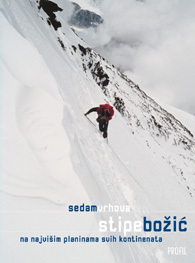
"Sedam vrhova" (2003)
"K2 trijumf i tragedija" (2014)
"Penjačevi zapisi", presented in 2024
Later life
Božić completed the 7 summits with Elbrus in July 2000. In July 2025 Croatian media reported that Božić suffered a stroke and was hospitalised in Split; reports at the time described him as recovering.
Image credits: Photo: stipebozic.com · modified