








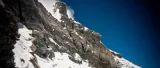

Climbers at the Second Step, north ridge of Everest, Tibet
Trips & expeditions
What are the Three Steps on Everest, and how do they compare with the Hillary Step?
The Three Steps are bands of rock on the North-east Ridge of Everest, the last obstacles on the Tibet route: the First Step at about 8,550 m28,051 ft, the Second Step at about 8,625 m28,297 ft and the Third Step at about 8,700 m28,543 ft. The Hillary Step is their counterpart on the Nepal route, a single rise of about 12 m39 ft at 8,765 m28,757 ft between the South Summit and the top. The Second Step is the hardest of the four, and since 1975 climbers have got up its final wall on an aluminium ladder.
The First Step
From High Camp at 8,250 m27,067 ft the route climbs a series of gullies, the Exit Cracks, to the summit ridge at about 8,500 m27,887 ft and follows the ridge to the First Step. Its main part is only about 12 m39 ft high. At sea level it would be an easy scramble; in the dark at 8,550 m28,051 ft it is very tough. Above it lies Mushroom Rock, where many climbers change their oxygen bottle, and where Lincoln Hall, left for dead in 2006, survived the night and was found alive and rescued the next morning.
The Second Step
The Second Step is about 40 m131 ft of rock, of which the last 5 m16 ft are almost vertical. The lower part is a pile of blocks and smooth slabs, scratched white by years of crampons, which climbers work up beside a tangle of old fixed ropes. Then comes the headwall, and the ladder. A large share of the deaths on the Tibet route have happened here, through falls, fear and exhaustion. Coming down is harder than going up: you step backwards over the edge with the Rongbuk Glacier far below your feet, and your feet have to find the ledges without your eyes. On busy days queues form, and climbers have been frostbitten after standing still for one or two hours.
The Chinese ladder
A Chinese expedition made the first ascent from the north in 1960. At the Second Step the climbers could not get up the final wall until Liu Lianman let Qu Yinhua stand on his shoulders; Qu had even tried the rock barefoot for a better grip. Liu was then too exhausted to go on, and Wang Fuzhou, Qu Yinhua and Gongbu reached the summit on 25 May 1960.
Fifteen years later, in 1975, another Chinese expedition made the second ascent from the north and fixed an aluminium ladder, about 4.6 m15 ft long, to the headwall. It was replaced by a new ladder in 2007 for safety. Since 1975 almost every climber on the Tibet route has used it, and the ladder turned the hardest move of the route into a few rungs. It did not make the Step easy: reaching the foot of the ladder is still the hardest climbing of the day, with a full pack, a down suit, big mittens and an oxygen mask.
Mallory, Irvine and the question the ladder hides
The ladder also made the oldest question on Everest harder to answer. On 8 June 1924 George Mallory and Sandy Irvine set off for the summit. At about 12:50 Noel Odell saw two figures on the ridge, climbing a rock step, before cloud closed in, and they never came back. Odell first reported them nearing the base of the final pyramid, then changed his account several times, and nobody knows which step he saw. If it was the Second Step and they got up it, they may have stood on top 29 years before Hillary and Tenzing.
In 1933 Irvine's ice axe was found below the ridge, about 250 yards east of the First Step. On 1 May 1999 the American climber Conrad Anker, searching with the Mallory and Irvine Research Expedition, found Mallory's body at 8,156 m26,759 ft. On the same expedition Anker tried the Second Step without the ladder. He climbed almost all of it, but had to put one foot on a rung where the ladder covered the only foothold, and he graded it 5.10 on the American scale, harder than Mallory was thought able to climb.
Climbed without the ladder
The Catalan climber Òscar Cadiach is recorded as the first to climb the Step without the ladder, in 1985, and he graded it 5.7 to 5.8 (V+ on the UIAA scale). Theo Fritsche climbed it alone and on sight in 2001 and came to a similar grade. In 2007 Anker went back for the Altitude Everest expedition with the British climber Leo Houlding. With special permission the team took the ladder off the rock, and on 14 June 2007 Anker and Houlding free climbed the headwall. Anker fell off on his first attempt; Houlding graded it 5.9, just within what Mallory might have managed.
That climb showed that the Step can be climbed free at that altitude. It did not show that Mallory and Irvine did. In September 2024 a team found partial remains of Irvine on the Central Rongbuk Glacier, far below where Mallory lies. Their camera, which might settle the question, has not been found.
The Third Step and the summit
Beyond the Second Step the ridge is easier, always a few metres from the drop down the Kangshung Face. The Third Step is a pile of rocks about 10 m33 ft high, and in good snow it takes a few minutes. Above it comes the Snow Pyramid, a 45 degree slope, then an exposed rock traverse and a false summit. The top is still at least an hour away from the foot of the Snow Pyramid, more often two or three.
The Hillary Step
On the Nepal route there is one step. On 29 May 1953 Edmund Hillary found "a rock step some forty feet high" (about 12 m39 ft) on the ridge above the South Summit, its rock smooth and almost holdless, with a narrow crack between the rock and the snow cornice beside it. He wedged himself into the crack and, in his words, "literally cramponed backwards up" it, then brought Tenzing Norgay up after him. It has carried his name ever since.
For decades the Step was a near-vertical pile of big rocks, reached along the Cornice Traverse, a very narrow ridge with drops of thousands of metres on both sides. On busy days it was the worst bottleneck on the route, where climbers waited for hours on the fixed ropes. In 2013 Nepali operators proposed fixing a ladder to it to ease the queues.
What the 2015 earthquake did
The earthquake that struck Nepal in April 2015 also shook the summit ridge. Deep snow hid the Step in 2016, and in May 2017 the British guide Tim Mosedale reported from the summit that "the Hillary Step is no more": the big blocks had gone. Nepali officials first disputed it, saying the rocks were only covered by snow, and later agreed that at least the upper part of the Step had changed. Today it is mostly a steep slope of snow and ice with some rock. It is easier to climb, but still a place where queues form, now with separate ropes for going up and coming down.
Which is harder
The Second Step is the hardest single obstacle on either route, even with its ladder. The Tibet route's summit day is also the longer one: three steps, a long traverse above 8,500 m27,887 ft, and the hardest moves to repeat on the way down. On the Nepal route the crux is the Cornice Traverse and the Hillary Step above the South Summit, after a shorter and steeper climb from the South Col. None of it would be hard at sea level, and all of it is hard at 8,700 m28,543 ft in the dark and the cold. The Tibet side was closed to foreign climbers in 2026, so check whether it is open before planning a climb over the Three Steps.
The summit day over the Three Steps is described move by move in our guide's High Camp to the summit, and the Nepal side in South Col to the summit. The landmarks above the South Col are in What are the Hillary Step and the South Summit on Everest?, and the choice between the two sides in Should I climb Everest from Nepal or from Tibet?