








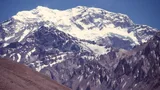

The International Union of Geological Sciences added Aconcagua to its list of Geological Heritage Sites on 6 November 2026, in a set of 100 new sites announced at a meeting in Portugal. The nomination came from Argentina's geological survey, SEGEMAR, and rests on the rock exposures of the massif rather than on its height. Two other Argentine sites were included: Campo de Piedra Pomez in Catamarca and the Fitz Roy plutonic complex in Santa Cruz.
The International Union of Geological Sciences (IUGS) has added Aconcagua to its list of Geological Heritage Sites. The announcement was made on 6 November at an international meeting in Portugal, where 100 new sites were presented. Three of them are in Argentina, and the highest mountain in the Americas is one.
The nomination was put forward by SEGEMAR, the Argentine geological and mining survey, working with outside researchers and specialists. Both Sitio Andino and Diario NDI report the same core of the decision: the listing is about what the rocks record, not about the summit altitude of 6,961 m22,838 ft.
What the citation rests on
The IUGS description treats the Mendoza massif as one of the world's better examples of a mountain built inside a system of folds and thrust faults linked to subduction. Subduction is the process by which one plate of the Earth's crust moves beneath another. In this part of the Andes, the meeting of the Nazca plate and the South American plate drove the compression and uplift that raised the range.
What makes Aconcagua useful to geologists is that the evidence is visible. High-altitude vegetation is thin here, so rock layers that would be buried under forest or soil elsewhere are left bare on the slopes. Folded sedimentary beds and volcanic formations can be followed with the eye and mapped on the ground.
The rocks span a long stretch of time. Research circulated by SEGEMAR identifies formations in the region covering hundreds of millions of years, including marine and continental rocks of Mesozoic age alongside younger volcanic and sedimentary material. Part of the area where the mountain now stands was once a marine basin. Later movement of the crust deformed those materials and lifted them to their present height.
The south face draws particular attention in the IUGS description. The structures are exposed there in a way that allows the growth of a major mountain chain to be read directly off the wall. On that basis the organisation treats the region as a reference locality for studying how the Andes were built.
The other two Argentine sites
Campo de Piedra Pomez, in Catamarca, was listed for its wind-sculpted volcanic rock formations at high altitude. The Fitz Roy plutonic complex, in Santa Cruz, was listed for its granite towers and spires, shaped first by mountain-building processes and then by glacial erosion. All three nominations came from SEGEMAR.
This is the third set of 100 geological heritage sites published under the IUGS initiative. The first two were released in 2022 and 2024, and the new batch brings the worldwide total to 300.
What this is, and what it is not
The designation is scientific. It marks places that help explain the history of the planet, and it is separate from the tourism and biodiversity labels that mountains more often collect. The reports from Mendoza connect it to research, to environmental education and to geotourism in the province.
For anyone planning a climb, the practical arrangements on the mountain are governed by Provincial Park rules and the permit system, and those are unchanged by a listing of this kind. Nothing in the announcement alters the seasons, the routes or the paperwork. Our Aconcagua guide covers the normal route and the Polish Glacier side, and operators by peak covers who runs trips there.
Why the south face matters to climbers too
The wall the geologists single out is the one most visitors see without climbing it. Trekkers heading up the Horcones valley look at the south side; most summit attempts go up the other flank entirely. A listing that names that face is a reminder that the mountain has two quite different reputations, one of them earned by a wall that very few people touch.
Aconcagua sits in the 7 summits list as the high point of South America, and for most people attempting the set it is the second or third mountain they climb. It is the usual place to find out how a body behaves above 6,000 m19,685 ft, which is why the altitude questions in our FAQ are worth reading before the trip rather than at base camp.
The numbers in the announcement
The height given in both Argentine reports is 6,961 m22,838 ft above sea level. Published figures for Aconcagua have varied over the years depending on the survey, and the IUGS citation is not a resurvey. It is a description of the geology, and the altitude appears in it only as context.
The broader point of the IUGS programme is to identify sites where a piece of Earth history can be read in the field, then to promote their study and keep them known. Mendoza now has one on its provincial emblem. Climbers walking in through the Horcones or the Vacas valley are crossing an uplifted marine basin on the way to the camps, which is a reasonable thing to know while the approach is long and the view is mostly scree.
This story is part of This week on the 7 summits: 9–15 November 2026, the week's news in brief.
Header photograph: AconcaguaSouthface1997.jpg by Albert Backer, CC BY-SA 3.0 (licence), via Wikimedia Commons.