








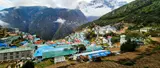

American endurance athlete Tyler Andrews covered the 54-kilometre trail from Everest Base Camp down to Lukla in 7 hours and 43 minutes on Tuesday, a new fastest known time for the route. His watch put him more than two hours ahead of the previously listed men's self-supported mark of 9:47:59, set by David Byrne and Majell Backhausen in December 2023. Andrews already held the listed times for the same trail in the uphill direction.
Tyler Andrews ran from Everest Base Camp down to Lukla on Tuesday in 7 hours and 43 minutes. The Tourism Times gives the distance as 54.4 kilometres and the time as the one recorded on his watch. The clock started at 7:45am at Base Camp.
His morning began a long way below the start line. Andrews flew by helicopter from Namche Bazaar to Gorakshep, then walked up to Base Camp on foot before beginning the timed run. The attempt was announced while it was under way by Asian Trekking, whose managing director Dawa Steven Sherpa confirmed that Andrews had set off from Base Camp that morning.
The splits
The progress recorded on his Garmin was published through the day, village by village. The named points on the descent were these:
near Lobuche at 8:50am
Pheriche at 9:40am
Tengboche at 11:00am
Kyangjuma at noon
Namche Bazaar at 12:41pm
Chumoa at 1:41pm
Phakding at 2:21pm
Namche came just under five hours after the start, with the steep drop below Tengboche and the climb back up to Kyangjuma already behind him. The last published split is Phakding, which leaves roughly an hour of trail into Lukla.
The time it replaces
The listed men's self-supported record for the route stood at 9 hours, 47 minutes and 59 seconds. David Byrne and Majell Backhausen set it on 11 December 2023, and it is carried on Fastest Known Time. Andrews is more than two hours inside that figure.
Fastest Known Time keeps the directions apart, which matters on this trail more than on most. The route runs about 54 kilometres with somewhere near 3,000 metres of height difference, so the two directions are different efforts entirely. Going down from Base Camp means starting at the thinnest air and finishing in the thickest. Going up means the reverse, with the hardest kilometres arriving last.
Andrews already holds the listed men's self-supported time for the uphill direction, Lukla to Base Camp, at 11 hours, 1 minute and 49 seconds, set on 16 March 2020. His listed round trip is 23 hours, 42 minutes and 13 seconds.
The Everest record in May
This is the second speed mark Andrews has taken on Everest this year. In May 2026 he climbed from Base Camp to the summit in 9 hours and 55 minutes using supplementary oxygen. The previous mark was 10 hours and 56 minutes, set by Lakpa Gelu Sherpa in 2003 and standing for more than two decades.
That record and this one share a start point and almost nothing else. One climbs through the Khumbu Icefall and on to 8,848 metres; the other runs away from the mountain and down into the forest.
Why this particular trail
The Base Camp to Lukla corridor is the walking approach to Everest from the south. Every trekker who flies into the Lukla airstrip and every expedition member who does not take a helicopter covers it, which is why it is one of the few trails in Nepal with a measured, contested record on it. The names in the split list are the same names on every trekking itinerary in the Khumbu: Pheriche, Tengboche, Namche, Phakding.
The altitude profile is what makes the downhill direction fast and the uphill direction slow. From Gorakshep the trail falls steadily, with the one serious reversal between the Dudh Kosi bridge and Tengboche and another on the pull out of the river to Namche. Running it in one push means arriving at the low end of the valley after starting the morning above 5,000 metres, which is the opposite of how acclimatization normally works on this trail. Anyone planning a slower version of the same walk will find the altitude answers in our FAQ, and the approach itself described in the Everest guide.
What is on the clock and what is not
Times like this one go onto Fastest Known Time with a category attached, and the category does the work. Self-supported, supported and unsupported are different records on the same trail, and a time only displaces another time within its own category. The 9:47:59 Andrews has gone under is the listed men's self-supported mark.
The helicopter flight from Namche to Gorakshep happened before the clock started, as did the walk from Gorakshep up to Base Camp. The timed segment is Base Camp to Lukla.
Speed records on Everest and on its approach trails sit slightly apart from the 7 summits challenge, which is counted in summits rather than hours. They draw on the same acclimatization, the same permits and often the same operators. For climbers the relevant number remains the summit itself, and the people who have completed all seven are listed on our finishers page.
Andrews now holds listed times in both directions on this route. The downhill mark is the newer and the faster of the two, and the one that changed on Tuesday.
This story is part of This week on the 7 summits: 26 October – 1 November 2026, the week's news in brief.