








Andrea Cardona of Guatemala climbed the 7 summits in four years and seven months, from Aconcagua in February 2008 to Carstensz Pyramid in September 2012, and skied the last degree to both poles in between. She was the first Central American woman on Everest and the first Latin American to finish the Explorers Grand Slam.
Andrea Cardona climbed the 7 summits in four years and seven months, from Aconcagua on 17 February 2008 to Carstensz Pyramid on 23 September 2012. In the same stretch she skied the last degree to both poles. She was 30 when she finished, and our record has every one of her summits to the day.
She was the first Central American woman on Everest, and the first Latin American to complete the Explorers Grand Slam, the 7 summits plus both poles on skis.
From Guatemala City to Genoa
Cardona was born in Guatemala City on 19 June 1982. She had asthma as a child and was afraid of heights. At 18 she left Guatemala on a scholarship to study tourism economics at the University of Genoa in Italy. After that she worked for a hotel chain in Sardinia and in marketing in New York.
The mountains came through work. She took a job as a trekking guide for a tour operator in Asia and led seven treks to Everest Base Camp. By the end of them she had a goal: to be the first Central American woman on the highest peaks of the world.
Four summits in eighteen months
Aconcagua was the first, in February 2008, when she was 25. Then came a fast run through 2009: Denali on 4 May, Elbrus on 28 June and Kilimanjaro on 17 August, three continents in fifteen weeks.
On 24 September 2009 she climbed Cho Oyu, at 8,201 metres her first peak above 8,000 metres. Everest followed on 23 May 2010, inside the usual pre-monsoon summit window, and made her the first Central American woman to stand on top.
The poles, and the last two peaks
Between December 2011 and April 2012 she skied the final 111 kilometres to the South Pole and then to the North Pole. One degree of latitude measures about 111 kilometres, so a last-degree ski starts at 89 degrees and ends at the pole itself. It is the shortest of the recognised polar trips, and the one most Grand Slam finishers choose.
The South Pole leg fits the southern summer, and Vinson came in the same season, on 6 January 2012. The North Pole runs in April, while the sea ice is still firm enough to ski. Carstensz Pyramid closed the list that September.
Carstensz is the Oceania summit on the Messner version of the 7 summits, and Kosciuszko the one on the Bass version. Our finishers list records both lists, and Cardona's finish is on the Messner one.
One more step
Cardona later founded Un Paso Más ("one more step"), a health app built around mountain habits for ordinary weeks. It offers exercise routines, guided breathing, short activity breaks and a daily visualization in her voice, meant to be done with a partner, family or friends. She runs a workplace programme under the same name, and her talks are listed at andreacardona.com.
The name comes from how a rope team moves: tied in together, at the pace of the slowest person, one step at a time. It is also a fair description of how she climbed the list, one continent after another, with the poles fitted in between.
A list climbed in one push
Her record is the opposite of a list built over decades. Four of her summits fell inside eighteen months, and the whole set inside five years. The statistics page shows how other finishers have spread theirs, and our operator directory lists who runs trips on each peak for anyone planning a similar run.
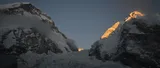
Header photograph: 7ST 7264.jpg by Thaneswar Guragai, CC BY-SA 4.0 (licence), via Wikimedia Commons.
All parts of Finisher Files
- Part 1: Carlos Soria, from Elbrus at 29 to Kilimanjaro at 70
- Part 2: Andrea Cardona: 7 summits and both poles by 30 (you are reading this)
- Part 15: Andrea Cardona: Guatemala's Grand Slam finisher