








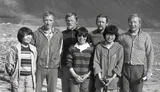

Junko Tabei was the first woman on top of Everest, on 16 May 1975, twelve days after an avalanche buried her camp. In 1992 she became the first woman to complete the 7 summits, paying her own way after refusing sponsors. A profile of a climber who never wanted the fame.
Junko Tabei reached the summit of Everest on 16 May 1975, the first woman to stand on top. Seventeen years later she became the first woman to complete the 7 summits. She once said she would rather be remembered as the 36th person on Everest than the first woman.
A frail child who liked the quiet of mountains
Junko Ishibashi was born on 22 September 1939 in Miharu, in Fukushima prefecture, the fifth of seven children of a printer. She was considered a frail child. At ten she climbed Mount Nasu on a school trip and found what she liked: a sport with no winners and losers, and a wide view at the top.
Her family could not afford climbing, so she did little of it until university, where she studied English and American literature. Afterwards she joined men's climbing clubs. Some welcomed her, and some asked what she was really after. She married Masanobu Tabei, a climber she met on Mount Tanigawa, and they had two children.
A club of her own
In 1969 Tabei founded the Joshi-Tohan Club, a mountaineering club for women only, with the slogan "Let's go on an overseas expedition by ourselves". The next year two of its members, Tabei and Hiroko Hirakawa, reached the top of Annapurna III by a new route on its south side.
The club then set its sights on Everest. The permit took four years to come through. Sponsors told her the women should be raising children instead, and each of the fifteen members still had to find 1.5 million yen. Tabei taught piano to raise her share, and she made some of her own gear, sewing trousers from old curtains.
Everest, 1975
On 4 May 1975, at 6,300 metres, an avalanche buried the camp. Tabei was dug out unconscious by the Sherpas and could barely walk for two days. Then she carried on.
There was oxygen for only one woman to go to the top, and the leader, Eiko Hisano, chose Tabei. Near the summit she had to cross a narrow ridge of ice that earlier accounts had not mentioned, and she later called it the tensest moment of her life. Twelve days after the avalanche, on 16 May, she reached the summit with the Sherpa Ang Tsering.
Kathmandu held a parade for her, and thousands met her at the airport in Tokyo. She never liked the fame much.
The other six, on her own terms
After Everest Tabei refused corporate sponsorship and paid her own way, through talks, guiding and teaching music and English. She climbed the rest of the 7 summits over the next seventeen years, and in 1992 she became the first woman to complete the set. Our record holds all eight of her summits, on both lists, and her climber page lists them.
By 2005 she had taken part in 44 all-women expeditions. The women who have followed her onto all seven are in the finishers list. She also set herself the goal of climbing the highest point of every country, and reached at least 70 of them.
The mountains after the summits
Tabei cared about what climbers left behind. In 2000 she completed postgraduate studies at Kyushu University on the waste on Everest, and she led clean-up climbs in Japan and the Himalaya. After the 2011 earthquake and tsunami she took young people from the stricken region up Mount Fuji every year.
She was diagnosed with cancer in 2012 and kept climbing. In July 2016 she led one more youth climb on Fuji. She died on 20 October 2016, aged 77.
Her books, and a film
Her own account of a life in the mountains is available in English.
In 2025 her life became a feature film, Climbing for Life, directed by Junji Sakamoto with Sayuri Yoshinaga as Tabei. It opened the Tokyo International Film Festival that October.
Children meet her through several picture books too, and an asteroid and a mountain range on Pluto carry her name. Her slogan sums her up best: "Do not give up. Keep on your quest."