








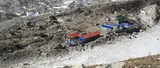

Anjunath KV, 31, an Indian trekker from Kerala, was found dead in his hotel room at Gorakshep (5,164 m) on 19 November, the last settlement before Everest base camp. He was walking without a guide or a registered agency, carrying only a Sagarmatha National Park entry ticket. His body was flown to Kathmandu for an autopsy and the cause of death is still to be established.
What the police have reported
Anjunath KV, 31, an Indian trekker from the state of Kerala, was found dead in his hotel room at Gorakshep on Thursday 19 November. Lukla Police reported the death the following day. Gorakshep stands at 5,164 m16,942 ft and is the last settlement on the walk up to Everest base camp, which sits at 5,364 m17,598 ft.
He was travelling alone, without a guide and without a registered trekking agency. Police said he carried an entry ticket for Sagarmatha National Park, the protected area that covers the Everest region, and had made none of the other arrangements the rules require. With no agency holding his paperwork and no emergency contact listed in Nepal, police worked through the Indian embassy. His body was flown by helicopter to Tribhuvan University Teaching Hospital in Kathmandu on Friday morning for an autopsy, the Everest Chronicle reported. The cause of death is still to be established.
That sequence matters for anyone walking the same trail. An agency booking gives the police a name to call, a record of where a trekker slept each night, and insurance details for a helicopter. A solo walker with only a park ticket leaves the local police to reconstruct all of it after the fact.
Altitude at 5,164 m16,942 ft
A report in Onmanorama, published in Kerala, treats the death as a case of acute mountain sickness and uses it to set out the warning signs. The police position is that the autopsy will decide. Both things can be read without conflict: the medical finding is pending, and the lesson about the altitude stands on its own.
At Gorakshep each breath delivers roughly half the oxygen of a breath at sea level. The early signs are a bad headache, nausea, poor sleep and a lost appetite, and fitness offers no protection against any of them. The treatment that works is going down, by 500 to 1,000 m1,640 to 3,281 ft, and going down early. Our FAQ page covers the symptoms and the decision points in more detail.
Sleeping lower, which many walkers already do
Plenty of trekkers choose to spend the night at Lobuche, at 4,940 m16,207 ft, and walk up to Gorakshep and base camp as a long day. Anyone feeling unwell at Gorakshep is normally sent down to Lobuche or further, to Pheriche. The standard itinerary also builds in rest days at Namche Bazaar (3,440 m11,286 ft) and Dingboche (4,410 m14,469 ft), and those days are the reason most people arrive at base camp in good shape.
The difference between this walk and a lower Himalayan trek is not obvious from a photograph. Annapurna base camp, a common first big trek for Indian and Nepali walkers, lies at about 4,130 m13,550 ft and can be reached in a shorter push. The last three days of the Khumbu trek are spent above 4,900 m16,076 ft, in a place where night temperatures fall well below freezing and the nearest hospital is a helicopter flight away. Our Everest guide covers the approach up the valley and the altitudes of each stop.
The guide rule, and what changed in March
Nepal introduced regulations in 2023 requiring foreign trekkers to hire a licensed guide and to book through a registered agency, which ended independent solo trekking in the national parks and conservation areas. In March this year the Department of Immigration added a provision letting an individual foreigner apply for a restricted-area permit alone, removing the old requirement to find a partner first. The guide requirement itself stayed in place.
We think the guide rule is sound above about 4,000 m13,123 ft. It is not mainly about route-finding, because the trail to base camp is well marked and busy in season. It is about having a second person who notices. The altitude illnesses that kill people at these heights interfere with judgement, so the walker is often the last to understand what is happening. Someone sharing the lodge who knows the signs can start a descent hours before the sufferer would have chosen to.
The counter-argument: a rule written in Kathmandu is enforced at a checkpoint, and a checkpoint cannot put anybody in a room at two in the morning. Guides vary in training. A trekker who hires one and then overrules them has bought very little.
A pattern Nepali authorities have been flagging
This death arrives alongside several other cases involving walkers in remote country without the required paperwork. On 4 November, six Indian trekkers were lifted out of Upper Dolpo by helicopter after heavy snow stranded them near 4,500 m14,764 ft. Authorities said the group had entered the restricted zone near the Tibetan border without permits or a guide, avoiding the checkpoints; they were fined, charged the permit fees and sent home. Two days later Nepal fined a trekking agency and four Mexican nationals over a restricted-area entry in Dolpo. In October, a 36-year-old Chinese woman trekking without a guide in the Khumbu was found dead after falling from a cliff.
The Khumbu in late November is still inside the autumn season, which runs from September into November, with reasonable weather and lodges open. It is also getting colder each week, and the teahouses at Lobuche and Gorakshep thin out as December approaches. A trekker who feels poor at 5,164 m16,942 ft in late season has fewer neighbours around than one who felt poor there in October.
For anyone planning the walk, the practical steps are small. Book through a registered agency, which our operators page can help with. Give someone in Kathmandu an emergency contact. Build in the rest days at Namche and Dingboche even when you feel strong on the way up, and treat a headache that will not clear as the signal to sleep lower rather than higher.
This story is part of This week on the 7 summits: 16–22 November 2026, the week's news in brief.
Header photograph: Gorakshep.1.jpg by DARIO SEVERI, CC BY-SA 3.0 (licence), via Wikimedia Commons.