







Start with Kilimanjaro: it teaches you how your body handles altitude and asks for no technical skill. Then a skills course, Elbrus or Aconcagua, Denali, and the three hardest to schedule last. The order most finishers followed, and why it works.
Start with Kilimanjaro. It teaches you more about yourself at altitude than any other peak on the list, and it asks for no technical skill. More finishers on our record began there than anywhere else.
That is the short answer. The longer one depends on what you already know, and on the calendar.
What the finishers did
Among the finishers on our record who completed the set since 2010, about a third climbed Kilimanjaro first. Roughly one in four started on Everest itself, often years before the 7 summits became their goal. Elbrus and Aconcagua come next, and those two are also the most common second peak.
The pattern is not a rule, and nobody checks the order. It is a sensible ladder, and most people climb it for the same reason: each step adds one new difficulty to what the last one taught.
Step one: Kilimanjaro, to learn altitude
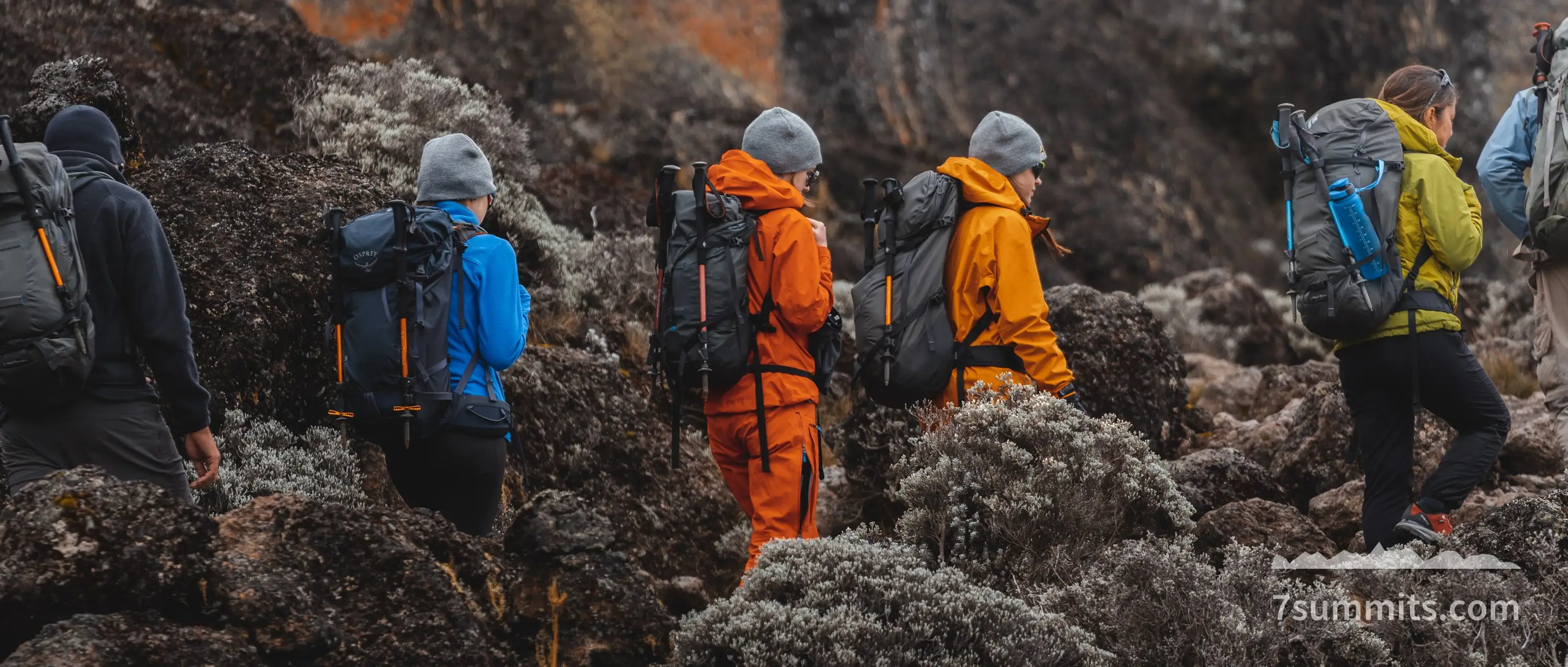
At 5,895 metres, Kilimanjaro is high enough to show you how your body handles thin air. You walk on trails the whole way, with a crew carrying the loads, so altitude is the only real test.
A good itinerary takes seven or eight days, and longer is better for acclimatization. If you come down feeling strong, you have learned something no training plan can tell you. If you struggled, you have learned that too, at a modest price.
Step two: a skills course, then Elbrus or Aconcagua
Kilimanjaro needs no crampons. The next peaks do, or soon will. A basic mountaineering course of a few days teaches crampons, the ice axe and rope work, and it makes Elbrus a safe next step.
Elbrus, 5,642 metres, is your first summit on snow and ice, usually climbed in about ten days. Aconcagua, 6,961 metres, is the bigger jump. It needs little technique on its normal route, but it is a two to three-week expedition in real cold, where you carry loads and live in a tent. The FAQ on going from Kilimanjaro to Aconcagua covers that gap honestly.
Step three: Denali, the full expedition
Denali is where everything comes together. You pull a sled, travel roped on a crevassed glacier, build camps in snow and wait out storms, for up to three weeks. Climbers who have done Denali well are usually ready for the rest.
Last: Vinson, Carstensz Pyramid and Everest
The final three are the most expensive and the hardest to schedule. Vinson needs a flight to Antarctica in a short season. Carstensz Pyramid is a rock climb that depends on permits and helicopter access. Everest adds the death zone, bottled oxygen and two months away from home.
Most finishers save at least one of these for the end. Everest is the most common last peak on our record, followed by Carstensz and Vinson. If you follow the Bass list, Kosciuszko can fit in anywhere, since it is a walk of a few hours.
The calendar decides the details
The peaks have seasons, and they rarely line up with your holidays. Aconcagua is climbed in the southern summer, roughly December to February, and Vinson from late November to January. Denali is mostly May to July, Everest is mostly May, and Elbrus is best in July and August. Kilimanjaro can be climbed most of the year outside the rains.
So a real plan often looks like this: Kilimanjaro in the summer, a skills course in the autumn, Aconcagua over New Year, Elbrus the following August, and Denali the June after that. The statistics page shows when finishers actually reached each summit.
Three things to settle first
Fitness comes first: you should be able to walk uphill for eight hours, day after day, with a pack. If that is not yet you, the training FAQ is the place to start.
Then time. Kilimanjaro and Elbrus fit in a week or two. Aconcagua and Denali need three weeks, and Everest needs two months.
Then guiding. Some peaks give you no choice, and the FAQ on climbing without a local guide goes through all of them. The operator directory lists the companies on each peak.
Comment on this post on the forum →
Image credits: © Altezzatravel · CC BY-SA 4.0 · Wikimedia Commons · modified