









Erin Ton, a 29-year-old runner from Colorado, climbed Kilimanjaro from Mweka Gate to Uhuru Peak in 5 hours 47 minutes in early September 2026, and completed the round trip in 8 hours 33 minutes. Both times are reported as women's records on the mountain, improving on marks held by Kristina Schou Madsen and Fernanda Maciel. It is the second of the 7 summits where Ton has set a women's speed mark, after Aconcagua earlier this year.
Erin Ton, a 29-year-old runner from Colorado, ran from Mweka Gate to Uhuru Peak in 5 hours 47 minutes in early September 2026. Outside reports the ascent as a new women's fastest known time on Kilimanjaro, faster by one hour and five minutes than the previous mark. The Polish site wspinanie.pl gives the times to the second: 5:47:50 up, and 8:33:42 for the round trip.
The round trip is also reported as a women's record. The previous best for up and down was 10 hours 6 minutes, set by the Brazilian runner Fernanda Maciel. The previous ascent record belonged to the Danish runner Kristina Schou Madsen, at 6:52:54.
The route she used
Ton ran the Mweka route in both directions, starting and finishing at Mweka Gate on the southern side of the mountain in Tanzania. Outside gives the distance as 26.38 miles with 14,000 feet of climbing. wspinanie.pl gives about 42 km and about 4,270 m14,009 ft, which is the same line measured in other units.
Mweka Gate sits at 5,380 feet, roughly 1,640 m5,381 ft. That is the lowest-lying of the usual finishing points and the shortest line to the crater rim, which is why it is normally walked downhill rather than up. The summit, Uhuru Peak, stands at 5,895 m (19,341 ft)19,341 ft.
She passed Mweka Camp after about six miles, then Millennium Camp at 12,500 feet, then Barafu at around 15,000 feet. wspinanie.pl puts Barafu at 4,673 m15,331 ft. From Barafu the line follows a rocky ridge to the summit, about five miles of the run, and it is the section where almost everyone on this mountain slows down.
Tanzanian park rules require a guide for anyone going up, so Ton ran with two. wspinanie.pl names them as Dao Kapela and Marcel Sarwatt, and records the attempt as a supported run. The same report says she started at 5 a.m.
Three days before the record attempt she had climbed to the summit on a reconnaissance, going up by the Umbwe route and down by Mweka. She described that day as one of the coldest summits she has had anywhere, with wind on the ridge and three down jackets on.
Altitude on the upper half
Ton's splits at Mweka, Millennium and Barafu matched her plan. Above Barafu she reported dizziness and nausea, and her pace dropped. She told Outside that altitude is usually where she performs best and that this was one of the few times she has felt poor high on a mountain, without a clear explanation for it.
That is worth noting for anyone reading this as a template. Mweka in a single push gains well over 4,000 vertical metres from rainforest to the crater rim with no night spent high, and the symptoms she describes are the ordinary early ones. Our FAQ covers what those symptoms mean and when going down is the only answer. The normal schedule on this mountain is several days, and the walk-in days are doing a job.
The men's record on the mountain still stands to Karl Egloff, according to wspinanie.pl: 4:56 to the summit by the Umbwe route in 2014, and 6:42:24 for the round trip with the descent by Mweka.
Two of the 7 summits so far
Ton's stated project is a women's speed record on each of the 7 summits. Kilimanjaro is the second. Earlier this year she set a women's record on Aconcagua, the 6,961 m (22,837 ft)22,837 ft high point of South America. wspinanie.pl adds that she has previously set records on Pico de Orizaba and Ojos del Salado, two peaks from the volcanic seven.
The list she is working from uses Carstensz Pyramid rather than Kosciuszko, so what remains is Carstensz Pyramid in Indonesia, Denali in Alaska, Elbrus in Russia, Vinson in Antarctica and Everest. She told Outside that Denali in spring 2027 is the likeliest next one, unless Carstensz or Vinson comes together sooner.
It is worth being precise about what a project like this is. A speed record on a peak is a separate thing from completing the 7 summits, and the two are often reported as if they were the same. Our finishers list records people who have stood on the top of all seven, by whichever list, with no reference to how long each climb took. Ton has two of the seven climbed. Both of them were run fast.
The speed side of Kilimanjaro has a long history because the mountain allows it. There is no technical ground, no fixed rope and no glacier travel on the normal routes, so a fit runner can treat the whole thing as a long uphill trail race with thin air at the end. That is also exactly why the altitude catches people out: nothing on the route forces you to slow down, and the mountain is nearly 5,900 m19,357 ft high. The Kilimanjaro guide sets out the routes and the usual schedules.
What is on the record so far
Times of this kind are normally submitted to the Fastest Known Time project, where the route, the GPS file and the supported or unsupported status are listed for anyone to inspect. Ton ran with two guides, which places the attempt in the supported category. The ascent is reported on a different route from Egloff's, which is why the men's and women's marks on this mountain are not strictly comparable lines: Egloff went up Umbwe, Ton went up Mweka.
Ton told Outside that she hopes the run encourages other people to take on something uncomfortable, and that chasing comfort is a poor use of a large world. She also offered the detail that the dust on the lower trail gave her a nosebleed before she reached Mweka Camp, which is the sort of thing that does not appear in the splits.
This story is part of This week on the 7 summits: 21–27 September 2026, the week's news in brief.
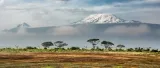
Header photograph: Kilimanjaro from Amboseli.jpg by Sergey Pesterev, CC BY-SA 4.0 (licence), via Wikimedia Commons.