About the 7 summits
The 7 summits are the highest mountain on each of the seven continents. Because the edge of Australia is argued about, there are two lists and eight mountains: six that everyone agrees on, plus Kosciuszko on the Kosciuszko list (Bass) or Carstensz Pyramid on the Carstensz Pyramid list (Messner). This page is the short version of all eight, highest first: what each mountain is, who climbed it first, what a climb involves and what it costs. The 7 summits lists page has the two lists and the record, how it began tells the story, and the finishers are everyone who has completed them, 805 so far.
 Everest
El punto más alto de la Tierra.
- Altitud
- 8849 m29.032 ft
- Dónde
- Asia · Nepal / China
- First climbed
- 1953
- Dificultad
- Extremo
- Mejor temporada
- Abr–May
- Duración del viaje
- 60–65 días
- Costo típico
- 55.000 US$
- Qué lista
- Ambas
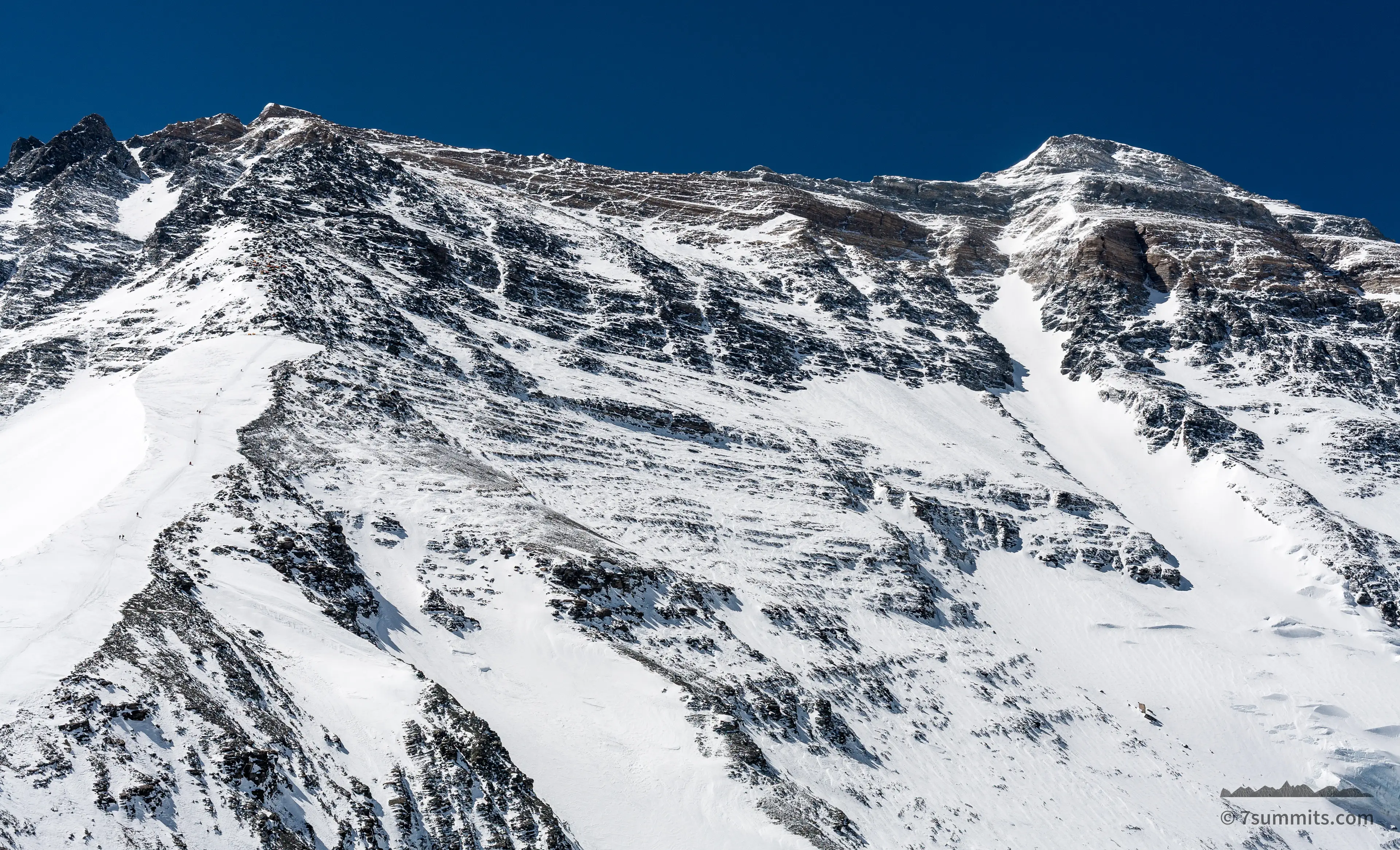
Everest is the highest mountain on Earth: 8,849 m of rock and ice on the border between Nepal and Tibet, so high that the summit stands in the jet stream and the air there holds a third of the oxygen it holds at sea level. Tibetans call it Chomolungma, Nepalis Sagarmatha; the English name honours a surveyor who never saw it. How high it is, and why the number keeps changing, is a question of its own.
Tenzing Norgay and Edmund Hillary stood on top first, on 29 May 1953, after three decades of British attempts from both sides. Reinhold Messner and Peter Habeler climbed it without bottled oxygen in 1978, and Messner alone in 1980. Today several hundred people reach the summit in a good spring, most of them by the South Col route from Nepal; the Northeast Ridge from Tibet is the other normal route, with its own politics. Nepal or Tibet is the first decision.
An expedition takes about two months. Weeks of it go on walking in and acclimatising between base camp and the camps above the Khumbu Icefall, then waiting for the few calm days in May when the wind drops. Almost everyone uses bottled oxygen high on the mountain, fixed ropes from bottom to top and a Sherpa team that does the heaviest work. The danger is real: the Icefall, avalanches, the cold, and thin air that makes every mistake slower to notice.
Everest is the last of the 7 summits for most finishers, because it is the most expensive, the longest and the one that asks for the most experience first; whether you need a 7,000 m peak before it is answered honestly in the FAQ. The Everest guide covers the routes, the seasons, the permits and the costs; the operators page lists the companies that take people up, and the route map shows where the camps are.
 Aconcagua
El techo de las Américas.
- Altitud
- 6961 m22.838 ft
- Dónde
- South America · Argentina
- First climbed
- 1897
- Dificultad
- Difícil
- Mejor temporada
- Dic–Feb
- Duración del viaje
- 18–21 días
- Costo típico
- 4500 US$
- Qué lista
- Ambas
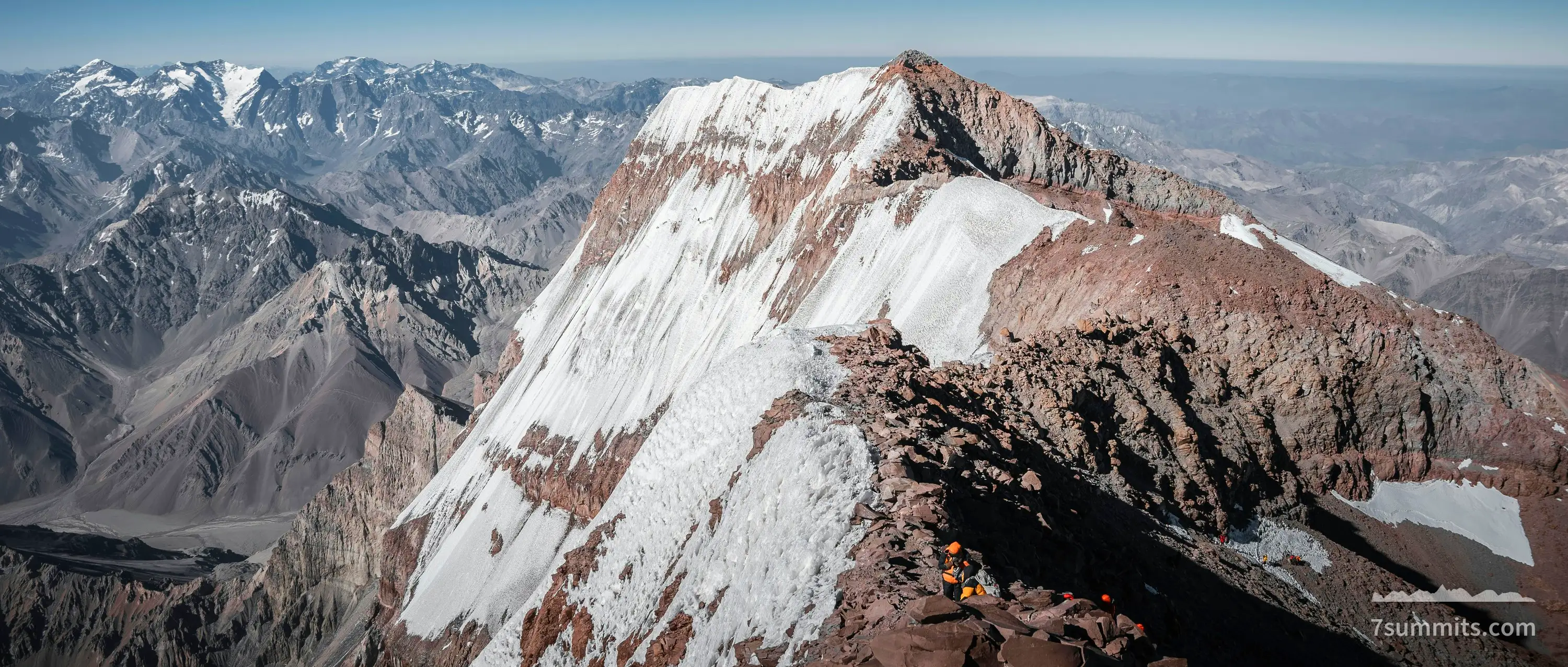
Aconcagua, 6,961 m, is the highest mountain in the Americas and the highest anywhere outside Asia. It stands in the Andes of Argentina, a few hours by road from Mendoza and its vineyards, and close enough to the Chilean border that Pacific weather comes straight over the top of it. A 500-year-old Inca child was found buried at 5,300 m on its flanks, so people were high on this mountain long before mountaineering existed.
The Swiss guide Matthias Zurbriggen made the first known ascent alone on 14 January 1897, on an expedition led by Edward FitzGerald, who turned back sick below the top. The Normal Route he took is still the way most people go: a long, steep walk over scree and snow with no ropes and no technical climbing, which is why Aconcagua is often called the highest trekking peak in the world. The Polish Traverse is the quieter alternative.
Do not let the word trek fool you. The climb takes about three weeks, with every camp carried up on your own back, and summit day starts near 6,000 m in cold that can fall to minus 30 degrees in the wind. Thin air is the main problem and the main killer: more people die on Aconcagua than on Denali, nearly all from altitude sickness or cold rather than from falling. Am I ready for it after Kilimanjaro is the question most newcomers should ask.
Aconcagua is the usual second or third summit, the place where a hill walker becomes an expedition climber. The season runs from December to February, the permit is bought in Mendoza, and a guided climb costs a fraction of what the three big ones do. The Aconcagua guide has the routes and the acclimatisation plan; the operators and the route map are beside it.
 Denali
La más alta: fría, autosuficiente, glaciada.
- Altitud
- 6190 m20.308 ft
- Dónde
- North America · United States
- First climbed
- 1913
- Dificultad
- Muy difícil
- Mejor temporada
- May–Jun
- Duración del viaje
- 17–21 días
- Costo típico
- 9000 US$
- Qué lista
- Ambas
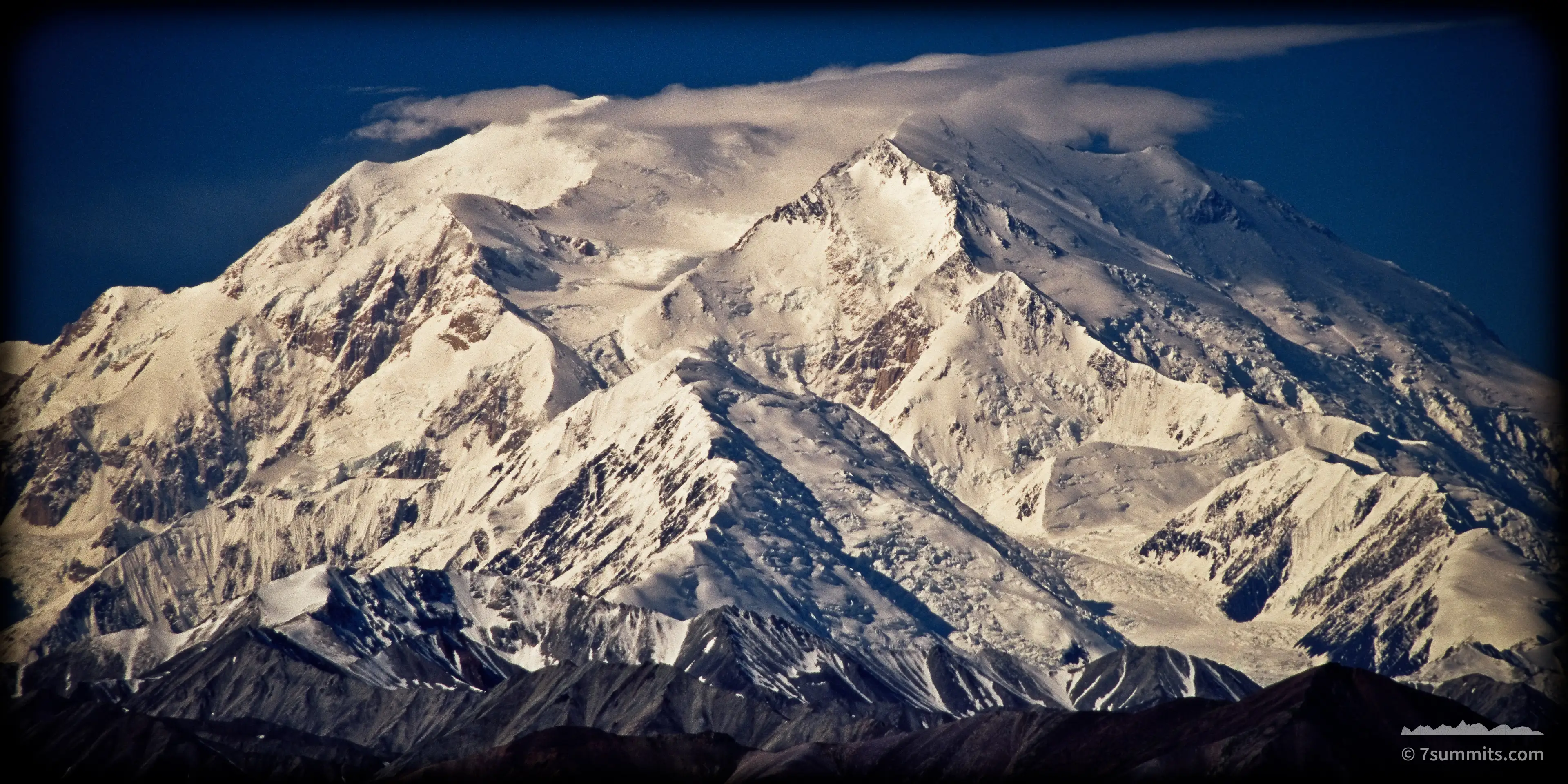
Denali, 6,190 m, is the highest mountain in North America and, measured from its base, one of the biggest on Earth: it rises some 5,500 m above the Alaskan lowlands, more than Everest rises above its own base camp. The name is Koyukon for the high one. Officially it was Mount McKinley from 1917 until 2015, which is why two names still turn up.
The first ascent came on 7 June 1913, when Walter Harper, a young Alaska Native, led Hudson Stuck’s party to the top. Today around a thousand climbers a year try it, almost all by the West Buttress route, and about half succeed. There are no porters here: climbers drag their own sleds and carry their own loads from the glacier landing strip at 2,200 m, moving camp by camp over three weeks.
The cold is the mountain’s signature. Denali stands just south of the Arctic Circle, so its high camp at 5,200 m feels like 6,500 m nearer the equator, and minus 40 degrees with storm winds is normal in May. The route crosses crevassed glaciers for its whole length, so everyone is roped, and crevasse rescue is a skill you must bring with you. What experience you need first matters more here than on any other peak except Everest.
Denali is also the only one of the 7 summits where the park itself decides who may guide you: a short, closed list of concession holders. The National Park Service runs the registration, weighs your rubbish and makes you carry it down. The Denali guide, the operators and the route map cover the rest.
 Kilimanjaro
El gigante accesible de África.
- Altitud
- 5895 m19.341 ft
- Dónde
- Africa · Tanzania
- First climbed
- 1889
- Dificultad
- Moderado
- Mejor temporada
- Ene–Mar, Jun–Oct
- Duración del viaje
- 7–9 días
- Costo típico
- 3500 US$
- Qué lista
- Ambas
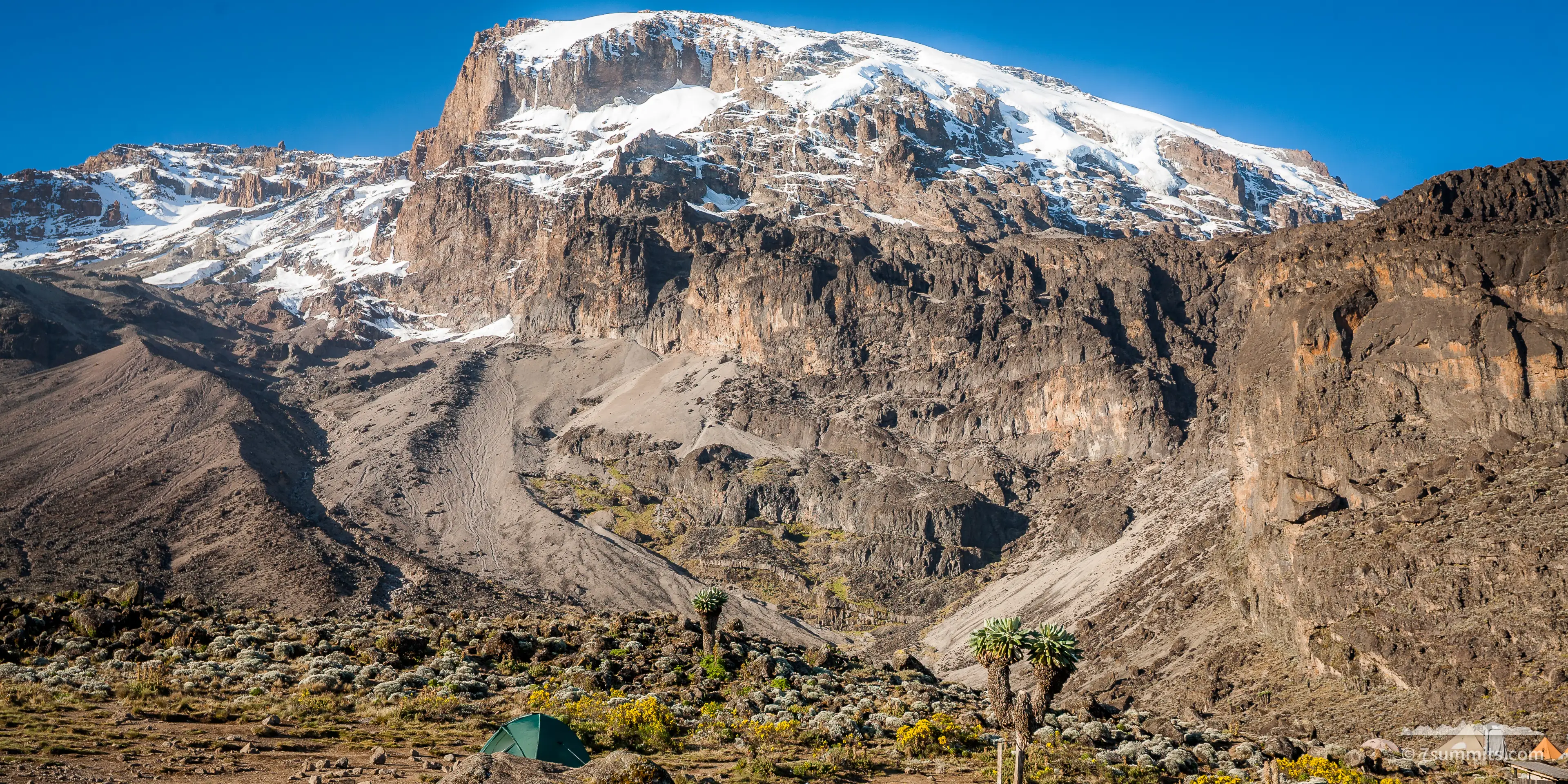
Kilimanjaro, 5,895 m, is the highest mountain in Africa and the highest free-standing mountain in the world: a dormant volcano rising alone from the plains of northern Tanzania, with glaciers on top three degrees south of the equator. Its summit crater, Kibo, is one of three volcanic cones; the highest point is Uhuru Peak, Swahili for freedom. How it formed is a story of the East African Rift.
Hans Meyer, Ludwig Purtscheller and their guide Yohani Kinyala Lauwo reached the top on 6 October 1889. Tens of thousands of people a year follow them now, and none of them needs a rope: Kilimanjaro is a walk, through five climate zones from rainforest to arctic summit, on routes with names like Marangu, Machame and Lemosho. Tanzanian law requires a licensed guide and a crew of porters and cooks for every climber, which is also what makes a climb here a living for hundreds of local families.
The difficulty is the speed. Most itineraries go from 1,800 m to the summit in five to seven days, far faster than the body likes, and altitude sickness is why so many walkers turn back and why a few die each year. The single best thing you can do is choose a longer route and go slowly; the best months are January to March and June to October, between the rains.
For most people Kilimanjaro is the first of the 7 summits, and for many the only one. A climb takes a week, costs less than any other peak except Kosciuszko, and can end with a safari. The Kilimanjaro guide covers the routes and what to pack; the operators page explains why prices differ so much, and the route map shows every way up.
 Elbrus
La más alta de Europa, un volcán glaciado.
- Altitud
- 5642 m18.510 ft
- Dónde
- Europe · Russia
- First climbed
- 1874 (west)
- Dificultad
- Moderado
- Mejor temporada
- Jun–Sep
- Duración del viaje
- 8–10 días
- Costo típico
- 4000 US$
- Qué lista
- Ambas
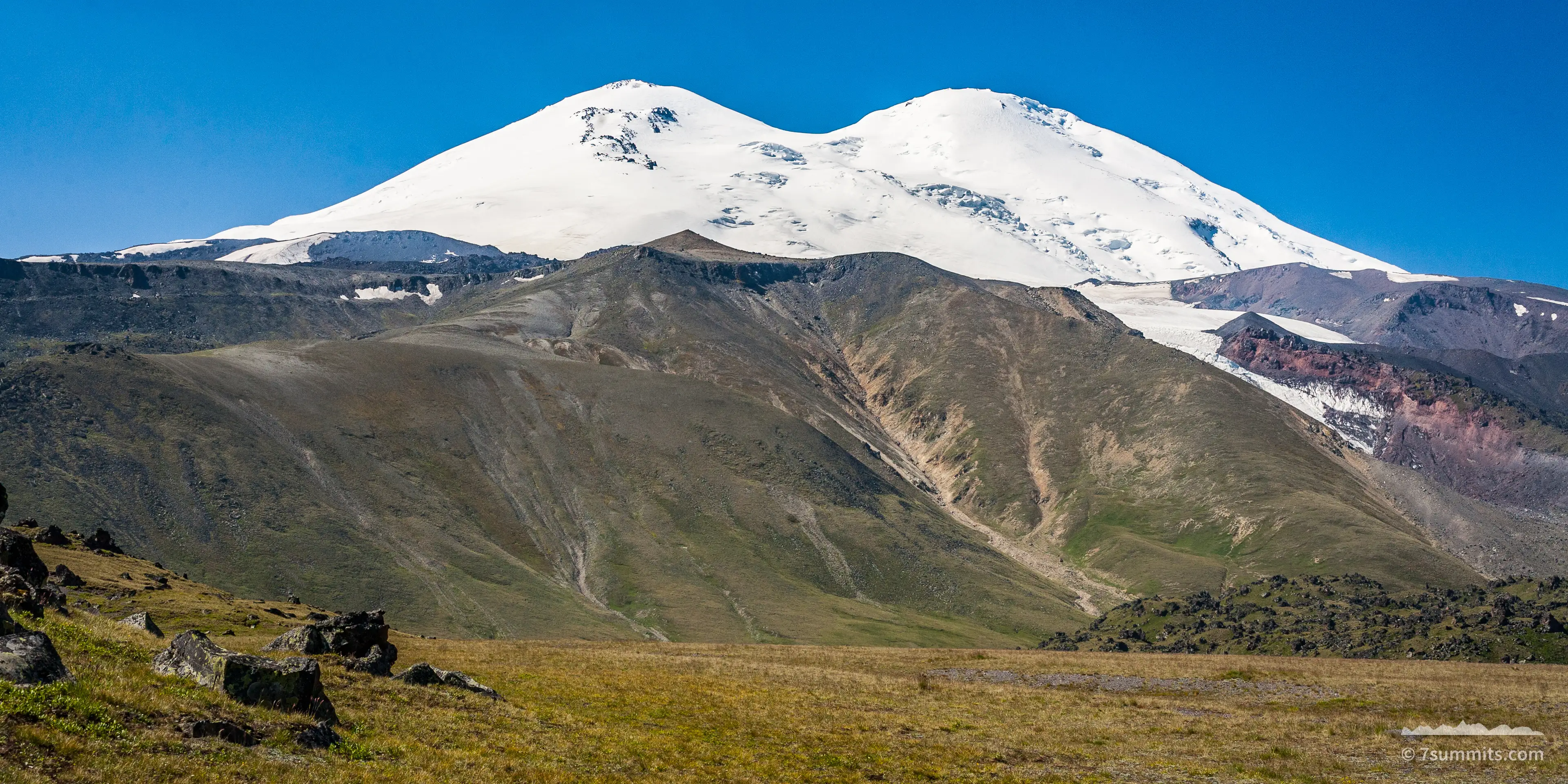
Elbrus, 5,642 m, is the highest mountain in Europe, if you accept the usual line that puts the Caucasus in Europe; whether it really is, and why not Mont Blanc, is the oldest argument in the 7 summits after Kosciuszko. It is a dormant volcano in southern Russia near the Georgian border, with two summits, the west and the east, 21 m lower, and 22 glaciers flowing off them.
A Karachay guide, Killar Khashirov, reached the lower east summit in 1829 with a Russian scientific expedition. The true summit waited until 28 July 1874 for an English party, Frederick Gardiner, Florence Crauford Grove and Horace Walker, with the Swiss guide Peter Knubel and the local guide Akhia Sottaiev. Today cable cars and snowcats carry climbers high up the south side, so summit day on the normal route is a long snow walk from the huts rather than an expedition.
That ease is deceptive. Elbrus makes its own weather, whiteouts arrive in minutes on slopes with no features, and climbers who wander off the marked route into the crevasses are the mountain’s main victims; by most estimates it kills more people a year than Everest. Crampons and an ice axe are needed, and the willingness to turn round. The south or the north route is the first choice; the north is wilder, longer and has no lifts.
Elbrus is the natural first or second summit for Europeans, a ten-day trip between June and September that costs about the same as Kilimanjaro. Since 2022 the question is less the mountain than the country; whether you can still go, and should, is answered in the FAQ and kept up to date. The Elbrus guide, the operators and the route map cover the climb itself.
 Vinson
La remota cumbre antártica.
- Altitud
- 4892 m16.050 ft
- Dónde
- Antarctica
- First climbed
- 1966
- Dificultad
- Difícil
- Mejor temporada
- Nov–Ene
- Duración del viaje
- 12–18 días
- Costo típico
- 48.000 US$
- Qué lista
- Ambas
Vinson, 4,892 m, is the highest mountain in Antarctica, in the Ellsworth Mountains about 1,200 km from the South Pole. Nobody had seen it until a US Navy aircraft flew over in 1958, which makes it the only one of the 7 summits discovered within living memory. In the Antarctic summer the sun never sets on it, the air is drier than any desert, and the summit stays below minus 20 degrees even on a good day.
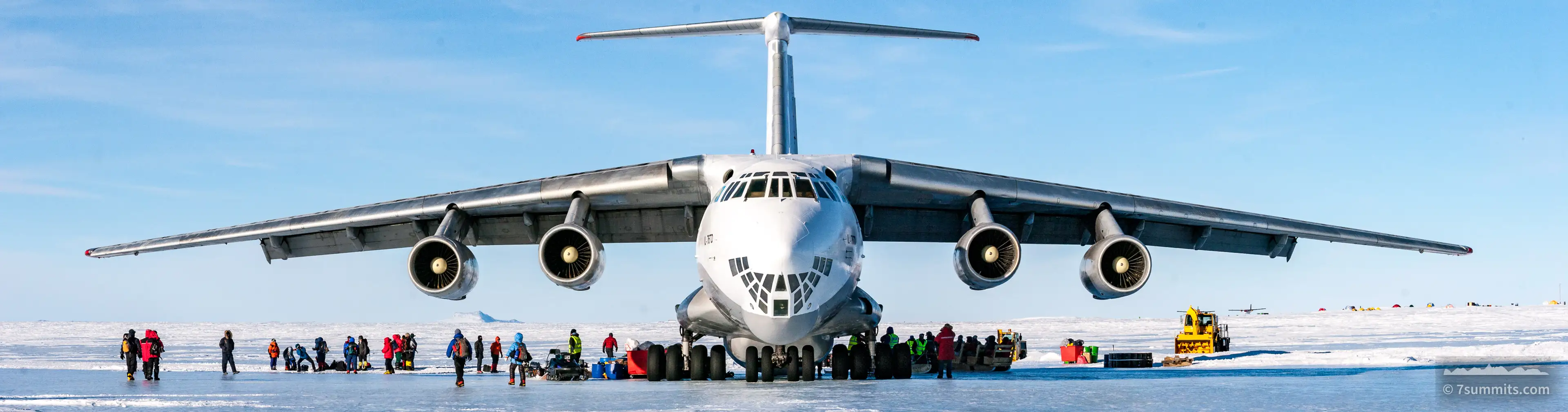
An American expedition led by Nicholas Clinch made the first ascent on 18 December 1966. Only a couple of thousand people have followed, mainly because getting there is the climb: a chartered flight from Punta Arenas in Chile to the blue-ice runway at Union Glacier, then a ski plane to base camp, all of it run by one company, Antarctic Logistics and Expeditions, and all of it at the mercy of the weather. Spare days for storms are not optional.
The climbing itself is moderate: a glacier walk to a high camp, a fixed rope up a headwall of about 1,200 m, and a long summit ridge. What makes it serious is the cold, the isolation and the fact that no helicopter is coming. Everyone is roped for the crevasses, and the gear list is the warmest of the eight. How to train for it is mostly about cold and about hauling a sled.
Vinson is usually one of the last summits, because of the price: the flights alone make it the second most expensive of the eight, and the season is short, from late November to January. No country issues a permit, but the Antarctic Treaty paperwork exists. The Vinson guide, the operators and the route map have the details.
 Carstensz Pyramid
La séptima del listado Messner, roca técnica.
- Altitud
- 4884 m16.024 ft
- Dónde
- Oceania · Indonesia
- First climbed
- 1962
- Dificultad
- Muy difícil
- Mejor temporada
- Todo el año
- Duración del viaje
- 10–14 días
- Costo típico
- 18.000 US$
- Qué lista
- Lista Carstensz (Messner)
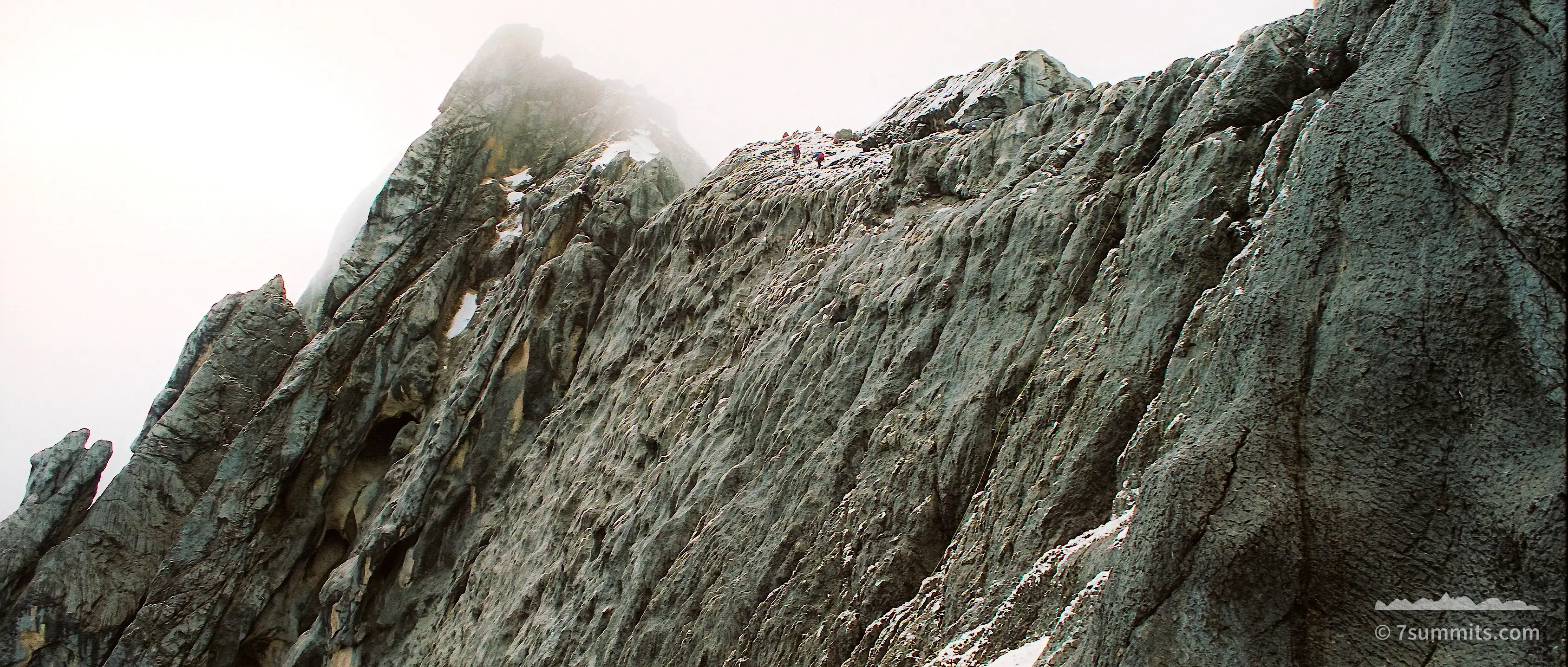
Carstensz Pyramid, 4,884 m, is the highest mountain in Oceania and the highest island peak on Earth. It stands in the Sudirman Range of Papua, the Indonesian half of New Guinea, where limestone walls rise out of jungle and, until recently, out of equatorial glaciers; the last of them are nearly gone. Its Indonesian name is Puncak Jaya. A Dutch sailor, Jan Carstenszoon, reported snow near the equator in 1623 and was laughed at for two centuries.
Heinrich Harrer, of Seven Years in Tibet, made the first ascent on 13 February 1962 with Philip Temple, Russell Kippax and Bert Huizenga. This is the mountain Reinhold Messner put on his list in place of Kosciuszko, arguing that New Guinea sits on Australia’s continental shelf and that a real seventh summit should need real climbing. It does: the normal route is rock climbing on fixed ropes, with several abseils and a Tyrolean traverse across a gap in the summit ridge.
The approach is the other half of the story. The mountain stands beside the Grasberg mine, one of the largest gold and copper mines in the world, in a region with a long-running independence conflict, so permits change from year to year and most climbers now fly in by helicopter rather than walk for a week through the jungle. Who is allowed to take you has a precise answer.
It can be climbed in any month, it rains most afternoons, and a trip takes about two weeks. Carstensz is the one summit where rock skills matter more than altitude, so people often fit it in after Kilimanjaro and before Denali. The Carstensz guide, the operators and the route map are where to continue.
 Kosciuszko
El séptimo de la lista Bass: una caminata sencilla.
- Altitud
- 2228 m7310 ft
- Dónde
- Australia
- First climbed
- 1840
- Dificultad
- Principiante
- Mejor temporada
- Nov–Mar
- Duración del viaje
- 1 día
- Costo típico
- 500 US$
- Qué lista
- Lista Kosciuszko (Bass)
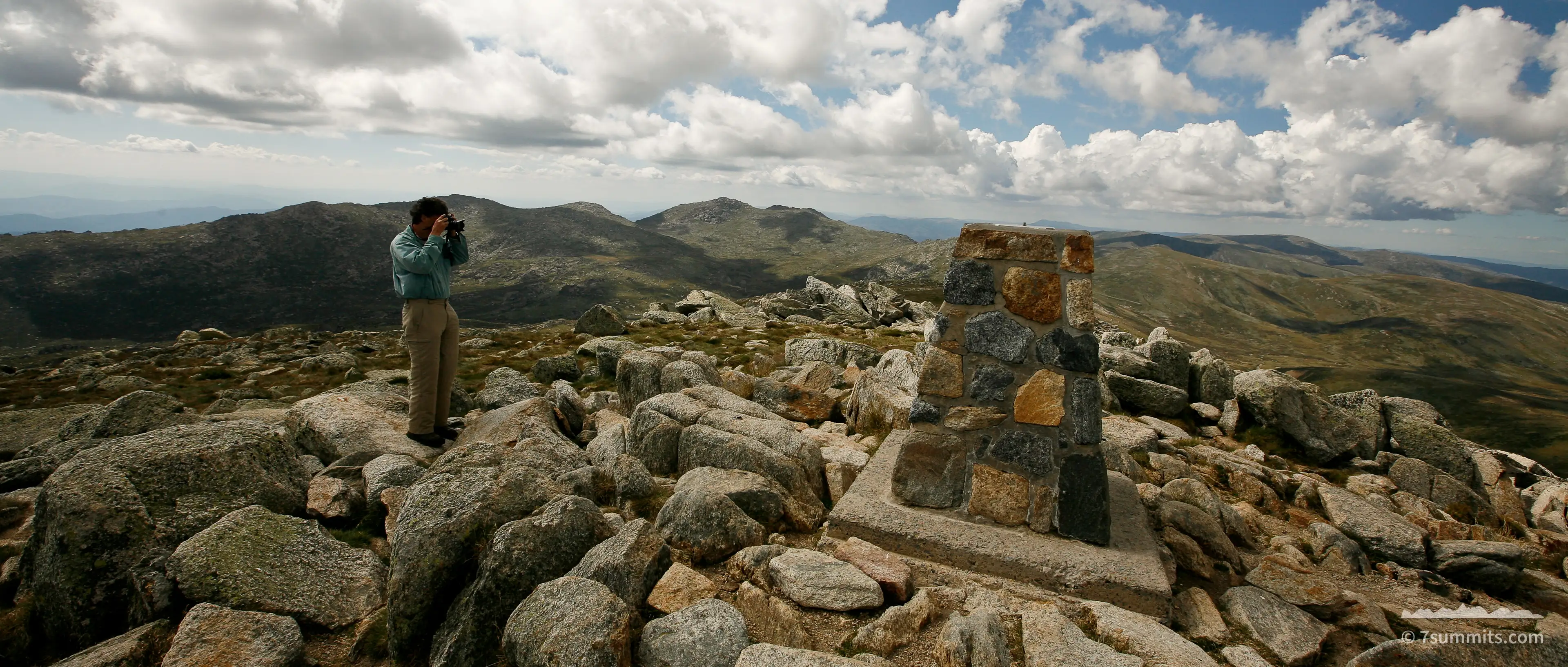
Kosciuszko, 2,228 m, is the highest mountain on the Australian mainland, a rounded granite summit in the Snowy Mountains of New South Wales, about five hours by road from Sydney or Canberra. The Polish explorer Paweł Strzelecki climbed it in 1840 and named it after Tadeusz Kościuszko, a hero of two revolutions, because the shape reminded him of the general’s burial mound in Kraków.
This is the mountain Dick Bass counted as his seventh when he completed the first round of the 7 summits in 1985, and it has been argued over ever since: what about Kosciuszko? is the question every finisher gets asked. The honest answer is that Australia is a continent and this is its highest point; the equally honest answer is that it is a walk.
In summer a chairlift from Thredbo lifts you to 1,930 m and a raised metal walkway carries most of the remaining 300 m of ascent, so families do it in trainers in a few hours; from Charlotte Pass the walk is longer and wilder. In winter it is snowbound and a real, if gentle, ski or snowshoe tour. Weather is the only danger, and on the Main Range it can turn in an hour.
Most climbers who count Kosciuszko also climb Carstensz Pyramid, so that both lists are complete; 254 finishers have done exactly that. A day here costs almost nothing beyond the national park’s entry fee. The Kosciuszko guide covers the walks; the operators, the route map and the Library shelf are beside it.
Where to go next: the eight guidebooks are the long version of each portrait, the operator directory compares the companies that guide them, the Library has the books and films, and the finisher record has everyone who has climbed all of them. Finished them yourself? Apply for the list; it is free.