







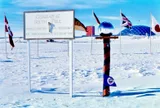

South pole
The 7 summits
What is the Explorers Grand Slam?
The Explorers Grand Slam, also called the Adventurers Grand Slam, is the 7 summits plus the North Pole and the South Pole. Most people who complete it ski to each pole over the last degree of latitude, about 111 km (69 miles). That is the standard guided trip at both ends of the earth. A few ski all the way from the coast, and the record keepers list them separately. Every Grand Slam finisher we know of is in our finisher records, and each name on this page links to their record.
Last degree, coast, or something in between
How you reach the poles decides which list you are on. The mountains are the same for everyone, with one choice: the seventh peak can be Kosciuszko or Carstensz Pyramid, so either version of the 7 summits counts.
The last degree
A last-degree trip starts at 89° and skis the final 111 km (69 miles) to the pole, usually in a week to ten days with a guide. In Antarctica the plane comes from Union Glacier, the same camp that serves Vinson, so many climbers do Vinson and the South Pole in one season. In the Arctic the start was Barneo, a Russian-run camp built on the drifting sea ice each April and reached by plane from Svalbard. Barneo has not opened since 2018: a political dispute stopped the 2019 season, the pandemic 2020 and 2021, the war in Ukraine 2022, and every season since has been cancelled, 2026 included. Since then a North Pole last degree has been close to impossible to buy.
The full journeys
The original idea was to ski to each pole from the coast. To the South Pole the usual start is Hercules Inlet, about 1,130 km (700 miles) and six weeks or more on skis; a few start further out, such as Berkner Island. To the North Pole the starts are Ward Hunt Island in Canada, about 775 km (480 miles) in a straight line, or Cape Arktichesky in Russia, nearer 1,000 km (620 miles). On the sea ice the real distance is much longer, because the ice drifts and breaks up under the skis.
In Antarctica the record keepers also ask which coast you started from. The Polar Expeditions Classification Scheme calls the seaward edge of an ice shelf the outer coastline and the line where the shelf meets the land the inner coastline. That is why the lists below have a middle group: one pole skied from the coast, the other from an inner start or over the last degree.
What does not count
Flying to a pole, or reaching the North Pole on an icebreaker cruise, does not count. The American Alpine Club, The Explorers Club and guiding companies such as International Mountain Guides set the minimum at skiing the last degree to each pole.
Bigger versions
Some add more. The true Explorers Grand Slam adds all 14 mountains over 8,000 m26,247 ft, and Park Young-seok of South Korea was the first to complete it, in 2005. A true Adventurers Grand Slam also takes in the North and South magnetic poles. The Three Poles Challenge is only Everest and the two poles; Erling Kagge of Norway was the first, in 1994. The Polar Hat Trick is the two poles plus a crossing of the Greenland ice cap, and Koen Wittevrongel of Belgium did his Grand Slam with a Greenland crossing along the way: the North Pole in 2009, Greenland in 2011 and the South Pole in 2015.
Who was first
Heo Young-ho of South Korea finished first, at the South Pole in January 1997, after skiing there from Berkner Island. Fedor Konyukhov was second, finishing on Denali in May 1997, and David Hempleman-Adams third, at the North Pole in 1998.
Since then the records have been about speed and age. Stuart Smith of Texas was the first American, in 2005. Richard Parks of Wales did it in seven months in 2011, the first inside one calendar year, and Vanessa O'Brien was the first woman to do the same, in eleven months, finishing on 16 April 2013. Jing Wang of China took 142 days in 2014, and Colin O'Brady of the United States 139 days in 2016, the fastest on record. Marin Minamiya of Japan was 20 when she finished in April 2017, the youngest. Ryan Waters of the United States skied both poles the full distance without resupply or outside help.
How many have done it
We know of 77, a small fraction of everyone who has climbed the 7 summits. Wikipedia lists 75, and two more have been reported elsewhere: Koen Wittevrongel of Belgium, and Lýður Guðmundsson of Iceland, whose Grand Slam ended on Everest in May 2019, as the Icelandic papers reported at the time. Every one of them is in our finisher records. A few are marked provisional while we confirm their dates. Their stories appear on this site as they come up: Andrea Cardona of Guatemala is one of them.
The three lists below follow Wikipedia's groups, each in order of completion.
Both poles from the coast
Young-Ho Heo (South Korea), Fedor Konyukhov (Russia), David Hempleman-Adams (United Kingdom), Young-Seok Park (South Korea), Bernard Voyer (Canada), Cecilie Skog (Norway), Max Chaya (Lebanon), Stuart Smith (United States), Ryan Waters (United States), Johan Ernst Nilson (Sweden), Wilco van Rooijen (Netherlands) and François Bernard (France).
One pole from the coast, the other from an inner start or the last degree
Haraldur Örn Ólafsson (Iceland), Swee-Chiow Khoo (Singapore), Arnold Witzig (Switzerland and Canada), Alison Levine (United States), Mostafa Salameh (Jordan), Newall Hunter (United Kingdom), Zhang Liang (China), Grażyna Machnik (United Kingdom and Poland), Jaco Ottink (Netherlands), Jérôme Brisebourg (France), Mark Shuttleworth (United Kingdom) and Inge Meløy (Norway).
Both poles over the last degree
Sean Disney (South Africa), Vaughan De La Harpe (South Africa), Sibusiso Vilane (South Africa), Arthur Marsden (South Africa), Andy van der Velde (South Africa), Vernon Tejas (United States), Will Cross (United States), Lei Wang (United States and China), Neil Laughton (United Kingdom), Jo Gambi (United Kingdom), Rob Gambi (Australia), Randy Peeters (United States), Yong-Feng Wang (China), Ci Luo (China), Liu Jian (China), Wang Shi (China), Kin Man Chung (Hong Kong, listed by Wikipedia as Zhong Jianmin), Fei-Bao Jin (China), Wang Qiuyang (China), Suzanne K. Nance (United States), Rich Parks (United Kingdom), Andrea Cardona (Guatemala), John Stephen Dahlem (United States), Matthew Holt (United Kingdom), Leonard Stanmore (Canada), Cheryl Bart (Australia), Vanessa O'Brien (United States and United Kingdom), Sebastian Merriman (United Kingdom), Wang Jing (China), Tashi Malik (India), Nungshi Malik (India), Omar Samra (Egypt), Masha Gordon (United Kingdom and Russia), Colin O'Brady (United States), John Moorhouse (United Kingdom), Victor Lance Vescovo (United States), Sean Swarner (United States), Marin Minamiya (Japan), Michael Grigsby (United States), Julia Elinor Schultz (Germany), Muhamad Muqharabbin Mokhtarrudin (Malaysia), Michael Gibbons (United States), Nikolaos Magitsis (Greece), Josu Feijoo (Spain), Jim Holliday (United States), Joel Schauer (United States), Alexander Pancoe (United States), Leifur Örn Svavarsson (Iceland), Khai Nguyen (Canada and United States), Taylor Sweitzer (United States) and Frank Fumich (United States).
Reported elsewhere
Koen Wittevrongel (Belgium), with a Greenland crossing, and Lýður Guðmundsson (Iceland), whose polar journeys we have not yet found described.
Where this comes from
Explorer's Grand Slam, Wikipedia, with its list of finishers and their sources
A to Z definitions, Polar Expeditions Classification Scheme, for inner and outer coastlines and the last degree
Barneo, Wikipedia, on the North Pole ice camp and its cancelled seasons
North Pole expeditions, Icetrek, on the cancelled 2026 season
Zeven toppen, Dutch Wikipedia, for Koen Wittevrongel's polar journeys