







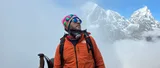

Michał Leksiński finished the 7 summits on Denali on 3 June 2026, at his third attempt on that mountain. The Polish speaker and former illusionist climbed all nine peaks of the Korona Ziemi for the Happy Kids Foundation, which supports children growing up in care. Along the way he waited a week for a helicopter to Carstensz, carried a flag signed by the children to the top of Everest, and was spokesman for a winter attempt on K2.
Michał Leksiński is a Polish climber, speaker and author who completed the 7 summits on Denali on 3 June 2026, at his third attempt on that mountain. He climbed every peak for the Happy Kids Foundation (Fundacja Happy Kids), which supports children growing up in care in Poland, under the name 7 Happy Summits. His list is the Polish Korona Ziemi of nine peaks: both Carstensz Pyramid and Kosciuszko for Oceania, and Mont Blanc as well as Elbrus for Europe.
The New Year on top of Africa
The project began on Kilimanjaro in the first minutes of 2017. Leksiński and his group had walked the Machame route for four days in rain, and the mountain that was meant to greet them with sun gave them snow instead. He felt the altitude on the way up: lethargy, no appetite and a headache.
The plan was simple, in his words: to greet the New Year on the summit. The group left a few minutes after midnight and reached Stella Point in under eight hours. At 9:15 local time on 1 January 2017 they stood on Uhuru Peak, and the colourful Happy Kids flag went up on the roof of Africa. "I promised the Foundation, and I kept my word," he wrote afterwards.
The climb also opened the celebrations of the foundation's 15th year, and every expedition after it was dedicated to the children in its care.
A former illusionist in the Alps
Leksiński grew up in Szczecin, in north-west Poland near the German border, and built his working life in Warsaw. He studied political science and is a former illusionist. His career is in public relations and public affairs: in 2018 he was Director of Public Relations at CEC Government Relations, and he has since been Chief Operating Officer of CEC Group.
The mountains came through a friend, who suggested a trip to the Alps to try Mont Blanc. The mountain let him up only at the third attempt. On the top, he has said, he understood how many obstacles he had overcome to get there, and the passion was born. "It wasn't a hobby," he said. "It was the moment I learned to breathe again."
Elbrus, Aconcagua and a pyramid with nobody on it
Elbrus followed in June 2017. The summit push started at 2:30 on a Thursday morning. On the mountain, heavy snow with no wind cut visibility to a few metres, and at one point he felt a crunch in his right leg. Nothing hurt and he could still move, so he slowed his pace and kept going. A unit of 15 Russian soldiers was on the mountain at the same time, and some of them were visibly struggling with the altitude.
Aconcagua came in February 2018, by the Horcones valley, Plaza de Mulas and Nido de Cóndores. At one point hail fell from a cloudless blue sky. Not everyone in the group of a dozen or so was cleared for the summit push, which started at about five in the morning. Leksiński reached the top and, as he says happens on every summit, started crying almost at once.
Carstensz Pyramid took patience. In August 2019 the weather kept the helicopter to base camp on the ground for seven days. When it finally flew, only three climbers were at base: a Spaniard, an American and Leksiński. On 9 August 2019 the three of them had the mountain to themselves.
The route is nearly 600 metres of steep, razor-sharp limestone, with the Tyrolean traverse on the summit ridge. They had no wind and a clear blue sky, and reached the summit after four hours, then came down in a series of quick abseils. The Happy Kids flag, he wrote, had flown in one of the least accessible places in the world.
Four days later, on 13 August 2019, he was on Kosciuszko in the Australian winter. He went alone from Thredbo, rode the chairlifts to Eagles Nest and walked on in hired snowshoes. A guide he passed told him nobody had been able to reach the summit for three days because of the weather. The round trip took about two and a half hours, and he had the top to himself for 15 minutes.
Spokesman for a winter attempt on K2
Between his own climbs, Leksiński worked on a winter expedition. Janusz Majer asked him to be the press spokesman of the Polish National Winter Expedition to K2 in 2017/18, and he also served as its project manager. K2 had never been climbed in winter. The Polish team did not reach the top, and the first winter ascent came in January 2021.
That work fed two more projects. In 2018 he created and led a postgraduate course in the marketing of extreme sports at Collegium Civitas in Warsaw. In 2021 he published a book, "Projekt: Wyprawa #travelmarketing" (Bezdroża), on how an expedition can build a story that brings in partners and the media.
Vinson, and Everest with the children's flag
He reached Vinson in Antarctica on 3 January 2023, which left two peaks. The first of them was Everest.
Before he left for Nepal in the spring of 2025, the children of the foundation gave him a flag covered in their signatures to carry to the top. He also set out to raise 45,000 złoty for the foundation's programme for young people leaving care. The money pays for psychological, educational and vocational support as they start living on their own.
The expedition took almost two months. He climbed with a Seven Summit Treks team by the South Col route from Nepal, using bottled oxygen, and reached the summit early on 18 May 2025.
He remembers one moment in particular. "At minus 30 degrees, tired and drained, I kept telling myself I was only a few steps from the goal." For him the climb meant more than sport. "Everest is a symbolic road," he said.
He told the story of that climb in a TEDx talk at Gdańsk University of Technology in late 2025, under the title "Every step is an answer. My path to Everest". The talk is in Polish; YouTube offers subtitles.
Nothing is loaded from YouTube until you press play.
Denali, three times
Denali was the mountain that made him wait. In 2018 he went with an agency, and a snowstorm stopped him about 70 metres below the summit.
In June 2023 he went back with two friends and no guide. They flew in by ski plane from Talkeetna after a briefing with the park rangers, and hauled sleds of 30 kg each up the glacier. At Windy Corner he suddenly sank to his waist in snow.
On Squirrel Hill, at about 3,500 metres, one of his partners shouted that he was falling. Trying to hold more than 200 kg on the rope, Leksiński dislocated a shoulder, the force coming through the strap of his pack. Storms kept the team in the tent for three days, with waist-deep snow, gusting wind and avalanche risk. The weather window passed. "Everyone came back safe, that matters most," he wrote. "The mountain will wait."
It waited three more years. In June 2025 he said he meant to finish in 2026, ten years after the project began. At 20:30 local time on 3 June 2026 he reached the summit of Denali, the ninth and last peak of his Korona Ziemi.
Talks about falling
Leksiński now speaks for a living, and much of what he says is about failure. His 2023 TEDx talk at TEDxSGH in Warsaw was called "The Power of Falling", and it treats setbacks as part of the route to a summit, in the mountains and at work. It is also in Polish.
Nothing is loaded from YouTube until you press play.
He describes his own method as passion, humility, steady work and reflection. "Success is not a straight line up," he has said. "It's a zigzag, full of doubt, fatigue and sometimes loneliness."
He still has a list of his own beyond the 7 summits. He has climbed in the Pamirs and the Andes, travelled to more than 50 countries, and collects the world's highest bungee jumps. His plan after Denali was a bungee jump from a helicopter over a volcano in Chile.
For the foundation, the climbs were always the means. Each expedition raised money and attention for the children in its care, and the foundation has also taken some of its young people into the mountains with him to learn climbing. "Real money, real help, and a symbol," he said of the project. "Because the summits are the backdrop."
Comment on this post on the forum →
All parts of Finisher Files
- Part 1: Carlos Soria, from Elbrus at 29 to Kilimanjaro at 70
- Part 2: Andrea Cardona: 7 summits and both poles by 30
- Part 3: Gangaamaa Badamgarav: Mongolia’s first 7 summiteer
- Part 4: Sibusiso Vilane: from a nature reserve to the 7 summits
- Part 5: Cheryl and Nikki Bart: a mother and daughter on the list
- Part 6: Gary Johnson: the governor who finished on Vinson
- Part 7: Mostafa Salameh: a refugee's son on the 7 summits
- Part 8: Michał Leksiński: nine summits for children in care (you are reading this)
Image credits: Photo: michalleksinski.pl · modified