








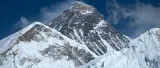

At the 2026 UIAA General Assembly in Kathmandu, the Nepal Mountaineering Association asked for international recognition of six Himalayan summits above 8,000 metres as separate mountains. Four sit in the Kanchenjunga massif and two on the Lhotse ridge near Everest. If all six were accepted, the world list would grow from 14 to 20, with Nepal holding 14 of them. The proposal is still subject to international assessment.
The six peaks on the list
The Nepal Mountaineering Association (NMA) used the 2026 General Assembly of the UIAA in Kathmandu to ask for international recognition of six summits above 8,000 metres as mountains in their own right. The heights presented with the proposal:
- Yalung Khang, 8,505 m27,904 ft
- Kanchenjunga South, 8,476 m27,808 ft
- Kanchenjunga Central, 8,473 m27,799 ft
- Lhotse Middle, 8,410 m27,592 ft
- Lhotse Shar, 8,400 m27,559 ft
- Yalung Khang West, 8,077 m26,499 ft
Four of the six belong to the Kanchenjunga massif. The other two sit on the Lhotse ridge, in the same massif as Everest.
NMA president Phur Gelje Sherpa presented profiles of the peaks at the inaugural ceremony, as The Tourism Times reported. He said the government of Nepal has already endorsed the six, and that they are listed on its website.
What recognition would change
Eight of the 14 internationally recognised eight-thousanders stand in Nepal or on its border: Everest (8,848.86 m29,032 ft), Kanchenjunga (8,586 m28,169 ft), Lhotse (8,516 m27,940 ft), Makalu (8,463 m27,766 ft), Cho Oyu (8,201 m26,906 ft), Dhaulagiri I (8,167 m26,795 ft), Manaslu (8,163 m26,781 ft) and Annapurna I (8,091 m26,545 ft). Nepali sources often use Sagarmatha for Everest.
If all six proposed summits were accepted, the world list would rise from 14 to 20. Nepal would then hold 14 of them. Nepal's own national records already count 14 peaks above 8,000 metres, following a revision by the Department of Tourism in 2025, as DD News reported. Six of those still lack separate international standing.
The practical machinery is already in place. Nepal issues climbing permits for these peaks, and climbers who reach them receive certificates. What is missing is the international classification.
The argument Nepal is making
Sherpa's case rests on identity rather than arithmetic. Each of the six has its own name, its own geographical features and its own route to the top, and local communities treat them as distinct peaks. He told the assembly that reaching one summit is not the same as reaching the next, and that each one is a separate goal needing its own expedition.
He also made the point that the aim is not simply a longer list. What the NMA wants is a fair and professional evaluation based on local names, geography and separate climbing lines, Ratopati reported. He added that international consensus is needed before a summit can be counted as a separate mountain, and that Nepal should lead the work on a clear scientific method for classifying mountains.
The proposal is backed by a technical assessment. An expert team led by Madhusudan Adhikari was formed to prepare the justifications, and Nepal has asked for a formal international review of the six summits on geographical, scientific and mountaineering grounds. Sherpa noted that earlier NMA presidents and committee members had raised the question for years without it being settled.
The critique from the professionals
This is not a new argument, and it has not gone unanswered. A near-identical Nepali push surfaced in 2023. Fellow 7 summits chronicler Eberhard Jurgalski tracks Himalayan summit data at 8000ers.com. He told ExplorersWeb at the time that the peaks "remain 'no-mountains,' just subsidiary peaks." His method ranks a summit by prominence, the height it rises above the lowest ridge connecting it to any higher point. It also uses dominance, that prominence as a share of the peak's total height. None of the six clears the threshold used for independent 8,000ers by that measure. It also falls short of the 30-metre drop the UIAA itself requires to count a separate 4,000-metre peak in the Alps.
Nepal's own definition of a separate peak does not use prominence at all. Ang Tshiring Sherpa, a former NMA president, told The Kathmandu Post that a summit counts as independent once the col between it and its neighbour runs at least 500 metres deep and it has a route of its own. He also linked recognition to tourism, telling the paper that the lobbying is meant to boost business for Nepal. The two sides are arguing from different definitions of a mountain, not different facts about these six summits.
The proposed recognition remains subject to international assessment and acceptance. No decision was announced in Kathmandu.
The assembly itself
The General Assembly is where UIAA member federations settle questions of role, activities and budget, and where elections are held. This one drew 95 delegates from 45 countries across five continents, hosted by the NMA. It was the third time Nepal has hosted, after 1982 and 2011. The 1982 gathering produced the Kathmandu Declaration, which called for protection of mountain environments, natural resources and the cultural heritage of mountain communities.
The third UIAA Mountain Safety Symposium ran in Kathmandu on 27 and 28 October as a side event. More than 60 mountaineers, doctors, rescuers, paramedics and insurance representatives took part. Practical demonstrations and field training were held at the Scout premises in Kakani, Nuwakot.
Climate change ran through the opening speeches. Minister for Culture, Tourism and Civil Aviation Khadak Raj Poudel said the impact of climate change on the Himalayas needs serious consideration now, and that the issue should be raised with the world. UIAA president Peter Muir said the recent natural disasters in Nepal were a hard reminder of how severe the problem has become, and he expressed solidarity with mountain communities. He pointed to the UIAA's Give Back to Climbing donation initiative and to a focus on bringing young people into the sport.
What it means for climbers
Nothing in the proposal changes a route, a permit or a summit day. Lhotse Shar and Lhotse Middle are already climbed from the Everest side of the range, and anyone planning a season in the Khumbu will see both from the Western Cwm approach described in our Everest guide.
For people working through the 7 summits, the list is defined by continents rather than by the 8,000-metre count, so a longer eight-thousander list leaves it untouched. The overlap is in the record-keeping question underneath it. A summit only counts once somebody agrees what a summit is, which is the same problem that makes the Carstensz and Kosciuszko versions of the continental list argue with each other. Our statistics page keeps both.
The interesting part of the Nepali argument is the method, not the total. If the UIAA does take up a formal classification standard, the result will apply well beyond Kanchenjunga and Lhotse. Prominence thresholds, the role of local names and the weight given to a separate climbing route are all live questions, and at the moment different lists answer them differently. We think a written standard is worth more to climbers than any particular outcome for the six peaks. A number everybody can check beats a number everybody argues about.
For altitude questions on any of these mountains, our FAQ is the short version.
This story is part of This week on the 7 summits: 2–8 November 2026, the week's news in brief.
Header photograph: Everest, Himalayas.jpg by Vyacheslav Argenberg, CC BY 4.0 (licence), via Wikimedia Commons.