








A study of 281 adults living between 970 and 2600 metres in the Colombian Andes reports that roughly half the altitude-related rise in haemoglobin concentration comes from a shrinking plasma volume rather than new haemoglobin. The two responses start at different heights: plasma contraction from about 1730 metres, extra haemoglobin mass from about 2180 metres. Published in Physiological Reports, the work has practical consequences for how anaemia is diagnosed in highland towns.
A study of residents of the Colombian Andes reports that the familiar explanation for high haemoglobin at altitude is only half the story. The work, published in Physiological Reports and summarised by Bioengineer.org, measured 281 adults living at six locations between 970 and 2600 metres. It found that the contraction of blood plasma raises haemoglobin concentration by about as much as the production of new haemoglobin does.
The authors are listed as Cristancho-Mejía, Trompetero-Gonzalez, Benavides-Pinzón and Schmidt. The article is titled "Altitude thresholds for hemoglobin and plasma volume regulation in adult residents of different altitudes and their impact on hemoglobin concentration".
What was measured
Participants were healthy non-smokers who had lived at their altitude for at least two years. The sites included areas around Bogotá in the Central Eastern Andes and lower Western Andes locations near Tuluá and Cali. There were 133 men and 148 women, with ancestry reflecting the regional mix of African, European and Native American heritage. None were endurance athletes, which removes a confounder that has complicated earlier comparisons between highland and sea-level groups.
Total haemoglobin mass was measured with the optimized carbon monoxide rebreathing method. Participants inhaled a calculated dose of carbon monoxide over two minutes, and the researchers tracked how much bound to haemoglobin. Venous blood gave haemoglobin concentration, haematocrit and oxygen saturation. From those values the team derived red cell volume, plasma volume and total blood volume.
Two thresholds, about 450 metres apart
The central finding is that the two adaptations do not begin at the same height. Plasma volume was already significantly reduced in residents at 1730 metres. Haemoglobin mass rose significantly only from 2180 metres, and the effect was firmly established at 2600 metres. The blood starts concentrating well before the bone marrow starts adding to it.
Between the lowest and highest sites, haemoglobin concentration rose by about 1.0 g/dL in men and 1.3 g/dL in women. Haematocrit rose by roughly 3.2 to 3.7 percentage points. Relative to lean body mass, haemoglobin mass at 2600 metres was 5.8 per cent higher in men and 8.9 per cent higher in women than at 970 metres, while plasma volume per kilogram of lean mass fell by about 6 per cent in both sexes.
The explanation the authors give runs through the shape of the oxygen dissociation curve. Arterial blood stays nearly fully saturated up to roughly 2000 metres, so the kidneys sense little reason to stimulate red cell production. Once saturation starts falling more steeply, the kidney releases erythropoietin and the marrow expands haemoglobin mass. Plasma volume works on different logic. It responds to the overall oxygen-carrying deficit, and it does so within days rather than weeks.
Splitting the rise
The team ran multiple regression analyses to work out how much each component contributed. Every 100-gram increase in haemoglobin mass raised concentration by 1.59 g/dL. Every litre of plasma volume lost raised it by 3.07 g/dL. Applied to the altitude-related changes at 2600 metres, the 1.2 g/dL rise in concentration split into roughly 0.56 g/dL from added haemoglobin mass and 0.61 g/dL from reduced plasma volume.
An alternative correction for the Fåhraeus effect, which accounts for the difference between central and peripheral haematocrit, made the plasma contribution larger still.
Above 2600 metres the curve steepens
Combining the new measurements with earlier data collected at 420 and 3800 metres in Bolivia using the same method produced a clear shape. Haemoglobin mass increases slowly up to about 2600 metres, then climbs sharply. At 3800 metres it reached 27 per cent above near-sea-level values.
Within the moderate range covered by the Colombian cohort there was no significant relationship between haemoglobin mass and oxygen saturation. That supports the reading that up to about 2600 metres altitude exerts only a gentle pull on erythropoiesis, and that above it the falling oxygen supply becomes the dominant driver.
Why it matters at the doctor's office
Haemoglobin concentration is one of the most frequently ordered measurements in medicine, and anaemia thresholds are already adjusted for altitude. What those adjustments have not accounted for is hemoconcentration from plasma contraction at moderate elevations. If a large share of the altitude-related rise reflects less liquid rather than more oxygen-carrying capacity, then current criteria may misclassify people living in towns at the height of Bogotá. The report notes that around 5 per cent of humanity lives above 1500 metres.
The finding also connects to work on Himalayan populations. Data from Sherpa communities suggest that their lower haemoglobin concentrations, compared with Andean highlanders, come largely from larger plasma volumes rather than smaller haemoglobin masses. The ratio of red cells to plasma, not the red cell count on its own, describes what the blood is actually doing.
What the authors say about the limits
Sample sizes at each individual altitude were modest, and variation between individuals in haemoglobin mass is large, driven mostly by differences in lean body mass. Ambient temperature may contribute, since the lowland sites were considerably warmer and heat acclimatization is known to expand plasma volume.
Plasma volume was calculated indirectly rather than measured directly. The authors report that an altitude-adjusted Fåhraeus correction strengthened their conclusions rather than weakening them.
What this does and does not say about climbing
The study is about long-term residents, not about climbers passing through. Every participant had lived at their altitude for at least two years, and the highest site was 2600 metres. Nobody in the cohort was doing anything resembling an expedition profile. Camps on the 7 summits routes sit well above the range studied, so the numbers here do not transfer to an acclimatization plan for Aconcagua or Denali.
What does carry across is the underlying point. A rising haemoglobin reading during an expedition is not by itself proof that more oxygen is being carried, because the same number moves when plasma volume drops. Dehydration does that too, which is one reason fluid intake gets the attention it does on acclimatization schedules. We think that is worth holding onto when anyone offers a finger-prick number as evidence of how well an acclimatization is going.
Altitude illness itself is a separate question, and the symptoms worth knowing are covered in our FAQ rather than here. Anyone being screened for anaemia who lives in a highland town has a reason to mention their altitude to the doctor reading the result.
This story is part of This week on the 7 summits: 28 September – 4 October 2026, the week's news in brief.
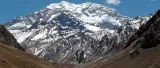
Header photograph: Aconcagua 13.JPG by Mariordo Mario Roberto Duran Ortiz, CC BY 3.0 (licence), via Wikimedia Commons.