









Avishai Breier, 51, a reserve officer in the IDF Paratroopers Brigade and a father of three from Modi'in-Maccabim-Re'ut, collapsed shortly after reaching the summit of Kilimanjaro on Monday. Resuscitation attempts on the mountain were unsuccessful. A rescue helicopter could not land near the top, and his friends carried him on a stretcher for about five hours to a point where an evacuation was possible.
A collapse near the summit
Avishai Breier, 51, from Modi'in-Maccabim-Re'ut, died on Kilimanjaro on Monday. He collapsed shortly after reaching the summit. Attempts to resuscitate him on the mountain were unsuccessful.
He had travelled to Tanzania with a group of 16 Israeli trekkers, four of them close friends. His death was reported by Israel National News, JFeed and The Jerusalem Post, which also published his family's account of his life.
Breier was an accountant who worked in finance and management, and he held senior positions in business. He is survived by his wife, Anat, and their three children, Maayan, Gaia and Itai.
Five hours carrying a stretcher
The terrain meant a rescue helicopter could not land at the summit. His friends gave first aid, then carried him on a stretcher for four to five hours to a lower point on the mountain from which an evacuation could be made.
Five hours of carrying a stretcher down from the crater rim, at altitude, by people who had themselves walked up through the night. Kilimanjaro is reached on foot and left on foot, and when something goes wrong high on the mountain, the first stage of any rescue is human. The guides, porters and companions present are the rescue service until the ground is low enough and flat enough for anything else.
Anyone who has been on the mountain knows what the summit crater is like in the hours after sunrise. It is cold, the air is thin and the ground underfoot is loose. Moving a person who cannot walk across it takes more hands than most groups have. The routes, the descent paths and the places where motorized help can reach you are set out in the Kilimanjaro guide.
What has been reported
Breier suffered cardiac arrest shortly after reaching the summit, according to reports of the family's account.
What can be said generally is this. Kilimanjaro takes people from farmland to its summit in a handful of days, and that rate of ascent is the central fact of the climb. Altitude illness does not sort people by fitness or by experience, and a strong walker can be affected while a slower one is not. The signs worth knowing, and what to do when you see them, are in our FAQ. The decision that matters most on that mountain is almost always the decision to go down.
For readers planning their own climb, the most useful question to put to a company is a practical one: what happens on the day somebody in the group cannot walk. How many staff come up with the group, what oxygen and what stretcher they carry, and how far down the first vehicle can come. Those answers vary by operator and by route, and they are worth getting in writing before the deposit. Our operators page lists the companies working on each peak.
Hundreds of days in the reserves
Breier served as an officer in the 226th Paratroopers Brigade. He reported for duty when the war broke out on 7 October 2023 and went on to serve hundreds of days, attached to the deputy battalion commander's forward command group. He took part in operations in Lebanon and Syria.
After turning 50 he kept volunteering for combat service. His family said he treated reserve duty as a personal mission and would not give up his place in the unit or his link with the men he served alongside.
Alongside the army and the career, his family came first. At one point he cut his working week by a day so that he could spend more time with his wife and children. His family described a father who knew what his children were interested in and stayed close to it. Breier and Anat met around 27 years ago, while they were students.
He had been involved in volunteer work and fundraising for families in need for about 20 years. Friends described him as the one who organized the gatherings and the trips, and who made sure nobody was left outside the group.
The mountain was a long-held plan
Climbing and travelling were his own pursuit outside the army and the office. He had walked up Mount Olympus in Greece with friends, and Kilimanjaro was the next plan. It was a trip he had wanted to make for a long time, and he went with people he had known for years.
His family said he often repeated two words: life is short. They said it described the way he chose to live, planning the next trip rather than deferring it.
Kilimanjaro draws more people each year than any other of the 7 summits, and most of them reach the crater rim without having climbed anything before. The great majority come home. When somebody does not, the people who carried him down are usually the ones he came with.
In a statement after his death, his family said that Avishai loved life, but perhaps more than anything he loved the people he shared it with, and that they loved him back.
This story is part of This week on the 7 summits, the week's news in brief.
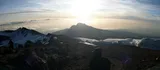
Header photograph: Mawenzi Cone at sunrise from Kilimanjaro crater rim.jpg by Sbork, CC BY-SA 3.0 (licence), via Wikimedia Commons.