








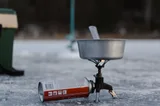

Above the last stream every drink starts as snow, and the stove is what turns it into water. Which stoves and fuels keep burning in the cold and thin air of the high camps, how much fuel melting snow really takes, and how to cook without carbon monoxide in the tent.
Above the last stream, every litre you drink starts as snow, and the stove is what turns it into water. On Denali that is an hour or two of every evening; at the South Col it is the job that decides whether you leave for the summit hydrated. Two things work against the stove up there, cold and thin air, and they work in different ways. One of them even helps.
Cold is the enemy of gas canisters, altitude is their friend
A screw-on gas canister holds liquid gas under its own pressure. The stove runs on the vapour that boils off the liquid, so the canister only works while its contents can still boil. Pure butane stops boiling at about −0.5°C31°F at sea level, isobutane at about −12°C10°F and propane at about −42°C−44°F. That is why the canisters sold for mountains are blends of isobutane with some propane (MSR's IsoPro and Jetboil's Jetpower are two common ones).
Altitude moves those numbers in your favour. A liquid boils more easily when the air outside presses less, and that holds for the gas in a canister just as it does for the water in a pot: every 300 m (about 1,000 ft)about 1,000 ft knocks about one degree Celsius off. At 5,000 m16,404 ft a blend that would sulk at −10°C14°F at sea level still gives a usable flame.
The canister also cools itself as it works, because boiling takes heat out of the liquid. Run a canister stove hard on a cold morning and you can watch frost form on the outside while the flame shrinks. A blend has a second weakness: the propane boils off first, so a half-empty canister is mostly butane and performs worse than a full one.
What helps:
Keep the canister warm before use: in your jacket on the way up, in the sleeping bag at night.
Stand it on a piece of foam mat, never directly on snow or ice.
Start with a full canister for the cold morning brew and finish the half-empty ones in the afternoon sun.
Choose a stove with a pressure regulator. It holds the flame steady as the canister cools, where an unregulated stove fades.
In real cold, use a remote-canister stove with a hose, which lets you turn the canister upside down. The stove then draws liquid fuel and vaporizes it in a preheat tube, so the canister's own vapour pressure matters much less.
Never warm a canister with a flame or put a windscreen around it. A canister that gets too hot can burst.
White gas does not care how cold it is
A liquid-fuel stove such as the MSR XGK EX or WhisperLite runs on white gas (Coleman fuel), pumped into the burner from a bottle you pressurize by hand. Because you supply the pressure, the cold cannot take it away. That is why white gas is the standard on Denali, where almost every party uses it, and why most expeditions carry a liquid-fuel stove for the big snow-melting jobs.
It asks for more care in return. The stove has to be primed: a little fuel is burned in a cup under the burner to heat the generator tube, so that the fuel arriving through it turns to vapour before it reaches the flame. Prime it too little and you get a tall yellow flare; prime it right and it settles into a roaring blue flame. MSR's instructions are to pump the bottle 20 to 30 strokes, or until the plunger resists firmly. Liquid-fuel stoves also soot up and need cleaning in the field, so learn to take yours apart at home.
Nothing is loaded from YouTube until you press play.
Handle the fuel with gloves. White gas does not freeze at mountain temperatures, so at −25°C−13°F it is still liquid, and a splash on bare skin evaporates so fast that it can freeze the skin in seconds.
Kerosene and multi-fuel stoves are the fallback where white gas cannot be had. Kerosene is cheap and available in most of the world, burns dirtier, smells, and needs priming with something more volatile. The old Everest expeditions ran on it.
Alcohol and solid fuel are for the valleys
Methanol and ethanol, the fuels in simple alcohol burners, give off too little vapour to light easily once they are colder than about 11 to 14°C52 to 57°F (their flash points), and they carry half the energy of gas per gram, or less. Solid fuel tablets burn slowly and gently. Both are fine for a cup of tea at Machame Camp. Higher up they lose out, and the Everest guide notes that many solid-fuel stoves do not work well above 7,000 m22,966 ft.
Thin air means a weaker, dirtier flame
At 5,500 m18,045 ft each lungful of air carries about half the oxygen it would at sea level, and the same is true for the air a burner sucks in. Burners are designed around sea-level air, so higher up the flame gets less oxygen than it wants. It burns a little cooler and yellower, and it makes more carbon monoxide.
That carbon monoxide is the one real danger of cooking at altitude. Carbon monoxide and thin air add up, so a dose that would give you a headache at home can kill at 4,300 m14,108 ft. In 1988 two climbers died in their tent at Basin Camp on Denali, poisoned by a butane stove they had used inside it to cook. The rules that follow are short:
Cook in the porch with the door open, or outside, never inside a closed tent or snow cave.
Keep a vent open even in a storm. A tent wall drifted over with snow seals the air in.
Never fall asleep with a stove burning.
A headache, sleepiness or nausea while cooking is a reason to open the tent at once, not a symptom to blame on the altitude.
Melting snow costs more fuel than boiling it
Snow is the most expensive drink on the mountain. Warming a kilogram of snow from −15°C5°F to 0°C32°F takes about 30 kJ; melting it takes 334 kJ; heating the water from there to 80°C176°F takes another 335 kJ. Almost half the energy goes into the melting itself. Heating a litre from a stream at 10°C50°F to the same 80°C176°F takes 290 kJ, well under half.
A good canister stove passes on somewhere between 30 and 50 percent of the fuel's energy to the pot, more with a heat-exchanger pot such as a Jetboil or MSR Reactor and less in wind. Worked through, a litre of hot water from snow costs about 30 to 50 grams of gas, and a litre from a stream about 13 to 21 grams. A standard 230 g canister turns snow into somewhere between five and eight litres of hot water.
The tricks for getting more water from the same fuel are old ones:
Start with a little water in the pot. Snow in a dry pot insulates itself, scorches on the bottom and gives the water a burnt taste.
Use the densest snow you can find, or better still ice. A pot of fresh powder melts down to a few centimetres of water.
Keep a lid on, and shelter the flame from the wind.
Collect snow from one clean spot upwind of camp, away from the toilet area, and keep one pot for drinking water only.
Fill insulated bottles at night and keep them inside your sleeping bag, upside down so that ice forms at the bottom and not in the lid.
Snow water carries almost no minerals. It tastes flat and does nothing to replace the salt you lose. Electrolyte tablets, soup or a pinch of salt fix both.
How much fuel to take
Two figures come from the ground. On Denali the National Park Service suggests 0.15 to 0.30 litres of white gas per person per day, most of it for melting snow; the Denali guide's own rule of thumb is one litre per person per week, so one US gallon (3.8 litres) each for a three-week trip. On Aconcagua the guide allows about 125 ml of white gas per person per day, doubled if you boil all your water rather than treating it with drops or tablets.
Plan for the high end early in the season. Cold, dry snow takes more heat to melt, and a storm day spent in the tent is a day of melting snow for drinks with nothing else to do. The Park Service also asks climbers to drink at least four litres of fluid a day, and each of those litres has to be melted first.
Fuel cannot fly with you
Airlines do not carry gas canisters or liquid fuel, in the hold or the cabin, so fuel is bought where the climb starts. On Denali you order white gas from the air-taxi company and collect it at Kahiltna Base Camp. On Elbrus the gear shops in Azau and Terskol sell canisters, as the chapter on camping and climbing independently explains. On Aconcagua climbers buy fuel in Mendoza, and on Everest in Kathmandu or through the expedition. Clean a liquid-fuel stove and its empty bottle carefully before you fly home, because a bottle that smells of fuel can be taken off you at security.
What the expeditions use
Most guided expeditions run two systems. In the base camps and on Kilimanjaro, cooks work on gas from large cylinders, the kind you would connect to a barbecue at home: the Kilimanjaro park banned firewood, and its crews have cooked on gas since the 2000s. Higher up, climbers use small stoves. On Everest above Advanced Base Camp that means canister stoves, with the canisters warmed in a sleeping bag before the morning brew. On Denali, where nobody else does the cooking and the trip runs to three weeks, white gas carries the load.
Whatever the stove, test it at home, then again at base camp before relying on it higher up. A stove that has run well for a week of base-camp brews is one you can trust at the South Col.
Comment on this post on the forum →
All parts of Tips & Tricks
- Part 1: Time on the mountain
- Part 2: Why water boils at 72°C on top of Everest
- Part 3: Stoves and fuel above 5,000 m: what keeps burning (you are reading this)