








Since the start of October 2026, foreign visitors to mainland Tanzania and Kenya must buy a government travel insurance policy to enter, at $44 per adult. The cover is limited and does not replace a proper mountain policy. Kilimanjaro climbers still need their own insurance for high-altitude trekking, rescue and evacuation.
Two East African entry requirements changed this month, and both affect anyone flying in for Kilimanjaro. Mainland Tanzania and Kenya now oblige foreign visitors to buy a government-issued travel insurance policy before they are let in. The cover must come from the official national portal. A valid private policy from your own insurer does not exempt you.
The Tanzanian requirement has been in force since 1 October 2026 for foreign visitors, unless they qualify for an exemption. Zanzibar has had a version of the same rule since late 2024, and the mainland scheme is an extension of it. Kenya's requirement also took effect this month, bundled into the electronic travel authorization that most foreign tourists already need.
What it costs and where to buy it
Tanzania's policy is $44 for adults and $22 for children aged 3 to 17, and free for children aged 2 and under. It covers stays of up to 92 days. Travellers arriving first in mainland Tanzania buy through NIC at inbound.nicinsurance.co.tz. Travellers arriving first in Zanzibar buy through ZIC at inbound.visitzanzibar.go.tz.
A trip taking in both the mainland and Zanzibar needs only one policy. Buy it from the provider serving your first point of entry. That detail matters for a common Kilimanjaro itinerary: climb first, then fly to Zanzibar for a week on the coast.
Kenya's cover is $44 per person, with no discounts for children mentioned in the published rules. It is bought during the eTA application at etakenya.go.ke, or separately through the eCitizen insurance portal. The US Embassy in Kenya has said airlines were asked to check passengers' insurance before boarding, and that travellers arriving without it may be refused entry.
Both portals are government sites. New entry rules attract copycat sites that charge a markup for the same product, so type the address rather than following an advertisement.
It is not a mountain policy
This is the part that matters for climbers. The mandatory cover caps medical expenses at a reported $50,000 and does not include the things a Kilimanjaro climber actually needs: helicopter evacuation, repatriation and trip cancellation. Shah Tours, the Moshi-based operator, tells partners plainly that the local policy does not replace comprehensive personal travel insurance.
So the practical advice is unchanged. Arrange your own policy, and check that it names high-altitude trekking at the height you are going to, plus mountain rescue and helicopter evacuation where it is available. Many standard policies stop covering you somewhere between 4,000 and 5,000 metres, which is below the top of Kilimanjaro. Read the altitude clause, not the summary page. Our Kilimanjaro guide covers the routes and the heights involved, and the FAQ covers altitude illness.
The criticism of the scheme has been loud. The British travel writer Simon Calder has described the two requirements as forcing travellers to buy a pointless extra policy, and called it a dash for cash by the two governments. We would put it less sharply: the money is small next to the cost of a Kilimanjaro permit, and the irritation is real, but the only thing a climber has to do about it is budget $44 and keep the confirmation.
Two other Tanzanian notices this month
Tanzania strengthened arrival health screening with effect from 17 October 2026, following the Ebola outbreak in the Democratic Republic of Congo and reported cases in Kenya. All international arrivals must complete the online Traveller's Health Surveillance Form at afyamsafiri.moh.go.tz. The form can be completed before departure or on arrival. Keep the QR code or reference number for inspection at the border.
Temperature and health screening is being carried out at airports, land borders and seaports. Travellers assessed as higher risk may receive follow-up health messages for up to 21 days. There is no travel ban and no Ebola vaccination requirement attached to the advisory.
The second notice is about rain. The Tanzania Meteorological Authority has forecast a strong El Niño influence on the October to December 2026 short rains. Average to above-average rainfall is expected in the Kilimanjaro region, along with Arusha, Manyara, the Lake Victoria area and the northern coast. November is expected to be the wettest month of the period, with some unseasonal rain possibly continuing into January 2027.
A seasonal forecast is not a forecast of continuous rain, and it is not a reason to cancel a climb. It does mean wetter trails on the lower forest sections, slower transfers and roads that can take longer than planned. Carry proper rain protection and leave some slack in the itinerary either side of the climb.
What to do before you fly
The whole list for a Kilimanjaro trip arriving through mainland Tanzania is short. Buy the mandatory inbound policy from the correct national portal for your first point of entry. Complete the health surveillance form and save the reference. Keep a separate personal travel insurance policy that explicitly covers high-altitude trekking and evacuation, and carry the certificate with the altitude clause on it.
If your route into the region goes through Nairobi first, the Kenyan eTA now carries its own insurance charge, and the airline may ask for proof at check-in. Budget for both countries if you are crossing between them.
Operators in Moshi and Arusha are already adding these links to their pre-departure packs. If yours has not mentioned either requirement, ask. Our operators page lists companies working on each of the 7 summits, and a good one will send you the portal links without being chased.
The rules on insurance for entry are spreading. Georgia introduced a proof-of-insurance requirement at the start of this year, set at coverage of about 30,000 Georgian laris. Argentina passed a similar law in 2025, although reports suggest it is not yet reliably enforced at the border. Those schemes let you use your own policy if it meets the stated minimum. The Kenyan and Tanzanian versions do not, which is what makes them unusual.
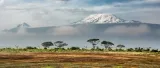
Header photograph: Kilimanjaro from Amboseli.jpg by Sergey Pesterev, CC BY-SA 4.0 (licence), via Wikimedia Commons.