








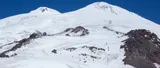

West (5,642 m) is the true summit and the one that counts; East (5,621 m) is a little lower. Crossing both in a day is a serious undertaking.
Elbrus has two summits, the tops of its two old volcanic cones, with a broad saddle between them. They are close in height and close together, but they are not the same climb, and it matters which one you are aiming for.
West and East
The West summit, at 5,642 m18,510 ft, is the higher of the two and the true summit of Elbrus, and of the Caucasus. The East summit is 5,621 m18,442 ft, only about twenty metres lower, and it still holds the old volcanic crater. For the 7 summits (the highest point on each continent) it is the West summit that counts. (Both the well-known versions of the 7 summits list use Elbrus for Europe; where they disagree is on Australia versus Oceania, not here.)
Both summits of Elbrus rise above the Garabashi area, with climbers heading up the lower slope.
Which summit you stand on usually comes down to which side you climb. The standard south (Normal) route goes to the West summit. The north route traditionally finishes on the East summit, which sits more directly above it, though strong parties can go on to the West top. So the "wilder" north route and the "true" summit are not automatically the same thing, worth knowing when you choose a side.
The saddle and the traverse
Between the two peaks lies the saddle, at roughly 5,350 m17,552 ft, a wind-scoured dip that the summit-day route skirts on the way to the West top. (Figures for the exact height of the saddle vary between sources; treat 5,350 m17,552 ft as a round number.) Reaching both summits in a single push (the "cross" or traverse of Elbrus) is a real undertaking, a long day at altitude that far exceeds a normal single-summit climb. It is for fit, well-acclimatized climbers, not a casual add-on.
Getting lost between the tops
The dangerous thing about the two summits is not the climbing between them, it is the ground. The upper mountain is a featureless white dome, and in cloud or a whiteout the saddle and the slopes around it lose all reference. People have become lost and died up here, unable to tell one summit, or the descent, from the open mountain. This is why navigation and turnaround discipline matter more on Elbrus than its easy grade suggests, and we come back to it on the summit-day pages.
Image credits: © Dmitry A. Mottl · CC BY-SA 4.0 · Wikimedia Commons · modified