








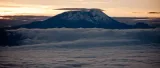

Time on the mountain is the single biggest factor in whether a Kilimanjaro climb succeeds, more than fitness, more than gear, more than the season you choose. The old investor's saying goes: time in the market beats timing the market. On Kilimanjaro, the same logic holds. A longer route does not just give your lungs more days to adjust; it changes the whole character of the climb. You stop rushing. You notice things. The altitude that floors a five-day group on summit night is the altitude a seven-day group has already been sleeping at for two nights. This post looks at why the extra days matter, what happens in your body when you give it time, and how to think about route length before you book. It is the first part of our Tips & Tricks series, so it starts at the beginning, with the one decision that shapes everything else.
Time on the mountain
There is an old saying in investing: time in the market beats timing the market. The point is that patience (simply being present for long enough) outperforms cleverness. If you wait for the perfect entry and miss a few good days, you have already lost the argument.
Kilimanjaro is not a stock market. But the logic transfers almost perfectly.
Most people who do not reach Uhuru Peak were not underfitted, underequipped, or unlucky with weather. They were not on the mountain long enough for their bodies to adjust to the altitude. That is it. That is almost always it.
What actually happens above 3,000 metres
When you climb, the air pressure drops. Your body gets less oxygen per breath. The first response is to breathe faster and deeper. Over the following days, your kidneys adjust blood chemistry, your body produces more red blood cells, and your tissues get better at extracting oxygen from the air you do have. None of that happens overnight. Physiologists call the process acclimatization, and it takes time measured in days, not hours.
Acute Mountain Sickness (AMS) is what happens when you climb faster than your body can adapt. Headache, nausea, broken sleep, a strange fatigue that no amount of rest seems to fix. In its serious forms it becomes dangerous quickly. Our altitude and AMS FAQ covers the full picture; the short version here is that the best treatment is also the simplest: slow down, or go lower.
The mountain gives you a choice. You can push through a five-day itinerary and gamble that your physiology will keep up. Or you can give yourself seven or eight days and stop gambling.
The numbers behind the routes
Kilimanjaro's most popular route, the Marangu, is often sold as five days. The summit success rate on five-day Marangu itineraries is considerably lower than on seven-day itineraries of the same route. Reputable operators publish these figures; the spread is wide enough that the difference is not noise.
The Lemosho route, typically done in seven or eight days but easily extended to 9 or even 10 days, has among the highest success rates on the mountain, simply because it is longer by default. It is also, by most accounts, among the most enjoyable. Those two facts are connected. When you are not racing altitude, you can actually look at the mountain you are on.
Our Kilimanjaro route guide has the day-by-day profiles for each option. What it cannot tell you is what the extra days feel like from the inside, and that part matters.
On a seven-day route, you typically spend a night at around 3,800 metres and another at around 4,600 metres before summit night. By the time you are standing at the crater rim at 5,895 metres, your body has already been at two-thirds of that altitude for two full nights. The summit is still hard. But it is a different kind of hard.
On a five-day route, you go from roughly 3,800 metres to the summit in basically a single push. The altitude on summit night is not something your body has met before. Your physiology is behind the schedule your itinerary has set.
There is also something less measurable. A slower climb gives the mountain room to be itself. You stop at a proper lunch spot instead of eating while walking. You watch the vegetation change from rainforest to moorland to alpine desert without feeling you have missed a transition. The porters, who know every stone of the route, have time to point things out. The whole experience changes register.
The acclimatization walk
Most multi-day routes on Kilimanjaro include what operators call an acclimatization walk, a side excursion on day three or four that takes you higher than the night's camp, then brings you back down to sleep lower. The principle is "climb high, sleep low", and it genuinely works. Your body registers the altitude stress of the higher point, then recovers during sleep at the lower camp. Repeat this a few times and you arrive at the summit corridor meaningfully better prepared.
A five-day itinerary compresses or eliminates this. There is not room for it in the schedule.
Booking the right length
If you are deciding between a five-day and a seven-day option, the cost difference is real, two extra days of park fees, porter wages, and guide time add up. But the cost of a failed summit attempt is also real: the flights, the training, the leave taken, the preparation. Most people who shortcut on days regret it. Most people who add days do not.
A useful question to ask any operator: what is your summit success rate, broken down by route length? An operator confident in their product will have an answer. One who does not is telling you something.
If you have any personal history with altitude (previous AMS, cardiovascular conditions, anything in that range) read our altitude FAQ before you book, and speak to a doctor who knows high-altitude physiology. We are not the right source for medical advice; the FAQ points you to people who are.
Further reading
Two shelves worth keeping close as you plan:
On altitude and AMS
---
On Kilimanjaro
Time on the mountain is not a luxury. It is the mechanism. Give your body the days it needs, and Kilimanjaro is a hard, beautiful walk to the roof of Africa. Rush it, and you are betting against your own physiology, and the mountain usually wins that bet.
Comment on this post on the forum →
All parts of Tips & Tricks
- Part 1: Time on the mountain (you are reading this)
- Part 2: Why water boils at 72°C on top of Everest
- Part 3: Stoves and fuel above 5,000 m: what keeps burning