








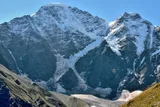

Before you go up: two or three days based in Terskol and Azau, with day-hikes up Mount Cheget, to the Terskol observatory and the Devichy Kosy waterfall to start acclimatizing.
| Time | 2–3 days based in the valley |
| Altitude gained | day-hikes to ~3,000–3,700 m9,843–12,139 ft, sleeping low at ~2,000–2,300 m6,562–7,546 ft |
| Terrain | valley paths and hillsides; walking, no glacier |
| Grade | easy hill-walking |
| Summary | Valley base at Terskol / Azau with acclimatization day-hikes before moving up to the huts. |
A good Elbrus trip does not start on the mountain. It starts with a few days based down in the Baksan valley, at the twin villages of Terskol and Azau at around 2,000 to 2,300 m6,562 to 7,546 ft, walking up into the surrounding hills by day and sleeping low at night. This is the walk-high, sleep-low principle that makes the whole climb safer, and it is the part rushed itineraries skip, to their cost. There are three classic day-hikes from the valley, and most operators do some combination of them.
Mount Cheget
The standard first walk is up Mount Cheget, the ski peak that faces Elbrus across the valley. Old chairlifts take some of the height to around 3,000 to 3,100 m9,843 to 10,171 ft, and from there (or higher, if you walk on up the slopes towards the summit ridge) you get the classic head-on view of Elbrus's two white domes, with the wall of the main Caucasus range, Donguz-Orun and the hanging glacier known as the Seven, behind you. It is a gentle day that puts useful height into your legs and lungs, and the view is the one on all the postcards.
Elbrus's twin summits seen from Cheget, the classic acclimatization viewpoint.
The Terskol observatory
A steeper valley walk climbs from Terskol up towards the old observatory on the shoulder of Mount Terskol at around 3,100 m10,171 ft, following a rough service track up through pine and meadow. It is a good leg-stretch with more Elbrus views, and a bit more of a climb than Cheget, so it makes a natural second acclimatization day.
Nothing is loaded from YouTube until you press play.
Drone footage over the Terskol gorge shows the observatory perched above the valley along with the Terskol waterfall and the sweep of the ravine below Elbrus.
The Devichy Kosy waterfall
The gentlest of the three is the walk up to the Devichy Kosy (the "Maiden's Braids") a wide waterfall that fans out over the rock above Terskol, fed by the glacier melt off Elbrus. It is a short, pretty walk, often paired with the observatory climb above it, and a good easy day if the weather is poor or you want to keep it light.
Do not treat these days as sightseeing to be trimmed when the schedule is tight. They are the foundation of your acclimatization, and the difference between arriving at the huts ready to climb and arriving already behind. Only once you have a couple of these days behind you do you move up to the Barrels.
Image credits: © Александр Байдуков · CC BY-SA 4.0 · Wikimedia Commons · modified